
By Nii Wallace-Bruce
A World Cup That Asked Bigger Questions
The 2026 FIFA World Cup marked the end of one cycle for Canada's Men's National Team.
The next may not begin in a stadium under World Cup lights, but on training pitches with the country’s youngest internationals.
This tournament did more than reveal how Canada played under Jesse Marsch against the world’s elite.
It hinted at something Canadian football has rarely possessed: the beginnings of a recognisable football identity.
If that identity now extends into the youth pathway, the tournament may ultimately be remembered less for its results than for the philosophy it left behind.
Results always shape narratives at major tournaments, but identities often outlast them.
Since 2024, Jesse Marsch has steadily embedded principles centred on aggressive pressing, rapid transitions, vertical attacking football and relentless athleticism.
The World Cup suggested those ideas were no longer aspirations—they had become Canada's defining characteristics.
The world's strongest national programs are rarely built by one coach imposing one style. They are built when different parts of the federation understand the same principles.
Now, with Marsch assuming a direct role alongside the U-20 programme as Canada Soccer seeks greater continuity between age groups, the conversation shifts from one tournament to the next generation.
The question is no longer simply what Canada achieved in 2026. It is whether that tournament provided the clearest evidence yet of a distinctly Canadian national game model.
The World Cup Confirmed Canada's Identity
Canada never enjoyed the luxury of continuity.
Injuries and selection challenges meant Marsch was rarely able to field what many would consider his strongest eleven, making sweeping conclusions difficult.
From the loss of Marcelo Flores before the tournament to the devastating injury to Ismaël Koné in the group stage, the world never got to see the best Canadian men’s XI on the biggest platform. All of this took place while the return of captain Alphonso Davies became a national saga in itself.
The reality of the FIFA World Cup is that it usually occurs at the end of most club seasons and the CanMNT bore the brunt of a number of fitness and injury concerns.
Yet the tactical themes remained remarkably consistent. Canada's greatest strength remained clarity. International football offers little preparation time.
Systems succeed when players recognise situations instinctively rather than learning them from scratch every international window.
At World Cup 2026, Canadian players generally understood their roles regardless of the opposition.
Defensive structures were more disciplined than in previous cycles, pressing triggers appeared increasingly coordinated and transition moments consistently carried threat.
Perhaps most encouragingly, the CanMNT rarely abandoned its identity under pressure. The underlying principles remained intact. That tactical consistency matters.
Canada were at their most dangerous within moments of winning the ball.
Marsch’s front foot philosophy was reflected in his team ranking in the top ten for defensive line breaks attempted in possession (119 total) - despite exiting the tournament at the Round of 16. Alistair Johnston, Richie Laryea, and on-field captain Stephen Eustáquio played key roles.
That identity aligned remarkably closely with several tactical trends identified across the tournament.
While possession remained valuable, many of the competition's most successful teams increasingly prioritised compact defensive structures, explosive transitions and efficiency over territorial dominance.
That mattered because Canada were not simply playing in a recognisable way—they were playing in a way that increasingly reflected where international football itself is heading.
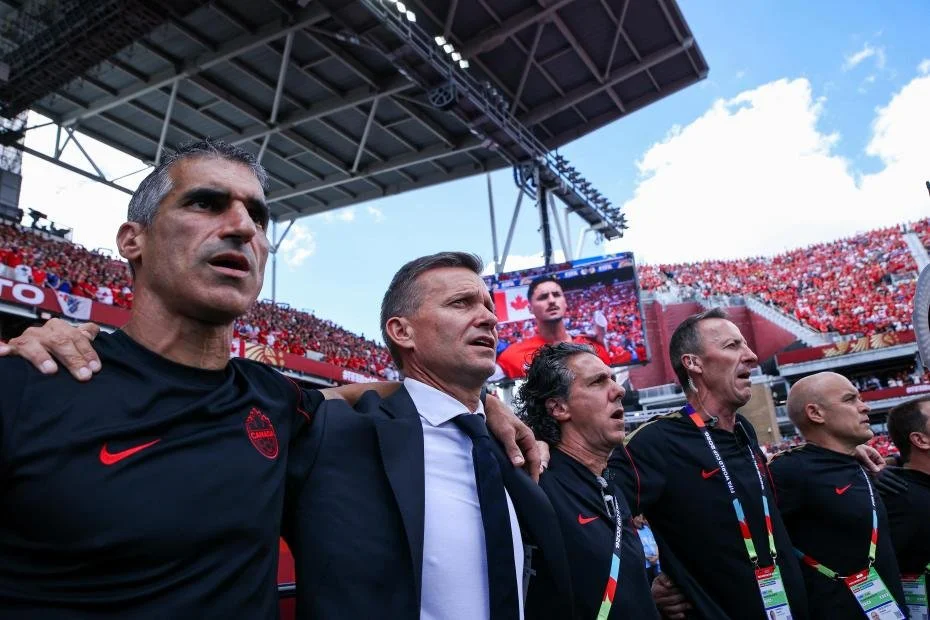
Paul Stalteri, Jesse Marsch, Mauro Biello, and others will solidify the youth pathway to the CanMNT (Photo credit: Indrawan Kumala)
Canada Was Moving With Football's Evolution
The World Cup reinforced several broader tactical developments across elite football.
The tournament increasingly rewarded teams capable of defending compactly before attacking at speed.
While Marsch's Canada preferred a higher starting line than many opponents, the underlying principle was identical: compress space, regain possession quickly and attack before defensive structures reset.
Long-range shooting emerged as an increasingly viable solution against organised defensive structures.
Stephen Eustáquio’s long-range strike at the death against a robust South African low block is a signature example. Swiftly breaking down the opposition from afar.
Canada's use of Jonathan David alongside rotating attacking support reflected another tournament-wide trend.
Rather than isolating a traditional No. 9, successful teams increasingly sought fluid partnerships capable of pressing aggressively and occupying multiple defensive lines.
Despite receiving criticism early on, Jonathan David finished the tournament with 3 goals created from an expected goal (xG) total of 2.71 - efficient.
However, his biggest impact came off the ball. David ranked in the top 15 for defensive pressures applied (227 total).
David’s 45 forced turnovers put him ahead of Enzo Fernández, Rodri and Julián Álvarez despite playing only 5 matches compared to these players who played up to 8 matches.
Explosive acceleration often mattered more than outright sprint speed.
Alistair Johnston, Richie Laryea, Tajon Buchanan, Jacob Shaffelburg, and Tani Oluwaseyi all provided the acceleration required for transition-heavy football.
Laryea and Johnston led the way for the red and white, clocking top speeds of over 35 km/h in the tournament.
Canada’s athletic profile suited the transition-heavy environment international football increasingly rewards.
Yet the tournament also exposed Canada's next steps.
Breaking down organised low blocks remained difficult whenever opponents denied transition opportunities. Bosnia-Herzegovina, Switzerland, and Morocco come to mind.
Longer spells of controlled possession still lacked the fluidity demonstrated by football's elite nations. A team that exited at the Round of 16 created xG of 9 goals.
That ranked 9th out of all 48 teams. However, games are not won solely on chances created. Conversion is key.
The final pass often arrived too early or too directly, while attacks occasionally became predictable once immediate transition opportunities disappeared.
Canada's technical quality continues to improve, but the World Cup highlighted the difference between becoming dangerous after winning possession and consistently controlling matches with the ball. Rather than appearing tactically behind the game's leading nations, Canada often looked aligned with where international football is heading.
That may prove more significant than any individual result.
The Next Evolution Begins Below the Senior Team
Tactical identities only become national identities when they survive the players who first establish them.
That is where Marsch's involvement with the U-20 programme becomes particularly significant.
Canada Soccer has made no secret of its objective: strengthen the connection between youth development and the senior national team as preparations begin for the next World Cup cycle. The immediate goals are tangible. The U-20 programme will pursue qualification for both the 2027 FIFA U-20 World Cup and the 2028 Olympic Games.
The longer-term ambition is far greater.
Rather than treating youth football as an entirely separate environment, Canada appears intent on building continuity across its national teams.
That does not mean every side plays the same formation. The world's strongest football nations rarely insist upon identical systems.
Instead, they establish shared principles. Pressing triggers. Defensive spacing. Transition behaviours. Positional responsibilities.
The language changes little even when personnel do. A young player promoted to the senior team should recognise the demands immediately.
Instead of learning an entirely new philosophy at twenty years old, they refine concepts they have practised for years. That dramatically shortens adaptation.
Following a Proven Blueprint
Canada's ambition is hardly unprecedented. Spain, Portugal, Croatia, Germany, and Japan all discovered that continuity is built less through identical formations than through shared principles.
Promotion becomes an extension rather than a reset because every age group speaks the same tactical language. Canada appears to be pursuing a similar outcome.
Marsch's involvement below the senior side suggests the federation values behavioural consistency more than tactical uniformity.
The current World Champions Spain provide perhaps the clearest modern example.
Under Luis de la Fuente, who progressed from Spain's youth setup to the senior national team after winning multiple youth European Championships and an Olympic silver medal. Continuity became a competitive advantage. Spain's commitment to continuity extended beyond coaching.
Eight members of the XI that started the Olympic final in Tokyo in 2021 were involved in Spain's 2026 FIFA World Cup final victory.
Dani Olmo, Mikel Merino, Unai Simón, Martín Zubimendi, Eric García, Pedrí, Marc Cucurella, and Mikel Oyarzabal had already worked extensively with Luis de la Fuentes before and during the Olympic campaign.
Success for La Furia Roja did not come because every youth team copied the senior team's formation; it came because players moved through a pathway where the expectations, behaviours and football language remained familiar. That is precisely the outcome Canada hopes to create.
If tactical principles are introduced earlier, promotion to the senior team becomes less about adaptation and more about refinement.
While no single pathway guarantees success, Spain's ability to carry the core of one generation from Olympic football to a World Cup-winning side illustrates the value of continuity. Players arrived at the senior level already fluent in the tactical language expected of them.
These players entered a familiar tactical environment because many of the principles remained consistent throughout the national-team pathway.
The transition became evolutionary rather than disruptive. Spain's model was never about possession alone.
It was about reducing cognitive load. Every promotion became an extension rather than a reinvention.
Spain's players didn't need to learn a new football language when promoted.
Canada's decision to involve Marsch directly with the U-20s suggests the federation wants to move in the same direction.
Rather than spending two years teaching each new generation the demands of the senior side, the objective appears to be introducing those behaviours much earlier.
If successful, the result would not simply be a smoother pathway for individual players.
It would be the emergence of something Canada has rarely possessed: a recognizable football identity stretching from the youth ranks to the senior national team.
Canada is not attempting to copy Spain's national game model. It may, however, be adopting one of its most important structural ideas. Identity.
Building the Canadian National Model
One of the enduring challenges in Canadian football has been inconsistency.
Youth national teams often played differently from senior teams.
Players developed within vastly different club environments across MLS academies, CPL clubs, provincial competitions, European academies and university programmes.
The senior team then became the place where those differing football educations attempted to converge. That process consumes valuable time.
Canada's greatest challenge has never been producing talented footballers.
It has been giving players from vastly different developmental environments a shared tactical vocabulary before they reach the senior team.
Marsch spent much of 2024 and 2025 establishing behavioural habits within the senior squad.
His players gradually learned when to press, when to retreat, how aggressively to counter-press and how quickly possession should move forward after recoveries.
The next evolution of Canada's football identity will not begin from zero. The foundations already exist within the national-team structure.
Andrew Olivieri's appointment with the U-20 program represents a continuation of work he helped shape within Canada's youth pathway, including his involvement with the Excel program that contributed to the development of the women's and men’s national teams.
Mauro Biello's role within the senior setup provides another link between generations.
Yet Marsch's direct involvement suggests Canada hopes to accelerate that process. A tight yet achievable timeline. The senior World Cup has ended.
The next milestone is the 2027 FIFA U-20 World Cup. Then comes the 2028 Olympic tournament in Los Angeles. Beyond that lies qualification for the 2030 FIFA World Cup.
Many members of Canada's current U-20 cohort could realistically feature across all four stages.
If those tactical principles become embedded throughout the youth pathway, each successive generation arrives closer to senior international football already speaking the same football language.
That is how national identities are built. Not through slogans. Through repetition.
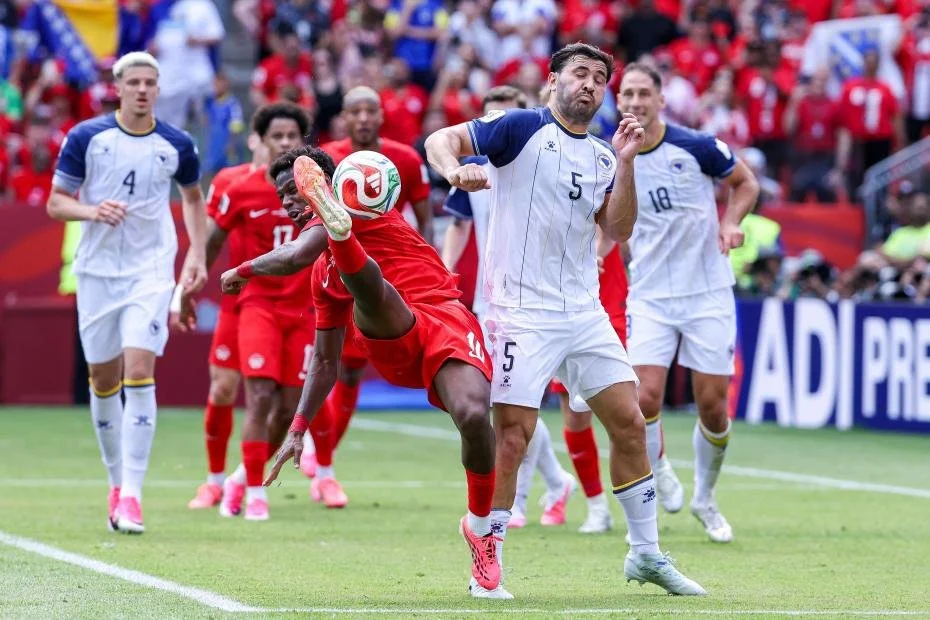
Jonathan David played for Canada at U-17 and U-21 level. (Photo credit: Indrawan Kumala)
More Than a Tournament
The 2026 FIFA World Cup did not prove Canada had arrived among football's elite.
This edition demonstrated that Canada could compete with a recognisable style.
The tournament itself suggested that style aligned with broader tactical developments shaping international football.
Marsch's expanding influence now presents Canada with an opportunity few generations have enjoyed: to transform one coach's ideas into a national football language.
If that happens, the lasting legacy of 2026 will not be a Round of 16 appearance.
It will be that Canada finally stopped borrowing football identities from elsewhere and began building one of its own.
The ultimate measure will not be whether Canada’s youth teams replicate Marsch’s formation.
It will be whether a teenager entering the national-team system in 2027 already understands what a senior international match demands in 2030.
That would represent one of the most significant structural developments in Canadian football history.
Sources:
FIFA Training Centre, “Expanded 48-team FIFA World Cup ‘a great success,’ says Arsène Wenger”, 18 July 2026
Arsène Wenger, Chief FIFA Technical Study Group, press conference, 18 July 2026
FIFA Training Centre , “Technical Study Group hails competitive 48-team FIFA World Cup™ as goals and intensity rise”, 29 June 2026
FIFA Training Centre, Canada 1 Bosnia 1 - POST MATCH SUMMARY REPORT, 12 June 2026
FIFA Training Centre, Canada 6 Qatar 0 - POST MATCH SUMMARY REPORT, 18 June 2026
FIFA Training Centre, Switzerland 2 Canada 1 - POST MATCH SUMMARY REPORT, 24 June 2026
FIFA Training Centre, South Africa 0 Canada 1 - POST MATCH SUMMARY REPORT, 28 June 2026
FIFA Training Centre, Canada 0 Morocco 3 - POST MATCH SUMMARY REPORT, 4 July 2026
FIFA Training Centre, “Canada v. Bosnia and Herzegovina: A clash of defending styles”, Jayne Ludlow, 17 June 2026
FIFA, FIFA World Cup 2026: Player Statistics, 20 July 2026
FIFA, FIFA World Cup 2026: Team Statistics, 20 July 2026
Canada Soccer, “Canada Soccer Names Squad for 2026 Concacaf U-20 Championship”, 17 July 2026
Canada Soccer, “5 takeaways from Canada’s inspirational run at the 2026 FIFA World Cup”, Daniel Squizzato, 6 July 2026
Canada Soccer, “Stephen Eustáquio & Diana Matheson: Stunning similarities of two great Canadian goals”, Daniel Squizzato, 29 June 2026
Jesse Marsch, Canada Head Coach, press conference, 13 November 2025
Photo Credits:
Canada coaching staff, Indrawan Kumala, 13 June 2026 - Photo courtesy of Indrawan Kumala
David and Kolasinac, Indrawan Kumala, 13 June 2026 - Photo courtesy of Indrawan Kumala
Video Credits:
Stephen Estaquaio winner, TSN Sports, 28 June 2026 - Video courtesy @TSN_Sportsvia X
All photos are used with permission. All rights reserved to the creator.

Support PSP Media
Every contribution helps support independent research and reporting