
Brazil’s Greatest Football Legacy May Be Japan
By Nii Wallace-Bruce
More Than Just Another World Cup Match
Japan's narrow defeat to Brazil in Houston revealed more than the fragility of the five-time world champions.
It highlighted the culmination of a football relationship more than three decades in the making.
For long stretches Brazil looked uncomfortable against an opponent that increasingly resembled something familiar: a football culture shaped, in no small part, by Brazil itself.
That version has been under construction for more than thirty years.
Football often celebrates the dramatic upset without asking how the gap became so small in the first place.
Japan's rise is frequently explained through discipline, organisation and relentless work ethic. All true.
But those explanations leave out one of the most important architects of modern Japanese football.
Brazil. Not merely as an opponent.
As a teacher.
A Relationship Older Than the J-League
The connection between Brazil and Japan did not begin on a football pitch.
More than two million Brazilians claim Japanese ancestry, the largest Japanese diaspora anywhere in the world.
In return, generations of Japanese-Brazilians have moved to Japan as workers, creating a two-way cultural exchange unlike almost any other in football.
When professional football arrived in Japan in 1993, that relationship naturally extended onto the pitch.
The new J.League did not simply import foreign stars for marketing purposes. The J-League wasn't created just to improve the national team.
It was designed as a community-based league, tying clubs to cities rather than corporations, creating sustainable football culture.
It imported Brazilian football culture.
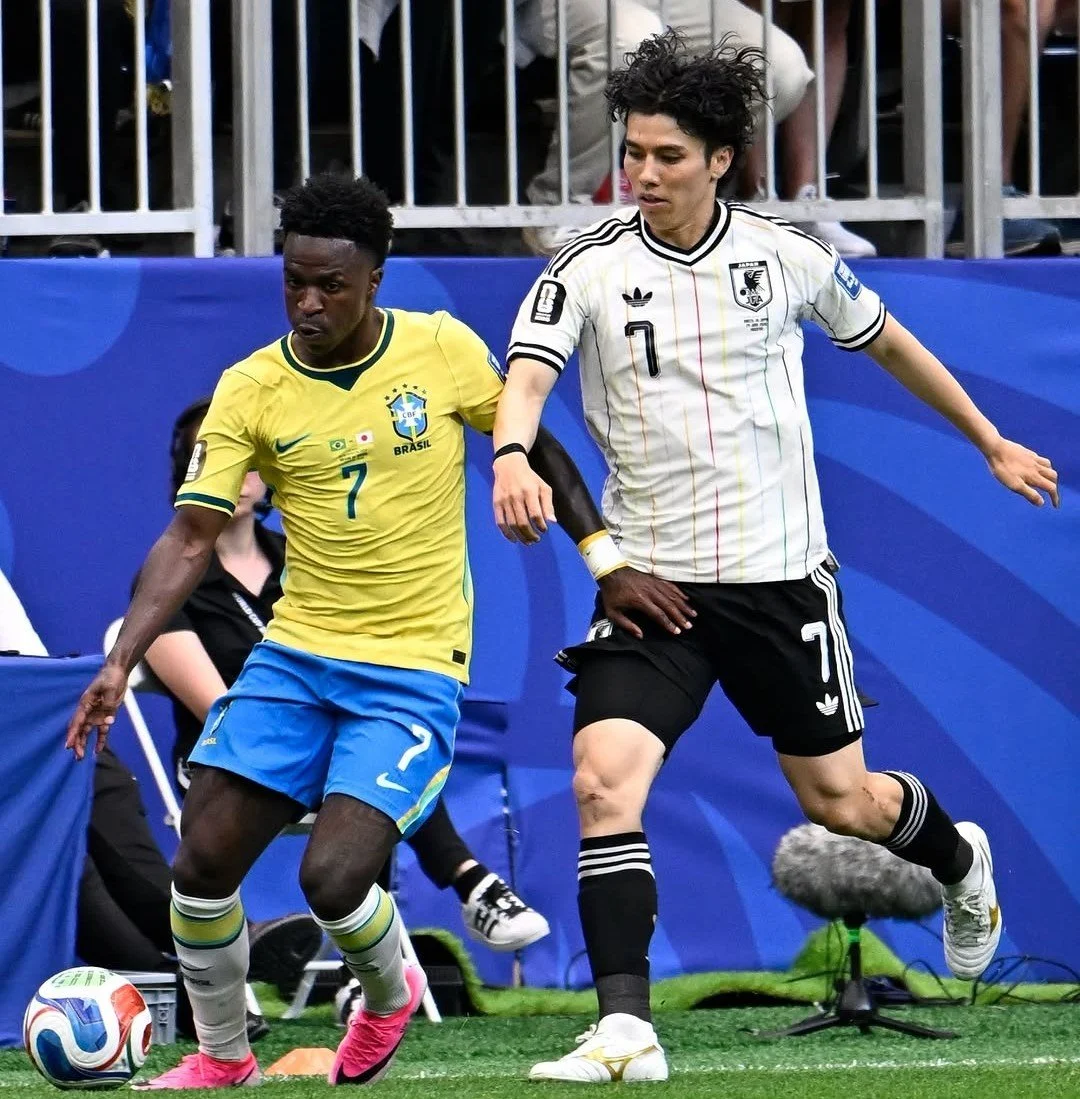
Vinicius Junior (left) and Brazil were pressured by Ao Tanaka’s Japan throughout their Round of 32 match (Photo credit: Lili Dibai/Area Sports Network)
Zico and the Foundations of Modern Japan
No individual represents that relationship more than Zico.
Long before European superstars arrived in Asia for lucrative contracts, Zico chose Kashima. He became far more than a player.
He became the philosophical father of one of the region's greatest clubs.
Zico did not merely lend his reputation to a young league. He embedded standards.
At Kashima Antlers he treated every training session, every youth player and every coaching discussion as part of a larger project.
The club became Japan's benchmark because its culture—not just its football—was built around elite habits.
A trip to Ibaraki Stadium reveals Zico’s impact. He is immortalised in the form of statue while banners of him can be found on matchdays,
Kashima Antlers became Japan's model club.
That was no coincidence.
Brazilian Ideas, Japanese Precision
Brazilian coaches such as Toninho Cerezo, Oswaldo de Oliveira and Levir Culpi also left lasting tactical and developmental influence.
When Japan faced Brazil at the 2006 FIFA World Cup, Zico was in the Japanese technical area as manager.
Zico believes the current generation plays “proper football”, having made tactical and psychological improvements from his cohort.
It was Brazilian football knowledge adapted—not copied—to Japanese conditions. That distinction matters.
Japan has always preferred innovation over imitation. The Brazilian footprint is everywhere. The list is enormous.
Over three decades, hundreds of Brazilian footballers have played in the J.League. Some became legends.
Others arrived as little-known professionals before rebuilding careers in Japan.
They brought improvisation, one-touch combinations, positional rotations and a freer relationship with the ball—qualities Japanese coaches absorbed rather than resisted.
Players like Leonardo, Dunga, Bismarck, Jorginho, and countless others left technical and tactical fingerprints across Japanese football.
Some influences were even more symbolic.
Building a Football Nation
Ruy Ramos, Alex Santos, and Marcos Tulio Tanaka were born in Brazil before representing Japan internationally.
They became the first high-profile examples that Japanese identity in football could be broader than birthplace.
In an overwhelmingly homogeneous society, that mattered. It quietly expanded the national team's definition years before diaspora recruitment became commonplace elsewhere.
The exchange also began to flow in the opposite direction.
Long before Japan regularly exported players to Europe's biggest leagues, pioneers such as Kazuyoshi Miura and Keisuke Honda travelled to Brazil to immerse themselves in its football culture.
Miura left Japan as a teenager to chase a professional career in São Paulo's youth system, absorbing the improvisation and competitiveness that would shape one of Asia's most iconic careers. Two decades later, Honda's spell at Botafogo carried similar symbolism: Japanese football was no longer simply importing Brazilian expertise, but producing players confident enough to test themselves in the country that had inspired its modern game
Japan never copied Brazil. They optimised it.
This is where the story becomes uniquely Japanese.
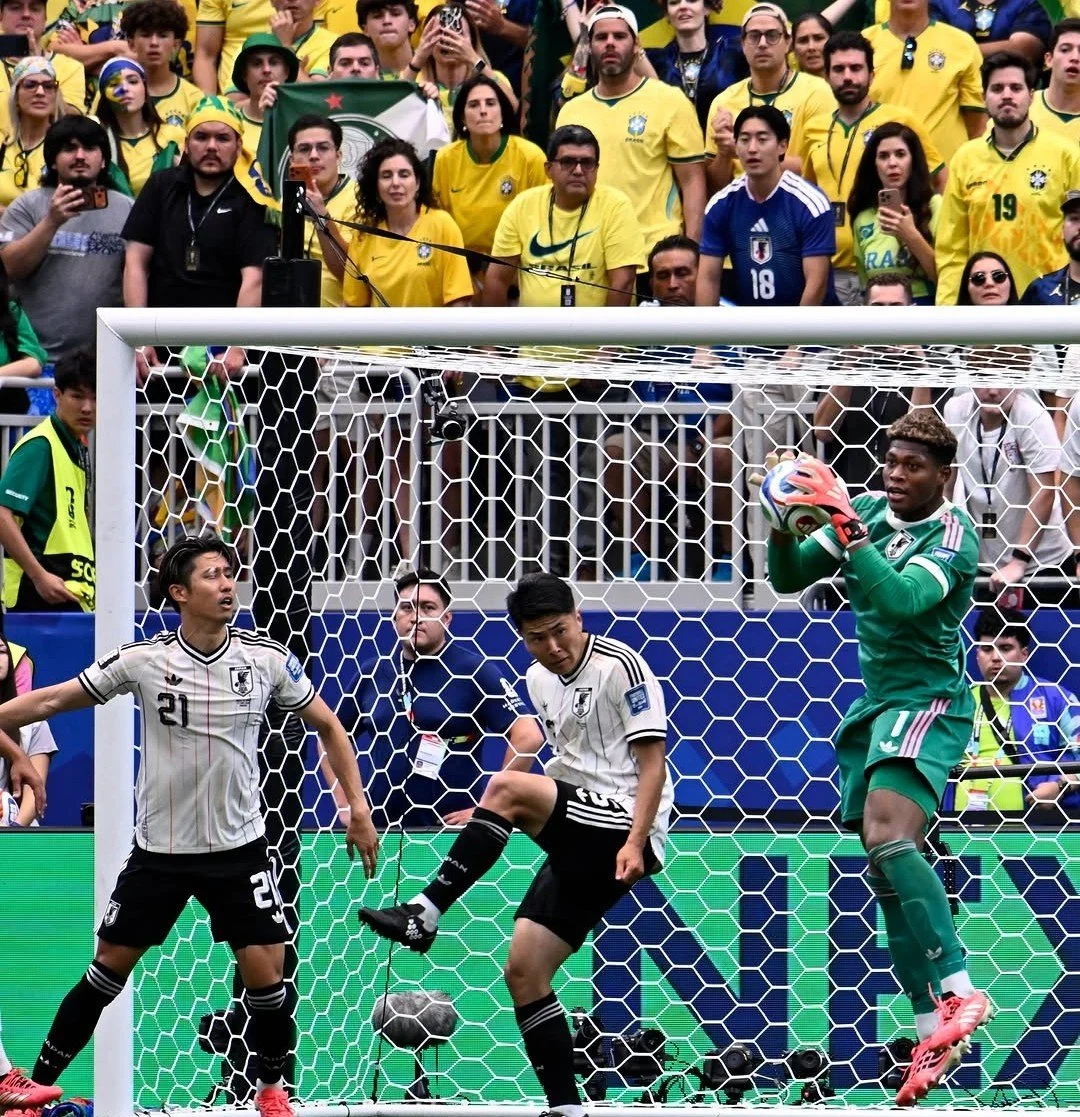
American-born goalkeeper Zion Suzuki made audiences stand up and take notice in Houston (Photo credit: Lili Dibai/Area Sports Network)
From Students to Rivals
Japan's famous hundred-year vision was never simply about qualifying for World Cups.
Its objective was explicit. Become world champions. Every academy, coaching licence, regional programme and youth competition became part of a long-term national project.
Japan's extensive coach education system is arguably among the world's best and helped localise imported ideas.
The coaching pool is large as a result, with an emphasis on teaching, not just instructing.
The emphasis on first touch, scanning, decision-making and technical repetition mirrors Japan's wider cultural commitment to continuous improvement—kaizen translated into football.
J-League alumni Hajime Moriyasu was the first men’s coach of Japan to have their contract renewed after a World Cup, just days after the match in Houston.
The ambition sounded unrealistic when it was announced.
Today, it no longer feels unrealistic that Japan will eventually challenge for the biggest prize.
Former Yokohama Flugel-Marinos and AFC Asian Cup winning manager Ange Postecoglou echoed such sentiments.
The women's national team proved it first by winning the 2011 FIFA World Cup.
The men's team appears to be travelling the same road. The world is taking notice.
The Generation Inspired by 2002
Yokohama created believers. Brazil's last World Cup triumph came in Yokohama in 2002.
For Brazil, it completed the era of Ronaldo, Rivaldo, Ronaldinho and Roberto Carlos.
For Japan, it became something else. An entire generation of children watched the world's greatest football nation lift the trophy inside their own country.
The images stayed. Many of those children are now professionals across the Bundesliga, Premier League, Serie A, Ligue 1 and Eredivisie.
They have become the dominant force in Asian football. They play fearless football against Europe's elite. And in Houston, they pushed Brazil to the edge.
The timing feels almost poetic.
The last Brazil team to become world champions may also have inspired the first Japan team capable of becoming one.
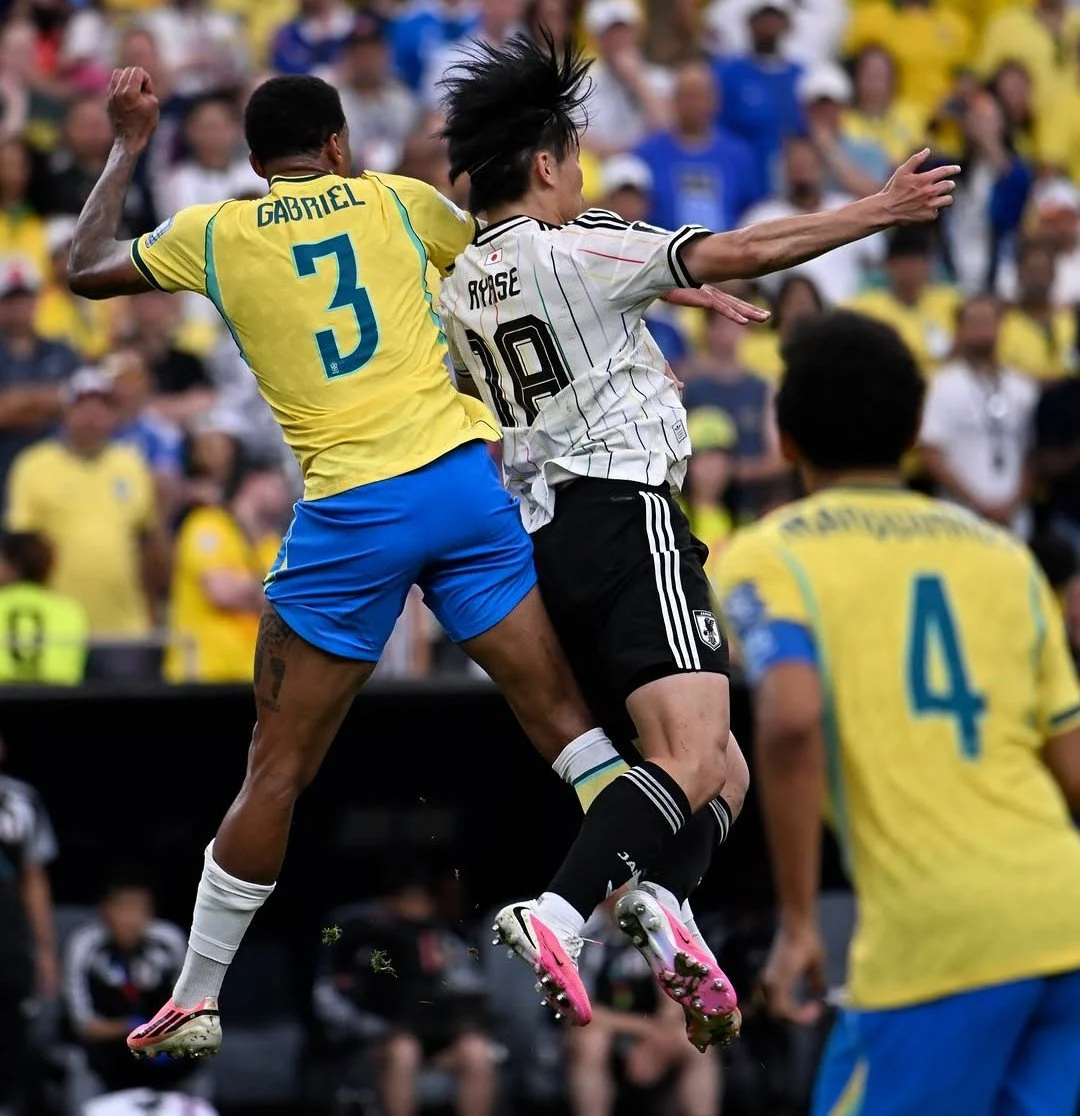
Ayase Ueda (right) went head to head with Champions League finalists Gabriel (#3) and Marquinhos (#4). (Photo credit: Lili Dibai/Area Sports Network)
When the Teacher Meets the Student
Brazil has exported footballers to every continent. Perhaps its greatest football export has been belief.
Japan did not become a serious football nation through isolation.
It learned selectively. It borrowed intelligently. It improved relentlessly.
That is often how sporting revolutions happen.
The surprise is no longer that Japan can compete with Brazil. The surprise is that many people are still surprised.
Japan now produces elite players as reliably as almost any nation outside Europe and South America.
The pipeline from the J-League to Europe's top leagues has become one of football's most successful development models.
Modern Japanese stars such as Kaoru Mitoma, Takefusa Kubo, Wataru Endo, Daichi Kamada and Ritsu Doan represent the first generation produced almost entirely within that mature ecosystem. The 26-man squad for the 2026 World Cup included 23 players playing in Europe.
The three exceptions were the two alternate goalkeepers (Keisuke Osako & Tomoki Hayakawa) and Yuto Nagatomo, 39, who has had an extensive career in Europe. Each squad member had some early development in the J-League.
Brazil remains arguably football's greatest talent factory.
Japan has become a rising talent system in world football.
There is a difference.
Brazil still relies on an unrivalled ability to produce extraordinary individual talent. Japan has built one of the game’s most coherent development systems.
Different routes, increasingly similar outcomes.
Increasingly, they produce similar results.
The Beautiful Game, Reimagined
For generations, Brazil represented football played with joy, freedom, and improvisation.
Japan has taken many of those principles and filtered them through planning, technology, education and relentless development.
If Brazil made football beautiful, Japan is discovering how to engineer beauty without removing its soul.
Houston may not be remembered as one of Brazil's greatest victories. The fixture is symbolic of football's globalisation: knowledge no longer flows in only one direction.
One of the game’s students pushed the teacher all the way to the end in a stern examination. History may remember it differently.
As another reminder that the most dangerous opponents are sometimes the ones you unknowingly helped create.
Sources:
FIFA Training Centre, Brazil 2 Japan 1 - POST MATCH SUMMARY REPORT, 29 June 2026
Hajime Moriyasu, Japan Head Coach, press conference, 28 June 2026
USA Today, “Once source of soccer inspiration, Brazil stands in way of an ascendant Japan”, Danielle Lerner, 28 June 2026
Reuters, “In Brazil, a World Cup clash pits homeland against home for vast Japanese community”, Victoria Pacheco, 29 June 2026
Daily Sun, “Japan look to turn tables on mentors Brazil", 29 June 2026
Reuters, “Soccer - Brazil match shows Japan closing gap on top teams, coach Moriyasu says”, Michael Kahn, 29 June 2026
FIFA, “Zico warns Brazil: Japan are ready”, 25 June 2026
The Athletic, “Malicia is the Brazilian term that defines Japanese football thanks to a World Cup legend”, Jack Lang, 29 June 2026
JFA, “Japan's way- Our National Football Philosophy”, 3 July 2026
These Football Times, “Japan and the 100-year vision”, George Pitts, 1 July 2018
Photo Credits:
Vinicius and Tanaka, Lili Dibai/Area Sports Network, 29 June 2026 - Photo courtesy of Lili Dibai/Area Sports Network
Suzuki catch in front of crowd, Lili Dibai/Area Sports Network, 29 June 2026 - Photo courtesy of Lili Dibai/Area Sports Network
Ueda duel with Gabriel, Lili Dibai/Area Sports Network, 29 June 2026 - Photo courtesy of Lili Dibai/Area Sports Network
All photos are used with permission. All rights reserved to the creator.

Support PSP Media
If this article resonated with you, consider supporting PSP Media.
Every contribution helps support independent research and reporting.