
Two Young Football Nations, Different Stages of the Same Journey
By Nii Wallace-Bruce
TORONTO — The final whistle brought neither celebration nor despair.
Canada's players applauded a home crowd that had spent most of the afternoon willing them forward. Bosnia and Herzegovina's players gathered together knowing they had survived long periods of pressure. The scoreboard read 1-1, a result that felt fair enough after 90 minutes.
Yet this was never simply a match about points.
Canada and Bosnia-Herzegovina arrived in Toronto carrying something larger than a World Cup opener. Neither nation belongs to football's aristocracy. Neither possesses the centuries-old football traditions enjoyed by Argentina, Brazil, Germany, Italy or England. Both are still engaged in a more fundamental task: defining who they are as football countries.
On Friday afternoon, they looked like two nations travelling the same road, albeit from different directions.
Football Built From Different Histories
Bosnia's football story is inseparable from the country's modern history.
Following independence and the devastating conflict of the 1990s, football became one of the few spaces capable of expressing a shared national identity. Qualification for the 2014 World Cup represented far more than a sporting achievement. It was proof that Bosnia and Herzegovina existed on football's map.
The generation of Edin Džeko, Miralem Pjanić and Vedad Ibišević gave the country its defining football moment. Even today, Bosnian football carries traces of that era. Resilience remains part of its character. So does a sense that every achievement must be earned the hard way.
Canada's journey has been entirely different.
There was no singular founding moment for the men’s team. No defining generation that permanently changed perceptions overnight.
Instead, Canadian football existed in pockets—community clubs, immigrant neighbourhoods and ethnic leagues scattered across the country. Every major migration wave left fingerprints on the sport. Communities from Croatia, Portugal, Italy, Jamaica, Somalia, Japan, Haiti, Poland, Guyana and countless other places helped sustain football through decades when it occupied the margins of Canada's sporting culture.
On Friday, it felt national.
Players repeatedly pointed to the crowd's role in dragging them forward after Bosnia's opener.
For a country that spent decades treating football as a secondary sport, the atmosphere felt significant.
That may ultimately be Canada's greatest advantage in this tournament. The team is still learning what it means to belong at a World Cup. So is the country.
For much of its history, Canadian football existed in the shadow of hockey, basketball and baseball.
Now it no longer feels like a niche pursuit.
Football has become one of the country’s most-played sports at the grassroots level. The talent pool is deeper. The pathways are clearer. The national team increasingly resembles the country itself.
That evolution may be slower than Bosnia's post-independence rise, but it could ultimately prove more durable.
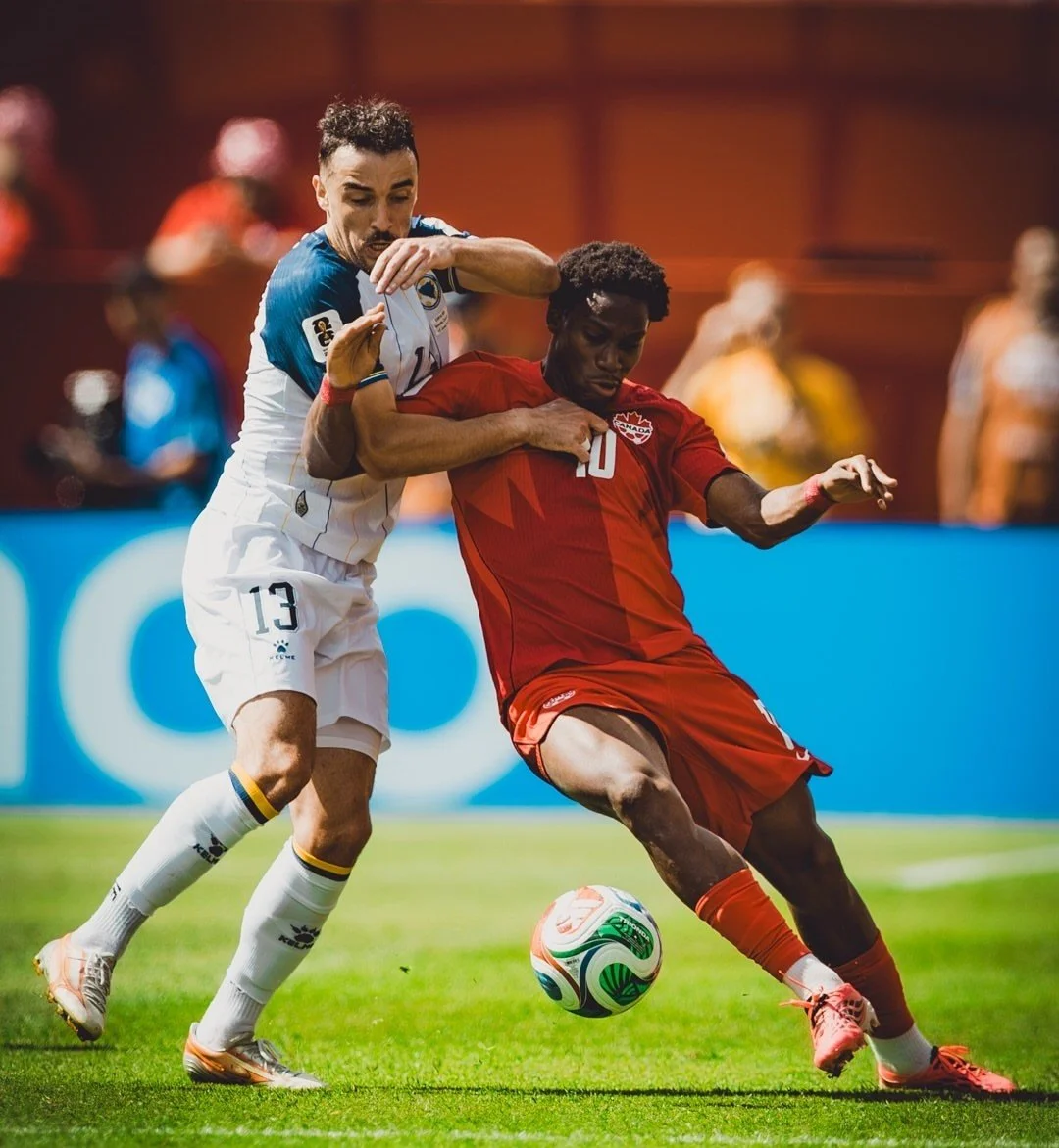
Bosnia’s Ivan Basić tussles with Canada’s Jonathan David, who is of Haitian descent (Photo credit: Grzegorz Wajda)
What the Match Revealed
World Cups have a way of stripping teams down to their essentials.
Canada's strengths and weaknesses were both visible in Toronto.
Marsch's side pressed aggressively, recovered possession quickly and spent long stretches pinning Bosnia deep inside its own half. The athleticism, energy and attacking ambition that have defined this Canadian generation remain intact.
Yet Bosnia exposed familiar vulnerabilities. Canada's defensive line occasionally looked uncomfortable dealing with direct service into the box, while periods of territorial dominance did not always translate into clear scoring chances.
For all the talk of Canada's attacking talent, the decisive contribution came from a veteran striker introduced from the bench.
Bosnia revealed something equally important about themselves.
They may not control many matches at this tournament, but they possess qualities that often travel well in international football: defensive organisation, physical presence and efficiency in key moments.
Teams built around structure rather than possession are rarely spectacular. They are often difficult to eliminate. Canada generated more chances, spent more time in dangerous areas and controlled possession. Yet they left with only a point.
The contrast felt instructive.
Canada increasingly resembles a modern football nation that wants to dictate games.
Bosnia resembles a nation that understands how to survive them.
The next stage of Canada's development may involve learning some of Bosnia's pragmatism. Bosnia's next stage may involve rediscovering enough creativity to move beyond it.
A Match Between Two Emerging Identities
The game itself reflected those broader stories.
Canada looked like a team trying to impose itself on an occasion.
Jesse Marsch's side controlled possession, carried greater attacking ambition and spent long stretches camped in Bosnia's half. Yet they also displayed the nervousness that often accompanies nations still learning how to handle expectation on football's biggest stage. Even more so for a team that had only known defeat at prior World Cups.
Bosnia, meanwhile, appeared entirely comfortable inhabiting a different role.
They defended with discipline, remained dangerous from set pieces and punished Canada's vulnerability when Jovo Lukić headed home after 21 minutes. It was the sort of pragmatic tournament football that experienced international sides understand instinctively.
Canada's response mattered.
Previous generations might have unravelled. Instead, they persisted.
Cyle Larin's equaliser — scored only minutes after entering the match — delivered Canada's first World Cup point and prevented an afternoon of frustration from becoming something more damaging.
There was a certain irony in Canada's equaliser arriving through one of the oldest and most experienced players in the squad.
Larin admitted afterward that he wanted to start.
"I showed today I should be playing," he said to assembled reporters.
Emerging football nations often celebrate youth. Mature ones understand the value of experience. Canada's first World Cup point arrived through a striker who has spent more than a decade carrying the national team's expectations.
That detail may prove significant.
Talent helps teams arrive.
Progression helps them stay.
What Comes Next?
The draw leaves both nations with reasons for optimism.
Canada demonstrated that it can control a World Cup match. Bosnia demonstrated that it can compete with one of the tournament hosts in a hostile environment.
Neither performance, however, felt complete.
Canada's longstanding issue remains unchanged. The build-up is often impressive. The final action is not. The team generated opportunities, controlled territory and created momentum, but still required a late intervention from Larin to secure a point.
Marsch's post-match assessment sounded less like a coach discussing a single result and more like a manager measuring a nation's development.
"We've got to learn these lessons and we've got to learn them quick," he said afterward.
The lesson was obvious. Canada controlled long stretches of the match, but spent the first half playing with the caution of a team aware of the occasion. Established football nations understand how to impose themselves from the opening whistle. Emerging ones often need time to grow into the moment.
Bosnia, by contrast, looked organised and physically imposing, but less capable of dictating proceedings over extended periods. They survived because of structure and discipline. Whether that is enough against stronger opposition remains uncertain.
Which raises the more interesting question.
Not which nation progresses from this group.
Which nation reaches footballing adulthood first?
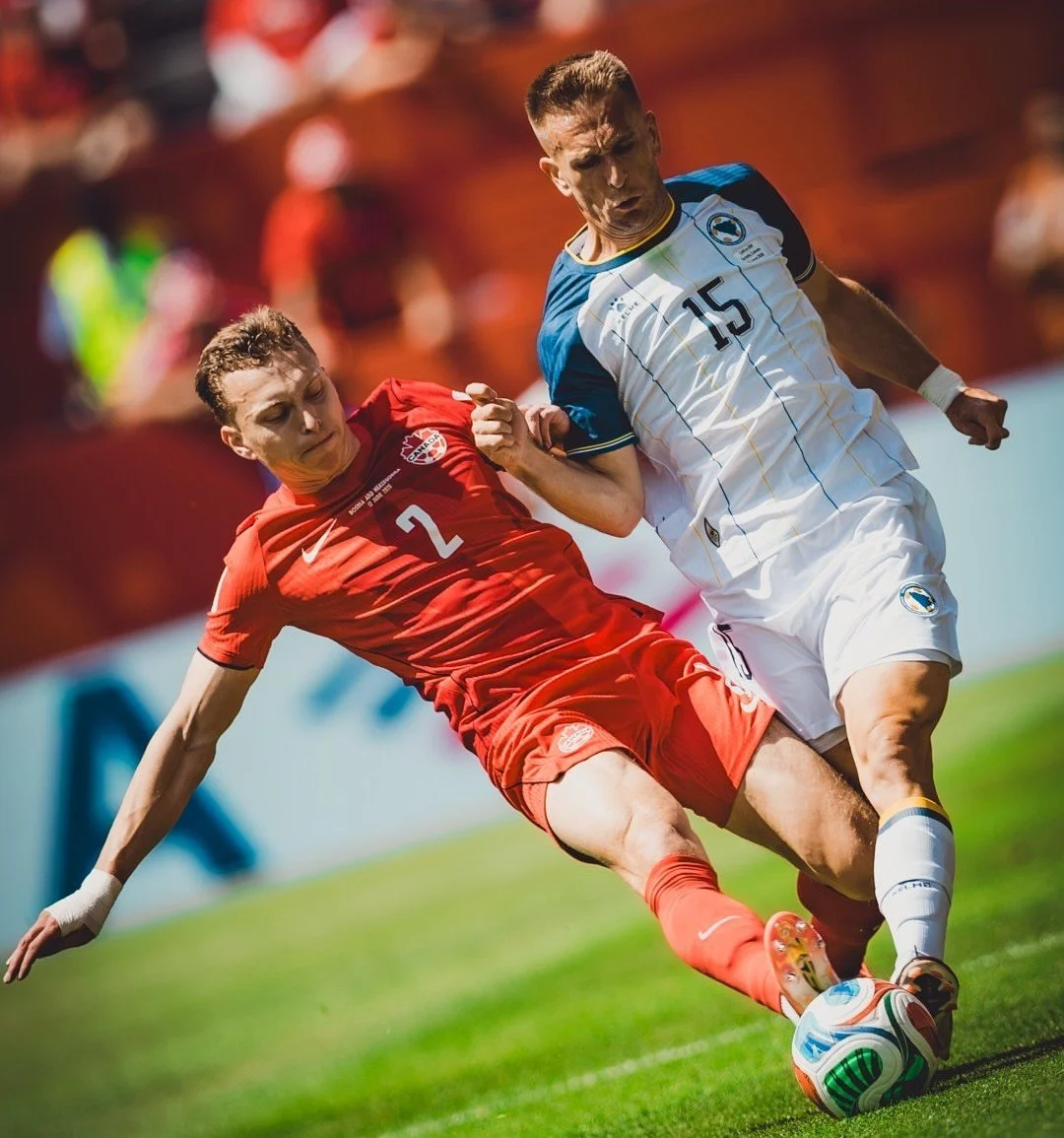
Canada and Bosnia are challenging for international relevance (Photo credit: Grzegorz Wajda)
The Race to Become More Than a Story
Football development is difficult to define, but easy to recognise. It arrives when qualification ceases to feel historic.
When participation is expected. When players no longer carry the burden of representing an entire sporting movement every time they step onto the pitch.
Bosnia came close to that threshold a decade ago. Since then, it has wrestled with the challenge of sustaining success beyond a golden generation.
Canada may be approaching it now.
The foundations are stronger than they have ever been. Professional infrastructure is improving. Youth development is expanding. The national team is no longer dependent upon one or two exceptional individuals.
But true evolution requires repetition.
One World Cup is a breakthrough.
Two is progress.
Three or four consecutive tournaments create a football culture.
Friday's draw did not answer which nation is closer to that destination.
It merely reminded everyone that both remain on the journey.
For 90 minutes in Toronto, two young football countries looked across the field and saw versions of themselves.
Bosnia looked like a nation trying to recapture a place it once illuminated.
Canada looked like a nation trying to discover how high it can climb.
Neither completed the journey in Toronto.
But Marsch's words afterward felt revealing.
“We've got to learn these lessons and we've got to learn them quick.”
Football maturity is nothing more than accumulated lessons.
The question after a 1-1 draw is no longer whether Canada and Bosnia belong on this stage.
It is which nation learns fastest.
Sources:
Jesse Marsch, CanMNT Head Coach, press conference, 13 June 2026
Cyle Larin, CanMNT Forward, media scrum, 13 June 2026
Steven Estaquaio, CanMNT player, media scrum, 13 June 2026
Ismael Kone, CanMNT Forward, media scrum, 13 June 2026
Luc De Fougerolles, CanMNT Forward, media scrum, 13 June 2026
Alistair Johnson, CanMNT Forward, media scrum, 13 June 2026
Richie Laryea, CanMNT Forward, media scrum, 13 June 2026
FIFA Training Centre, Canada 1 Bosnia-Herzegovina 1 - POST MATCH SUMMARY REPORT ,13 June 2026
Photo Credits:
Basic and David, Grzegorz Wajda, 13 June 2026 - Photo courtesy of Grzegorz Wajda and Maciej Rogowski - @ball.rawvia Instagram
Johnston and Memic, Grzegorz Wajda, 13 June 2026 - Photo courtesy of Grzegorz Wajda and Maciej Rogowski - @ball.rawvia Instagram
All photos are used with permission. All rights reserved to the creator.

Support PSP Media
If this article resonated with you, consider supporting PSP Media.
Every contribution helps support independent research and reporting.