
A Home World Cup Begins Without Alphonso Davies. Canada Must Show Who It Has Become.
By Nii Wallace-Bruce
There is no gentle way to lose your captain before a World Cup opener.
Especially not this captain.
Especially not at a home World Cup.
For nearly a decade, Alphonso Davies has been more than Canada’s best player. He has been the emotional ignition point of modern Canadian football — the blur of red breaking open matches and imaginations alike. The player who made a generation believe the distance between Edmonton and Munich was not impossible after all.
And yet, as Jesse Marsch prepares for Canada’s opening match against Bosnia-Herzegovina on June 12, all signs point toward Davies beginning this tournament from the sidelines. Marsch has admitted Bayern Munich fullback Alphonso Davies is unlikely to be ready for June 12, though he expects him to feature later in the tournament.
There is an irony to Canada's opening challenge. For years, the question surrounding this program was whether it had enough talent beyond Alphonso Davies. Now, on the eve of a home World Cup, the first test arrives without him.
The timing feels cruel. It may also prove revealing. For years, Canada’s greatest strength was obvious. The question now is whether its strength has become collective rather than individual.
The irony is that Marsch has quietly been preparing for this possibility for months.
Not publicly.
Not emotionally.
But tactically.
Because if the Copa América taught Canada anything, it is that this team can survive without comfort. The fourth-place finish in that tournament was built less on romance than resilience. Marsch turned Canada into a side that hunted games rather than waited for them. Vertical. Aggressive. Relentless. A team that pressed as though hesitation itself were dangerous. A footballing nation that showed no fear against the world champions Argentina — twice.
That identity will matter now more than ever.
Every World Cup produces moments when plans give way to reality. For Canada, that moment appears to have arrived before a ball has been kicked.
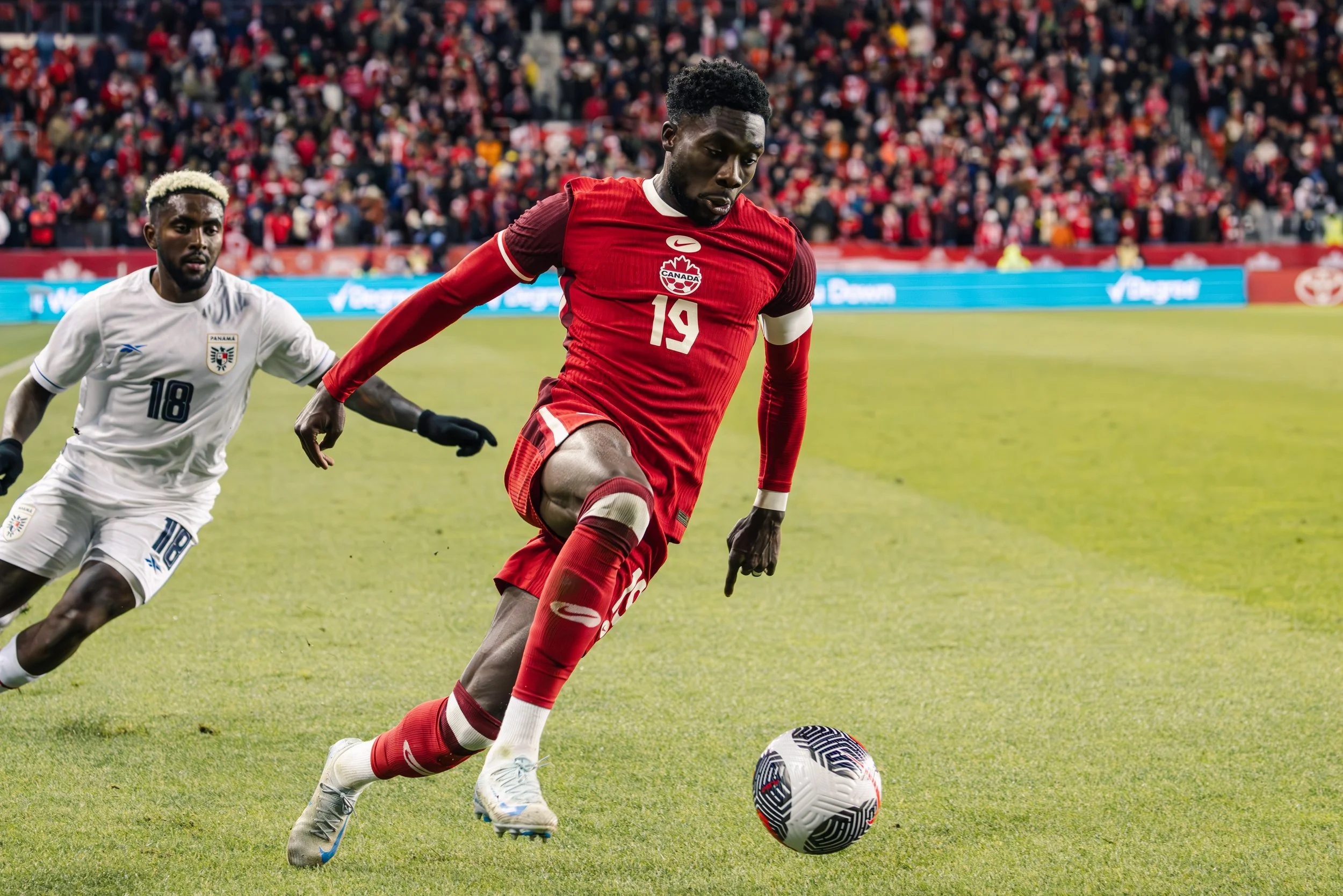
The pace and pressing of Alphonso Davies will need to be replaced for at least one group game. (Photo credit: Curtis Wong)
The Opponent
The challenge awaiting them is far from ceremonial. Canada were expected to open up the tournament against a European team that wears blue — the Azzurri of Italy as opposed to Bosnia-Herzegovina’s Zmajevi. Truth be told, the Zmajevi starting XI that eliminated Italy in the UEFA playoffs actually had a higher average age than their storied opponents at 27.9. This relatively high number is anchored by stalwart striker Edin Džeko (40) who was a part of the 2014 World Cup squad.
Overall, Sergej Barbarez’ team exhibits similar qualities to Canada when on the ball, with a 4-4-2 morphing into a 4-2-4. When on the attack, full-backs are encouraged to press out wide while wide midfielders tuck inside, creating defensive congestion and chaos with the strikers. Bosnia-Herzegovina are also known for being dangerous in transition — a weakness of the CanMNT at times. In the March international window against Iceland, Canada conceded two goals via quick transitional movements by Iceland.
If the visitors can withstand the initial period of hype and homegrown energy in Toronto, their hosts could become vulnerable. While the CanMNT has a younger squad on average, there will be a lingering narrative about a team that has yet to earn a point at the men’s World Cup. In a match that has an ongoing stalemate, that could be an unwanted source of anxiety for players and fans alike.
The lineup Marsch chooses against Bosnia-Herzegovina will not simply reveal his tactical preferences. It may offer the first glimpse of what Canada looks like when forced to step out of Davies' shadow.
The Likely XI
Goalkeeper
Maxime Crépeau
There are flashier goalkeepers in world football. There may even be cleaner distributors. But few embody the emotional temperature of this Canadian side quite like Crépeau. Marsch values emotional durability as much as tactical discipline, and Crépeau’s command during Copa América made him indispensable. Crépeau also started both meetings with Argentina at Copa America, a measure of trust Marsch places in him. Crépeau missed the 2022 World Cup due to injury in the MLS Cup Final.
Against Bosnia-Herzegovina, his handling on crosses and second balls could quietly decide the evening. Bosnia-Herzegovina’s attack runs through Edin Džeko and fellow centre-forward Ermedin Demirović. The pair can be dangerous from set-pieces as well as aerial duels in the box, hence the lean towards Crépeau as Canada’s preferred ‘keeper for this game.
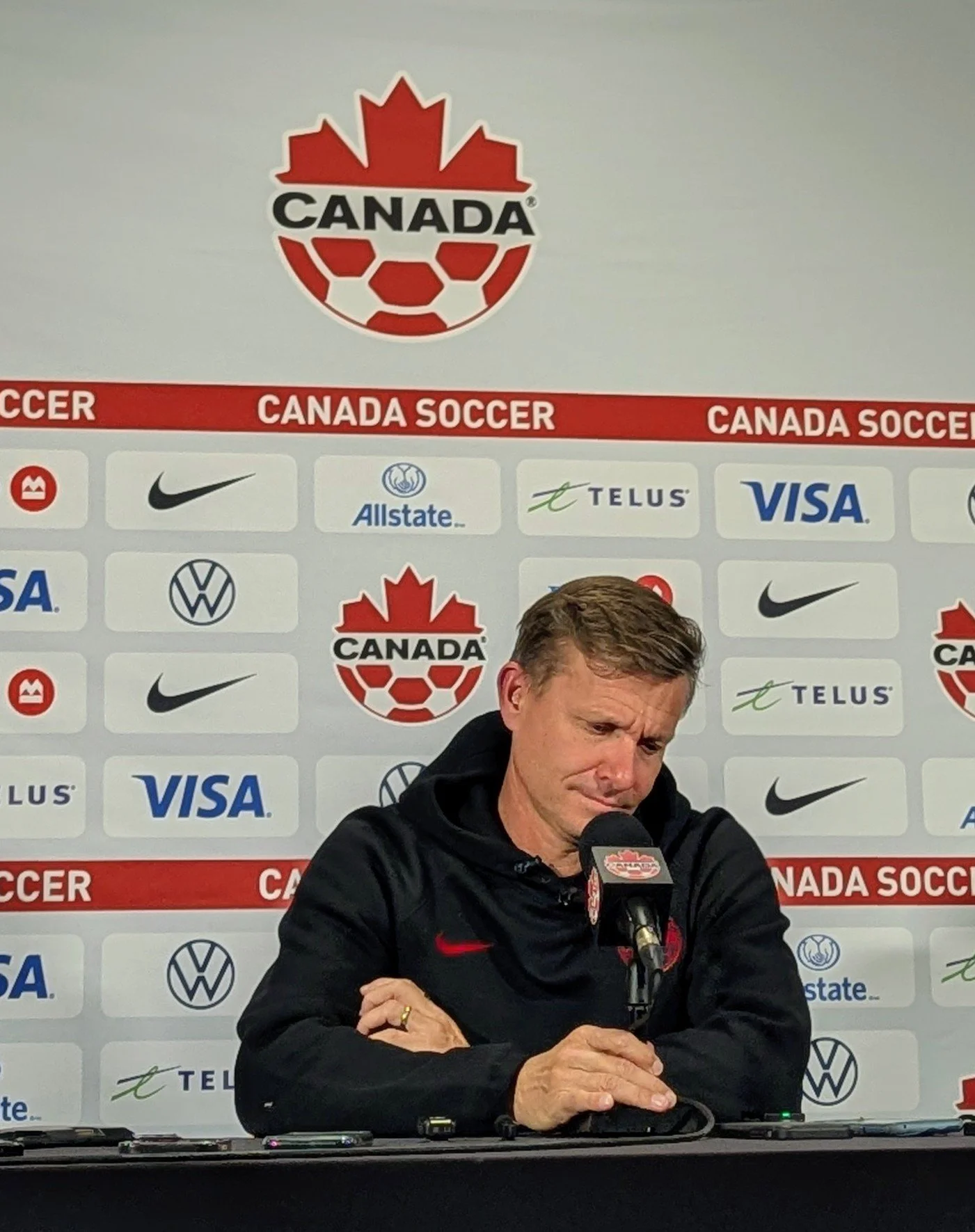
Jesse Marsch has had time to contemplate alternative lineups without Alphonso Davies. (Photo credit: Nii Wallace-Bruce)
Defence
Alistair Johnston
Moïse Bombito
Derek Cornelius
Richie Laryea
This is where the absence of Davies changes everything.
Normally, Davies distorts the geometry of Canada’s left side entirely. His recovery speed allows Canada to defend exceptionally high up the pitch. His carrying ability turns clearances into attacks. Without him, Canada loses not just pace, but territorial confidence.
Which is why Richie Laryea feels the most natural solution.
Laryea is not Davies — nobody is — but he offers something psychologically important: momentum. He pushes forward. He commits defenders. He forces transitions to happen quickly instead of safely. Jesse Marsch mentioned that Laryea was expected ”to be a major player in this tournament for us, like he has been over the last two-plus years.”
Expect Johnston to remain slightly deeper on the opposite flank, forming an asymmetrical back line that allows Laryea freedom to surge.
Bombito and Cornelius feel increasingly like Marsch’s preferred central pairing because they fit his worldview. Neither is passive. Both defend front-footed spaces aggressively. Bosnia-Herzegovina will likely look to bypass Canada’s press with early diagonal balls into channels, and Canada’s centre-backs will need to win uncomfortable foot races rather than simply dominate aerially.
That is the hidden tension in this opener. Bosnia-Herzegovina are not arriving merely to admire the atmosphere. They possess enough technical calm to punish emotional overreach.
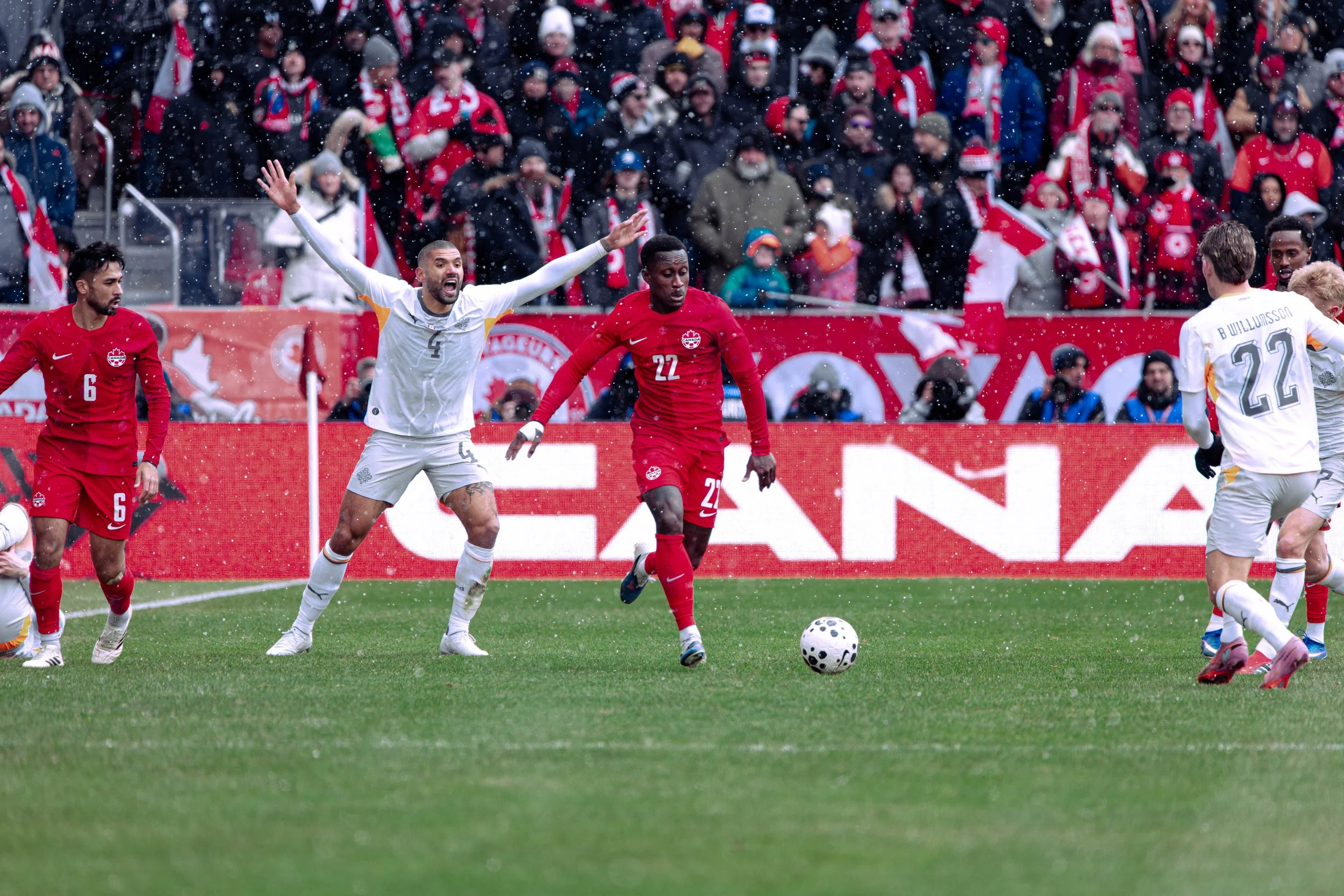
Richie Laryea has already been tasked with playing a similar role to Alphonso Davies in previous CanMNT matches. (Photo credit: John Jacques/Northern Tribune)
Midfield
Ali Ahmed
Stephen Eustáquio
Ismaël Koné
Tajon Buchanan
This is where Marsch’s tournament philosophy becomes clearest.
The first five seconds after winning the ball matter more than sterile circulation.
Eustáquio is therefore indispensable. He is the metronome beneath the chaos — the player who can slow a game just enough before Canada explodes vertically again.
Koné, meanwhile, may become the emotional barometer of this tournament. There are moments when he plays like a footballer hearing music nobody else can hear yet. Long-legged carries. Impossible escapes. Press resistance that suddenly becomes an attack.
It will be hard to ignore the recent form of Norwich midfielder Ali Ahmed. The creativity of Ahmed as well as his attacking mentality should give him the start here. Ahmed’s rise from Vancouver to Norwich has accelerated quickly enough to force his way into Marsch’s thinking. In previous international windows, Marsch talked about Ahmed's growing confidence to make plays on the ball. Further, he also praised Ahmed's running and pressing as well as his ability to compete defensively and in transition.
But World Cups punish inconsistency brutally.
Against Bosnia-Herzegovina, Marsch may ask Koné to simplify early: fewer risks in deep zones, quicker progression into wide areas, more defensive discipline beside Eustáquio.
Buchanan may ultimately become the player most liberated by Davies’ absence. Without Canada funneling so much progression down the left through Davies, the attack could tilt more heavily toward Buchanan’s direct running on the opposite side.
Overall, the midfield is an area of depth for Canada, with the likes of Jonathan Osorio, Marcelo Flores, Jacob Shaffelburg, and Liam Millar all available off the bench in this scenario.
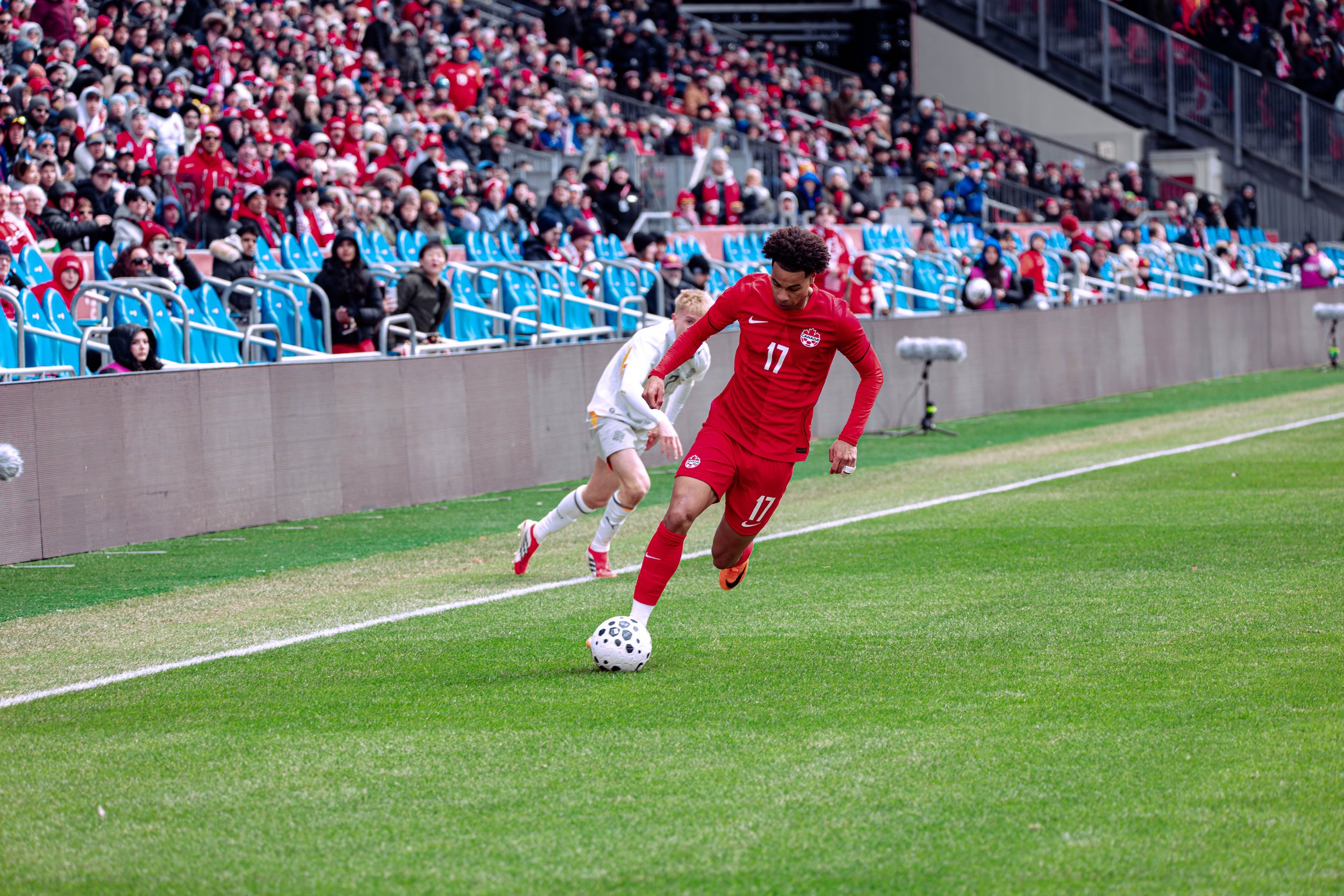
Tajon Buchanan will also see a more prominent role in the absence of Davies (Photo credit: John Jacques/Northern Tribune)
Attack
Jonathan David
Cyle Larin
This front pair tells us what Marsch believes this match will become.
David remains the essential piece - Canada’s Iceman according to Jesse Marsch. There are more explosive forwards in international football, but few interpret space more intelligently. Marsch’s pressing system depends upon forwards who recognise triggers instinctively — when to jump, when to screen, when to bait a pass before attacking it.
David does that naturally.
And then there is Larin.
Larin has scored crucial goals in Spain, Holland and England, yet he still feels oddly under-discussed globally. Perhaps because his brilliance rarely announces itself theatrically. Larin scores in moments that feel inevitable only afterward. Arsenal supporters still remember the damage Larin inflicted when he helped knock them out of the FA Cup.
Against a physically organised Bosnian defence, Canada may need precisely that sort of inevitability. Bosnia-Herzegovina’s tendency to defend man-to-man could create opportunities for David and Larin. This defensive shape can be stretched, as evidenced in games against Italy and Austria, where sharp passing will open up pathways for attackers to get in behind the central defenders and create scoring opportunities.
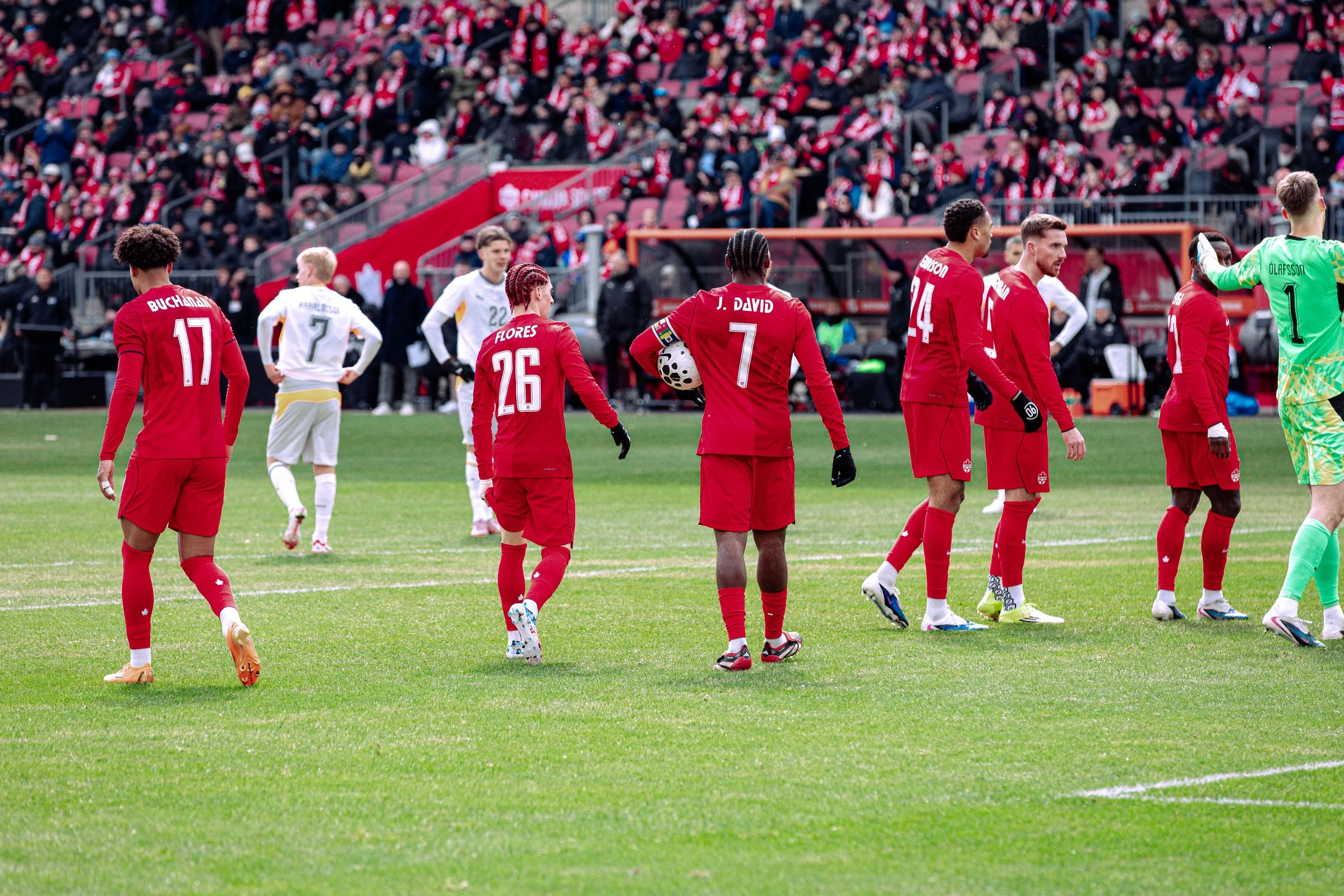
Jonathan David will lead the line on June 12 against Bosnia-Herzegovina. (Photo credit: John Jacques/Northern Tribune)
The Shape: More 4-2-2-2 Than 4-4-2
On paper, this may resemble a 4-4-2.
In reality, the structure often bends into a fluid 4-2-2-2 during pressing phases. In this instance, Buchanan and Laryea would be given license to pin the opposing full backs aggressively with David drifting between lines, linking up play. The objective is chaos from multiple directions — forcing rushed decisions before immediately attacking exposed channels.
It is exhausting football.
But it is also contagious football.
You can feel crowds surrender to it.
And in Toronto, under opening-day noise and expectation, Marsch will likely want emotional velocity from the first whistle. A sea of red in the stands matched by waves of red and white attacks into the blue 18-yard box.
If Canada score early, the stadium may become combustible.
If anxiety settles first, this suddenly becomes a very different kind of afternoon.
Again, an early period of chaos and chances could result in conversion to a crucial goal for Canada. Historically, the opening game of the group stage sets the tone for potential progression to the knockout stage, so an early goal will feel like double. Particularly for a nation that has only scored twice in two men’s World Cup tournaments. Completing that objective early will reduce any anxiety and quiet any simple historical narratives.
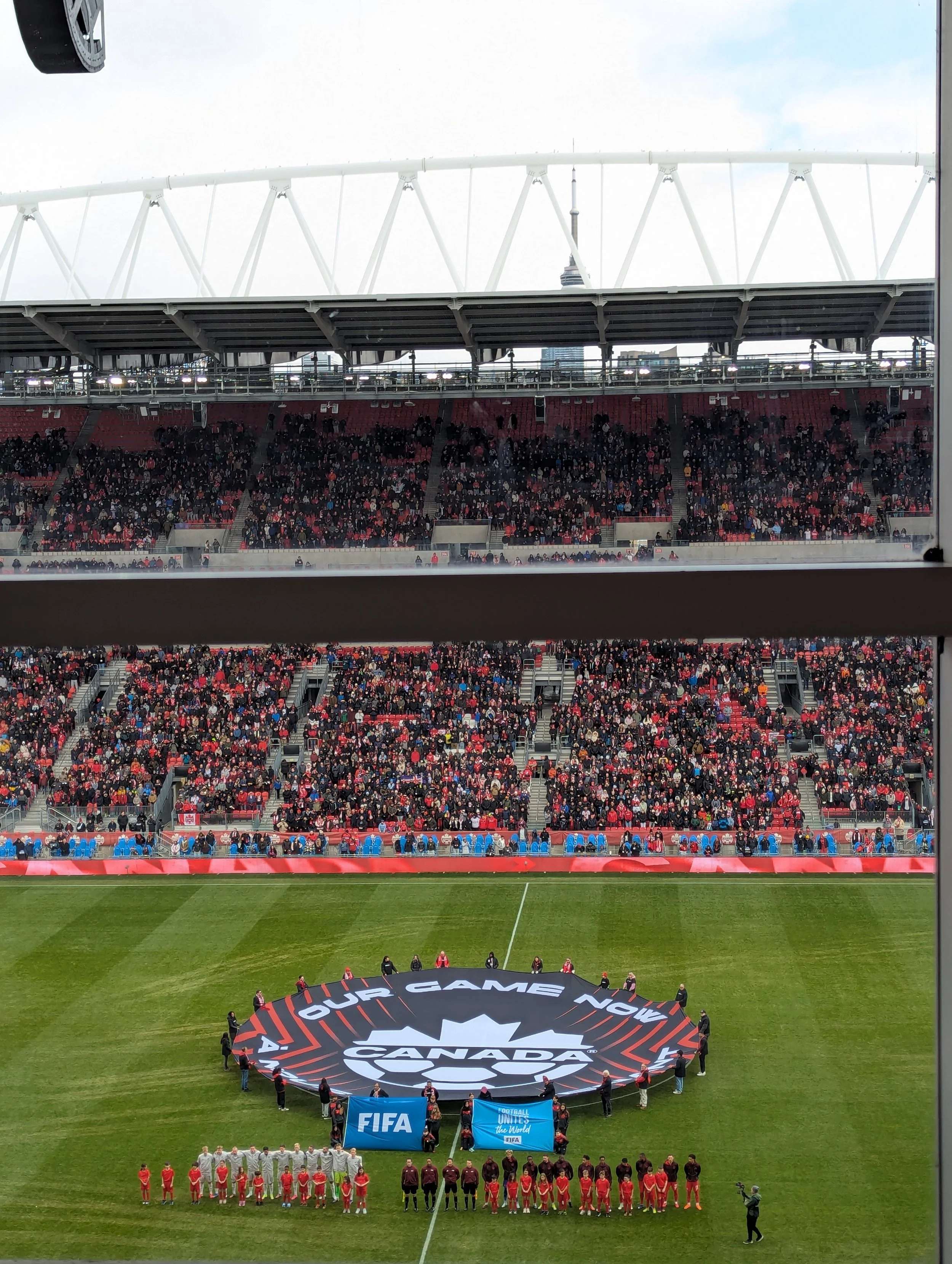
Toronto will be called upon to create a sea of red to help the home side on June 12. (Photo credit: Nii Wallace-Bruce)
The Deeper Question
Perhaps the real significance of this match has little to do with formations or pressing triggers.
For years, the CanMNT has been introduced to the world through Alphonso Davies. Through speed. Through possibility. Through the intoxicating feeling that one extraordinary footballer could drag a football nation somewhere entirely new.
Now comes the harder stage of growth. Can Canada still look like Canada without him?
Marsch appears convinced they can. Much of his tenure has been spent building a team less dependent on individual brilliance and more reliant on collective conviction. The aggressive pressing, the relentless running and the willingness to attack games rather than endure them are all designed to survive the absence of any one player — even Davies.
That belief will be tested immediately against a Bosnia-Herzegovina side capable of punishing mistakes and disrupting momentum. The opening 20 minutes may set the emotional tone not only for the evening but perhaps for Canada's entire tournament.
If Canada starts quickly, the atmosphere in Toronto could become electric. If nerves take hold, a very different kind of match awaits.
A convincing performance without their captain would say something important about where this program stands ahead of a home World Cup.
Not that Canada are talented.
Not that they are inspiring.
But that they are becoming something more durable than either.
A real football team with a real identity.
And one capable of carrying the hopes of a nation, even while its biggest star waits on the sidelines.
Sources:
Jesse Marsch, CanMNT Head Coach, media availability, 29 May 2026
Jesse Marsch, CanMNT Head Coach, media availability, 25 May 2026
Jesse Marsch, CanMNT Head Coach, media availability, 12 November 2025
Jesse Marsch, CanMNT Head Coach, press conference, 28 March 2026
Canada Soccer, Canada Soccer Announces CANMNT Squad for FIFA World Cup 2026™, 29 May 2026
Photo Credits:
Alphonso Davies v Panama, Curtis Wong, 15 May 2026 - Photo courtesy of assignment by PSP Media
Richie Laryea moving through snow and Iceland, John Jacques, 28 March 2026 - Photo courtesy of Northern Tribune
Tajon Buchanan on the ball, John Jacques, 28 March 2026 - Photo courtesy of Northern Tribune
Jesse Marsch postgame, 28 March 2026 - Photo courtesy of Nii Wallace-Bruce
Jonathan David steps up for Canada, John Jacques, 28 March 2026 - Photo courtesy of Northern Tribune
National anthems - Canada and Iceland, 28 March 2026 - Photo courtesy of Nii Wallace-Bruce
Video Credits:
John Walker, UEFA Licensed Coach and Scout, 19 May, 2026 via Twitter @johnwalker_1986
All photos are used with permission. All rights reserved to the creator.

Support PSP Media
If this article resonated with you, consider supporting PSP Media.
Every contribution helps support independent research and reporting.