
When Systems Collide: Germany’s Late Surge, Côte d’Ivoire Refuses the Script
By Nii Wallace-Bruce
There are games that feel like football. And there are games that feel like history arguing with itself.
This was the second kind.
Germany meeting Côte d’Ivoire, set against a city built on movement—languages layered over languages, a stadium that could have belonged anywhere and nowhere at once. It was the perfect stage for two national teams that no longer fit the old definitions of “national” at all.
Germany won. But only in stoppage time. Only just.
And even then, it felt like something had been left unresolved.
Empire and Reload
Germany arrived carrying the weight of 2014 like an inheritance that refuses to depreciate. The word rebuild has followed them for a decade now, spoken in polite tones but felt like impatience. Every tournament since Brazil has been a variation on the same theme: structure intact, identity searching.
This team, though, is no accident. It is the product of a system rebuilt after humiliation. Early exits at the 1998 World Cup and Euro 2000 prompted a sweeping review of development pathways. DFB academies were redesigned and Bundesliga clubs turned into production lines of elite tactical education. From Stuttgart to Munich, from Leipzig to Leverkusen, this became football as a curriculum. Die Mannschaft at the 2026 World Cup is, more than ever, a Bundesliga academy-built national team.
Fans and analysts recognise it immediately: spacing, automatisms, positional discipline. A team designed not to improvise chaos, but to manage it. German efficiency on grass.
And yet, empire football is always haunted by expectation. Germany do not just play matches. They inherit them.
German fans have high expectations for the national team, based on a sustained history of success.
The Elephants Without Fear
Côte d’Ivoire arrived with a different memory.
Winning the Africa Cup of Nations in 2024 changed something fundamental. It removed hesitation. This is a side that no longer carries history as pressure, but as permission. The stars of today were forged during a turbulent AFCON campaign at home, which reshaped their trajectory. Émerse Faé was thrust into the management role during the tournament’s early struggles. A significant portion of that title-winning squad have carried that momentum into the 2026 World Cup campaign under Faé in North America.
The rhythm of African football has often operated in Europe’s shadow. A pattern where migration is not loss, but transformation. This Côte d’Ivoire team made that idea visible.
Some were shaped at Abidjan’s ASEC Mimosas, that extraordinary conveyor belt of West African talent.
Others passed through Clairefontaine-adjacent systems in France, growing up between coaching philosophies and identities that never fully settled into one.
Africa’s best teams are no longer purely exported talent, but hybrid constructions—local instincts refined in European academies, then reassembled for national duty.
They do not fear Germany. They understand them.
A City of Movement, A Game of Mirrors
In Toronto, a city defined by migration, the match felt almost too neat in its symbolism.
Germany’s modern identity is inseparable from immigration. The squad that began this game included players shaped by Turkish, Nigerian, Polish and American heritage. In a notable detail, German centre-back Jonathan Tah had once been approached by Côte d’Ivoire when he was 17, reflecting his family’s West African heritage. In the same way that post-war Germany was shaped by immigration from Turkey, the decisive moments carried that reality into the present: Deniz Undav, of Turkish-Kurdish heritage, came off the bench to deliver the goals that saved Germany from what, by their standards, would have been a damaging result. Football, however, rarely behaves so cleanly.
It is a reminder that the old binaries—exporter and importer, European structure and African spontaneity—have dissolved. What remains is circulation.
Talent moves. Identity follows later, if at all.
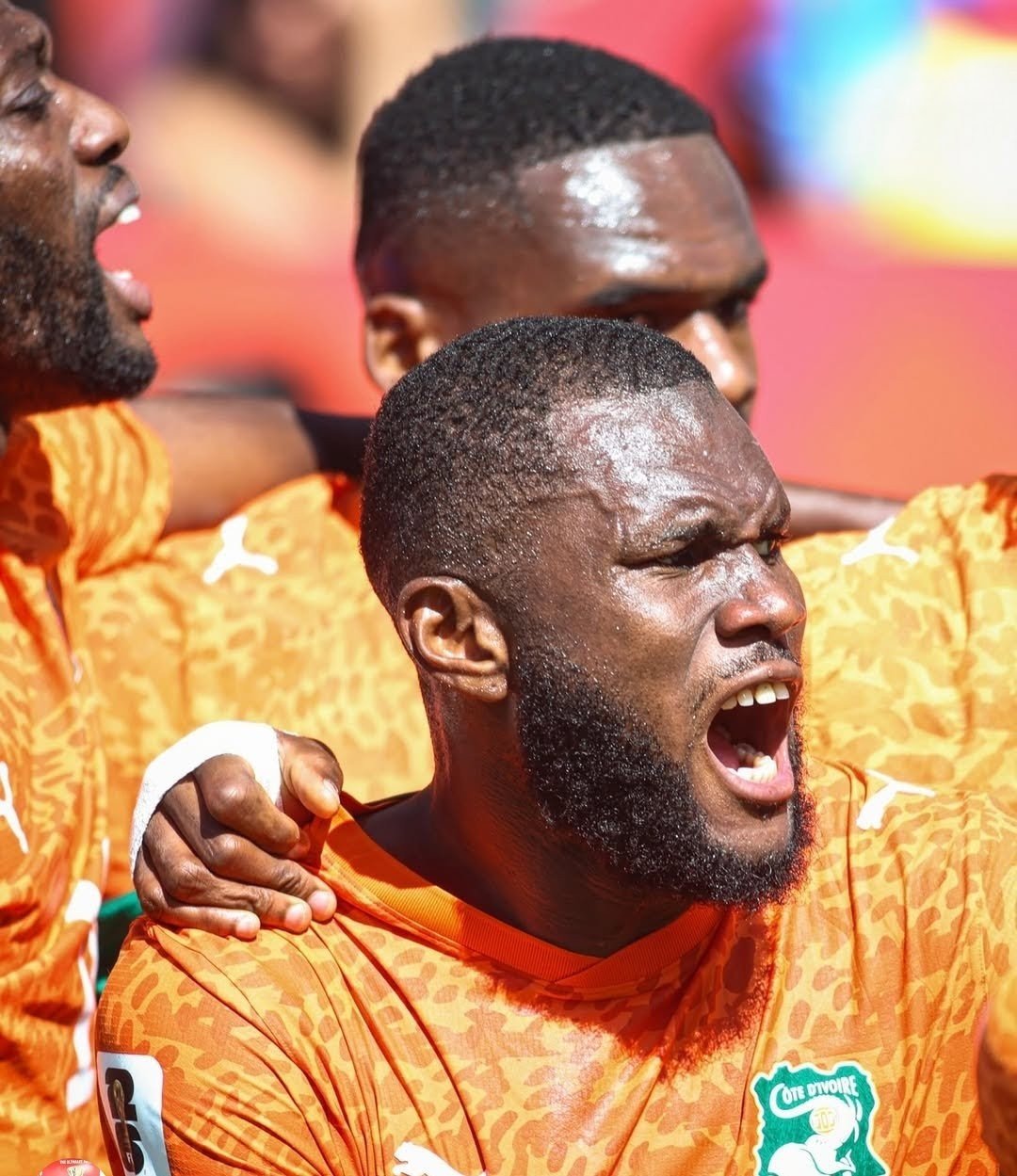
Côte d’Ivoire captain Franck Kessié honed his talent in Italy at Atalanta Bergamo’s academy (Photo credit: Cheick Haidara)
The Match: Structure vs Freedom
For 70 minutes, Côte d’Ivoire played without hesitation.
Faé’s structure was deliberate: a compact 4-5-1 designed specifically to absorb and disrupt Germany’s asymmetrical 3-1-6 in possession. When Germany advanced, their back line stretched into width, the single pivot dropping between centre-backs to circulate and dictate tempo. It created overloads in advanced zones, but it also invited patience from the opposition.
Côte d’Ivoire did not chase the extra man. They held their midfield line, compact and narrow, forcing Germany’s circulation sideways rather than forward. It was not passive defending; it was controlled containment. The kind that asks not how to win the ball, but when. After the match, Emerse Faé described the performance as a benchmark for future games.
They pressed Germany high, not with chaos but with organisation. Their midfield—many trained in French academies—understood spacing as well as any Bundesliga side. At times, Germany looked surprised not by intensity, but by clarity.
Germany responded in familiar fashion: control, patience, circulation. They tried to pull the game into zones where structure becomes suffocation. Short passes between the lines were the order of the day. Germany attempted to “solve” Côte d’Ivoire by moving them horizontally until gaps appeared. But Les Éléphants refused to fracture.
And then came the moment football often reserves for those who refuse to leave quietly.
A break. A finish. Côte d’Ivoire were ahead. After the goal, the structure shifted. Côte d’Ivoire dropped into a mid-block, no longer pressing with the same ambition. Lines compressed between the halfway line and their own box, the intention clear: protect space, reduce volatility, manage the rhythm of the game rather than dictate it.
Where earlier they had engaged Germany in midfield duels, now they surrendered initiative and trusted organisation. The risk was no longer structural—it was psychological. Inviting pressure against a side built to sustain it.
Les Éléphants, ironically, moved with the lightness their nickname rarely suggests. The move came down the left through Yan Diomande, whose acceleration opened the space for a cross that captain Franck Kessié converted.
For a stretch of the second half, Germany looked like a team remembering old anxieties. Memories of group-stage exits in 2018 and 2022 resurfaced.
The Weight of the Final Minutes
Time, in World Cup football, is never linear. It thickens.
Germany pushed bodies forward. Substitutions that read like institutional depth rather than desperation. The bench itself felt like a second national team. The heat was on figuratively and literally in Toronto.
Côte d’Ivoire defended like a side that had already learned the hard lesson of Europe’s finishing power: that control must last until the final whistle, not the 85th minute.
It did not.
In stoppage time, Germany found the space their system is designed to eventually manufacture. The introduction of Deniz Undav changed the geometry of the match. With Kai Havertz already occupying central channels, Germany now had two recognised strikers between the centre-backs, pinning the back line deeper and forcing Côte d’Ivoire’s defensive shape into constant recalibration.
That adjustment mattered even more after Wilfried Singo went off injured. Without his pace in recovery, Côte d’Ivoire’s defensive structure lost its balance. The back line became split between zonal caution and individual duels—some stepping, others holding.
It was in that uncertainty that the equaliser emerged. A moment not of collapse, but of misalignment. Germany did not break the structure; they exploited the space created when it briefly stopped being one.
A cross, a second ball, a finish—Undav arriving at the edge of fatigue and certainty. In post-match remarks, Julian Nagelsmann said Undav played a key role as a finisher who can “jump in right away”.
2–1.
Not domination. Survival.
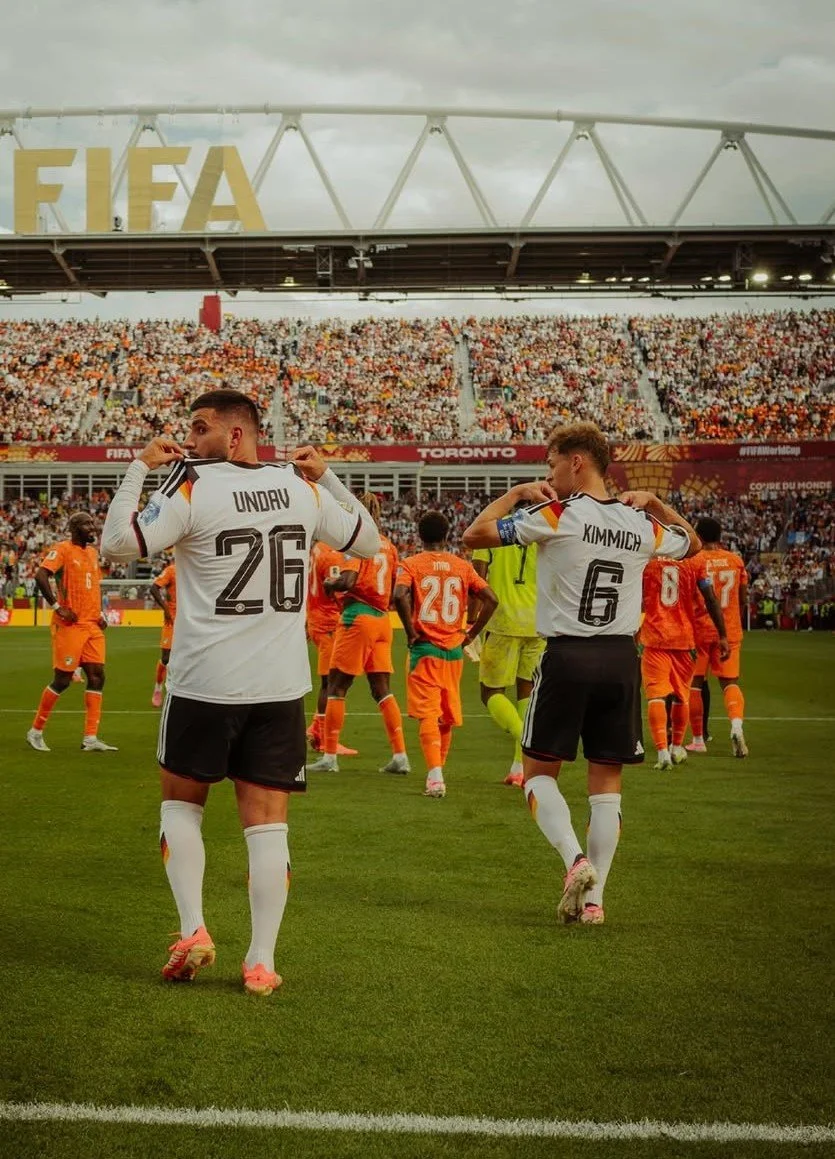
Both Deniz Undav (Werder Bremen) and Joshua Kimmich (VFB Stuttgart) are products of the Bundesliga academy system (Photo credit: Max Galys)
What the Score Hides
Germany did what Germany now does best: winning without fully convincing. But the deeper truth is more uncomfortable for both sides.
Germany’s system is powerful, but no longer singular. Côte d’Ivoire’s model is fluid, but no longer secondary. One is defending hierarchy. The other is testing whether hierarchy still exists.
This is modern international football’s central contradiction: the nation-state competing in a game shaped by transnational development pipelines.
Who “produces” talent? Who merely hosts it?
The answer, increasingly, is everyone.
The scoreline will be remembered in Germany as progress, another step in the long rehabilitation of identity since 2014.
In Côte d’Ivoire, it will be remembered differently: proof, albeit with missed opportunity. Proof that AFCON champions can go toe-to-toe with European systems and walk away feeling they belonged to the same game.
Because they did.
Football Without Borders, Only Pathways
There was a time when international football was simple geography. Now it is a biography.
Germany’s winners are shaped by migration. Côte d’Ivoire’s challengers are shaped by Europe. The academies of Munich and Abidjan, of Paris and Stuttgart, are no longer separate ecosystems—they are nodes in the same network.
And so the match ends not with clarity, but with recognition: There are no pure systems left.
Only overlapping ones.
And on this late afternoon, at the death, Germany found just enough structure to edge past a team that had long since learned how to live without fear of theirs.
Sources:
The Guardian, “How Germany went from bust to boom on the talent production line“, Stuart James, 23 May 2013
Deustche Welle, “Germany defender Jonathan Tah's Ivory Coast connection”, Thomas Klein, 3 June 2025
Julian Nagelsmann, Germany Head Coach, press confrence, 20 June 2026
Emerse Fae, Côte d’Ivoire Head Coach, press conference, 20 June 2026
FIFA Training Centre, Germany 2 Côte d’Ivoire 1 - POST MATCH SUMMARY REPORT, 20 June 2026
Photo Credits:
Players collide,Max Galys, 20 June 2026 - Photo courtesy of Max Galys
Undav and Kimmich celebrate, Max Galys, 20 June 2026 - Photo courtesy of Max Galys
Kessié goal celebration, Cheick Hardara, 20 June 2026 - Photo courtesy of Cheick Hardara
Video Credits:
German fans March, Nii Wallace-Bruce, 20 June 2026 - Video courtesy of Nii Wallace-Bruce
All photos are used with permission. All rights reserved to the creator.

Support PSP Media
If this article resonated with you, consider supporting PSP Media.
Every contribution helps support independent research and reporting