
By Nii Wallace-Bruce
The World Cup has long served as football's proving ground.
Tactical ideas refined over five weeks often ripple into domestic competitions, where coaches adapt, refine and evolve them over the months that follow. And vice versa.
FIFA's Technical Study Group (TSG) identified several recurring themes during the 2026 tournament.
While none emerged in isolation, together they painted a clear picture: elite football is becoming faster, more pragmatic and increasingly defined by transitions rather than sustained possession.
Those lessons are likely to shape the 2026-27 club season.
The Low Block Has Become a Base For Attack
Perhaps the tournament's biggest tactical shift was the continued rise of the low block.
According to the TSG, teams defended in low blocks 25% of the time when out of possession compared to 21% at Qatar 2022, while the use of mid-blocks declined in the same comparison. Significantly, this was not confined to underdogs.
Spain, France, and Argentina all demonstrated a greater willingness to defend deeper before springing forward at speed.
Further, Les Bleus featured three players with top speeds over 36 km/h - top 10 for the tournament (Kylian Mbappé, Bradley Barcola and Theo Hernández).
Canada’s disciplined shape and rapid counter-attacks under Jesse Marsch also reflected the tournament’s broader tactical direction.
The perception of the low block has changed. Rather than representing passive football, it has become a platform for launching devastating transitions.
The objective is no longer to monopolise possession but to manipulate space, inviting opponents forward before attacking the gaps they leave behind.
Few clubs have done more to modernise the low block than Diego Simeone’s Atlético Madrid, transforming it from a symbol of survival into a platform for attack.
So it was fitting that echoes of Atlético’s philosophy appeared in both World Cup finalists.
Argentina fielded Julián Álvarez, Nahuel Molina, and Giuliano Simeone, while Spain could call on Álex Baena.
The shirt colours were different, but the tactical DNA was unmistakable.
However, the Atléti influence should not be mistaken for tactical perfection. Molina's tournament became a case study in the trade-offs embedded within transition football.
While his vertical running and attacking intent embodied Simeone's philosophy, he was also directly involved in six opposition goals—against Cabo Verde, Egypt (twice), England, Switzerland and Spain.
The same principles that create attacking superiority also ask defenders to cover enormous spaces, meaning success increasingly depends not on eliminating risk, but on managing it better than the opposition.
Because pressing structures have become so sophisticated, elite teams increasingly prefer defending forty metres from goal rather than sixty, compressing space before attacking the larger spaces left behind.
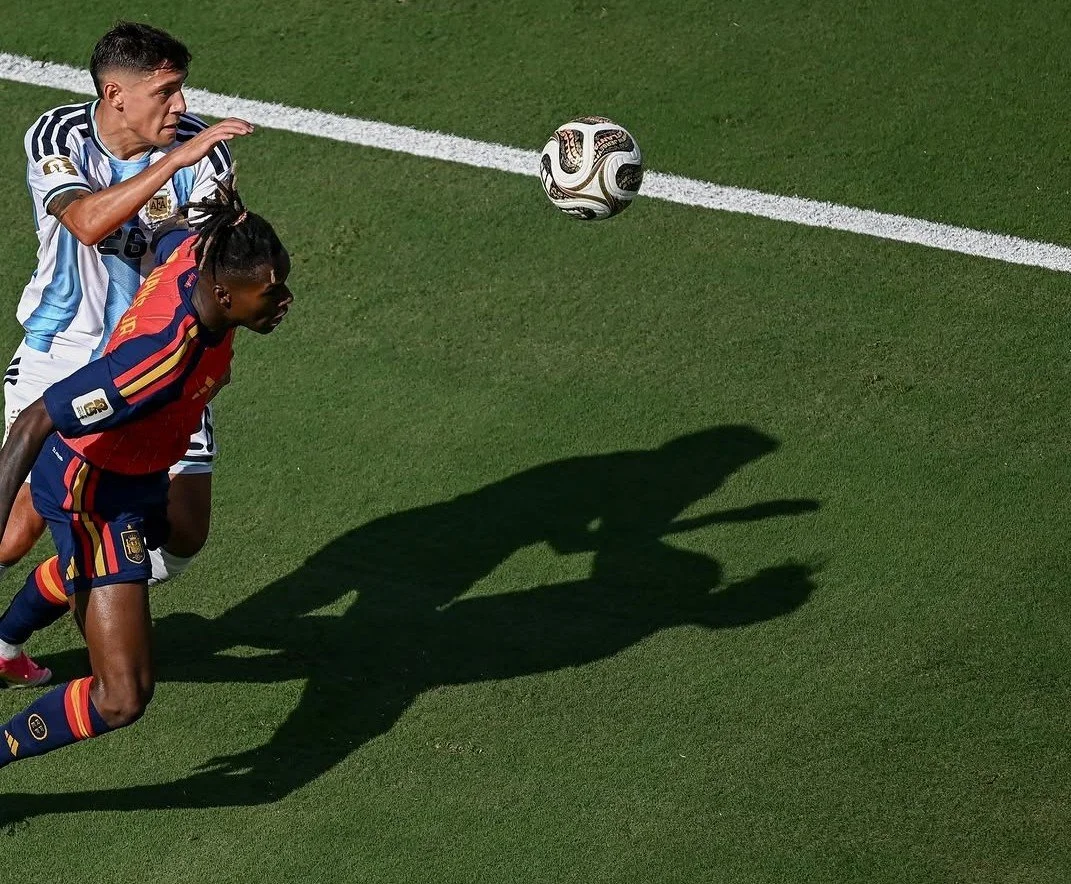
Argentina’s Nahuel Molina battled to keep out attackers including Spain’s Nico Williams (Photo credit: Waleed Zein)
Long Shots Are Challenging Compact Defences
As teams retreat into compact defensive structures, breaking them down has become increasingly difficult.
One solution is to shoot.
The tournament featured a noticeable rise in attempts from distance with goals scored from outside of the box at 16%, up from 8% at the 2022 edition, with Enzo Fernández's strike against England illustrating how quickly a low block can be punished. Long-range efforts are no longer acts of desperation; they have become tactical provocations.
If defenders continue to hold their shape, they risk conceding from distance. Step out to close the shooter, however, and passing lanes begin to emerge behind them.
Against organised defences, the shot itself has become another means of creating space.
The Front Two Has Returned. Without Two Strikers
The high press also continues to evolve.
Rather than relying on a lone striker, more teams pressed with a front two, often pairing a centre-forward with an advanced midfielder operating in the No. 10 role.
Wenger highlighted Martin Ødegaard’s role within Norway’s pressing structure during the TSG analysis, while Jude Bellingham fulfilled a similar function for England, stepping out of midfield to join Harry Kane and screen passes into the pivot.
Bellingham notched seven goals and an assist at World Cup 2026, while answering many of the pre-tournament doubts surrounding his performances.
In a similar vein, Ødegaard translated his connective role from Arsenal to the global stage, filling half-spaces and creating havoc for opposing defensive midfielders.
The result is not always immediate possession. Just as often, the reward is a hurried clearance, a misplaced pass or a disrupted build-up that shifts momentum.
As clubs continue searching for marginal gains without exposing themselves defensively, coordinated front-two pressing is likely to become even more commonplace.
The Game Belongs to Explosive Athletes
Transition football rewards acceleration because the decisive advantage is often created over the first five metres rather than the next fifty.
Technical quality remains indispensable, but the World Cup reinforced the growing importance of explosive movement.
Arsène Wenger highlighted the physical gap separating some Asian nations from the tournament's leading sides, pointing specifically to acceleration and repeated high-intensity actions rather than outright sprint speed.
There was one key exception to this - Australia. Tony Popovic built his Socceroos squad around speed and transition and this resulted in Jordan Bos, Mohammed Toure and Nestory Irankunda all recording speeds over 35 km/h, ranked among the tournament’s 30 fastest players. However, none of the AFC teams progressed beyond the Round of 32.
Transitions increasingly hinge on players capable of covering ground in an instant.
The ability to burst beyond defenders or recover possession within seconds has become one of football's most valuable attributes.
In a game increasingly decided between moments of possession rather than during them, acceleration is becoming as influential as passing range or technical skill.
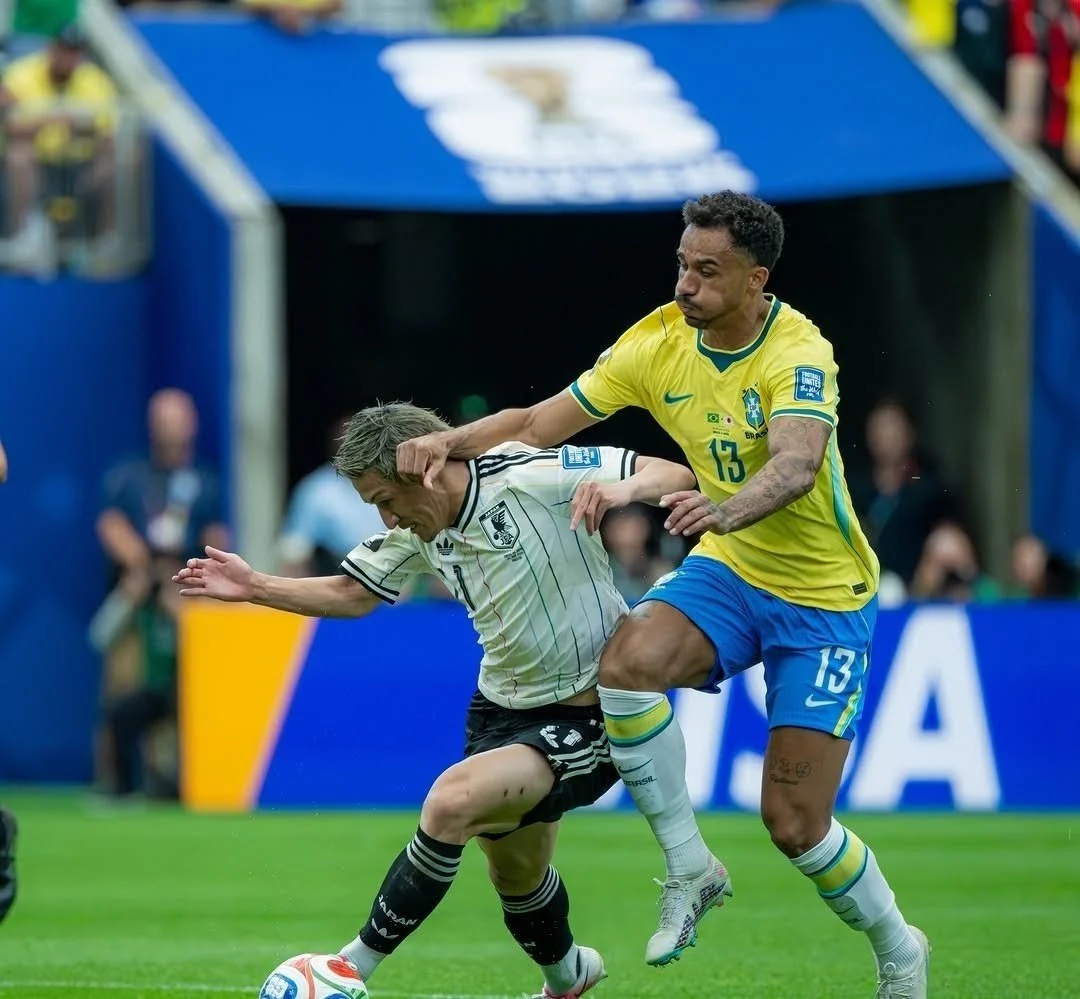
Despite his own individual speed, Daizen Maeda and Japan were unable to outlast Brazil in the Round of 32. (Photo: credit: Mohammed Al-Musaed)
Goalkeepers Are Adapting to Faster Football
Even goalkeeping reflected the sport's changing tempo.
FIFA’s TSG observed an increase in punches from crosses, while goalkeepers also relied more frequently on X-blocks in one-on-one situations, up 8% from Qatar 2022.
One of the defining moments of the 2022 World Cup Final came when Emiliano Martínez threw himself into a spider-like X block to deny Randal Kolo Muani with the final attack of extra time.
Four years later, the TSG recorded an 8% increase in the use of X-blocks, reflecting how goalkeepers are adapting to faster transitions and more frequent one-on-one situations.
Both trends reflect the same reality.
Attacks are unfolding more quickly, crosses are delivered with greater pace and forwards are arriving in dangerous areas sooner.
Goalkeepers are increasingly sacrificing possession security for speed of intervention. A punch may concede a second phase, but it also prevents the delay involved in claiming the ball cleanly.
As transitions continue to accelerate, decision-making inside the penalty area becomes just as important as shot-stopping itself.
Football is Becoming More Selective, Not Less Ambitious
Taken individually, each trend tells part of the story. Together, they reveal a broader tactical evolution.
Elite teams are becoming more comfortable defending deep, more willing to attack directly and more reliant on explosive athleticism to exploit moments of transition. Possession remains important, but increasingly as a means rather than an end. The World Cup did not signal the death of possession football.
It suggested something more nuanced. Control is no longer measured by how long a team has the ball.
Increasingly, it is measured by what they do in the seconds immediately after they win it.
Sources:
FIFA Training Centre, “Expanded 48-team FIFA World Cup ‘a great success,’ says Arsène Wenger”, 18 July 2026
Arsène Wenger, Chief FIFA Technical Study Group, press conference, 18 July 2026
FIFA Training Centre , “Technical Study Group hails competitive 48-team FIFA World Cup™ as goals and intensity rise”, 29 June 2026
FIFA Training Centre, France 0 Spain 2 - POST MATCH SUMMARY REPORT, 14 July 2026
FIFA Training Centre, England 1 Argentina 2 - POST MATCH SUMMARY REPORT, 15 July 2026
FIFA Training Centre, Spain 1 Argentina 0 - POST MATCH SUMMARY REPORT, 19 July 2026
FIFA Training Centre, “Jude Bellingham: The heartbeat of England’s attack”, 15 July 2026
FIFA Training Centre, “Martin Ødegaard’s free role within Norway’s tactical setup”, 3 July 2026
FIFA Training Centre, “Spain v. Argentina: A tactical preview ahead of the final showdown”, 17 July 2026
FIFA Training Centre, “Speed and aggression: The foundations of France’s unique rest defence”, 12 July 2026
FIFA, FIFA World Cup 2026: Player Statistics, 20 July 2026
FIFA, FIFA World Cup 2026: Team Statistics, 20 July 2026
Photo Credits:
Trionda, Adrian Jones/Rose Sports Media, 2 June 2026- Photo courtesy of Adrian Jones
Maeda and Danilo, Mohammed Al-Musaed, 29 June 2026 - Photo courtesy of Mohammed Al-Musaed
Molina and Williams, Waleed Zein, 19 July 2026 - Photo courtesy of Waleed Zein
All photos are used with permission. All rights reserved to the creator.

Support PSP Media
Every contribution helps support independent research and reporting