
By Nii Wallace-Bruce | Research Assistance by Juan Ramos
Canada and Panama will meet twice before the end of March.
The first encounter comes in women's football, with a place at the 2027 FIFA Women's World Cup on the line.
The second will take place at SoFi Stadium, where their men's national teams will contest a place in the Concacaf Nations League final.
The players will be different. So will the histories, expectations and immediate stakes.
But the two meetings offer a revealing moment to examine the changing relationship between two countries increasingly intent on challenging Concacaf's established order.
Saturday's quarter-final in Mansfield, Texas is the immediate concern. Victory guarantees a place at next year's Women's World Cup and brings the Olympic qualification picture into sharper focus.
For Canada, it is another opportunity to demonstrate the strength of a programme that has spent years trying to turn its considerable resources into sustained international success.
For Panama, it is a chance to show that its advancement is no longer confined to qualification campaigns or occasional moments of regional disruption.
The significance extends beyond the women's game. When the men's teams meet in March, both countries will have another chance to challenge the traditional regional powers.
Two competitions, four national teams and a shared question: how far can Canada and Panama move the boundaries of what Concacaf has traditionally expected of them?
In different ways, both countries have been shaped by movement and access. Yet their footballing journeys increasingly intersect.
The First Examination
For Canada, Saturday offers an immediate opportunity to turn its standing in the region into tangible progress.
The women's programme has spent years navigating the difficult relationship between international expectations and domestic development.
Canada’s last competitive outing came at the Paris Olympics, shrouded in the drone-spying controversy.
Casey Stoney's task is to bring those resources, experiences and individual qualities together in a national team capable of delivering when the margins become smaller.
October’s two friendlies against Denmark offered encouraging signs, particularly through the emergence of Arsenal’s Olivia Smith, DB Pridham, and Kaylee Hunter.
In October, PSP Media asked Stoney what Smith needed for her development. The answer was simple: minutes. Since then, Smith has been more involved at club level, operating centrally as well as from the wing.
Smith's ability to attract multiple defenders creates opportunities elsewhere. It can open central channels for Pridham and Hunter, while allowing Canada's full-backs to move into more advanced or inverted positions. The challenge for Stoney is ensuring that these individual qualities translate into a more varied attacking structure, particularly against opponents prepared to defend deep.
The Northern Super League’s arrival has added another dimension to that conversation, creating a domestic environment in which players can develop, compete and build professional careers without having to leave home. Five members of the current squad – Alidou, D’Angelo, Hunter, Pridham and Zadorsky – have connections to Canada's new professional competition.
Its significance is not that it replaces the established European and American pathways, but that it creates another route into the national team.
The Denmark fixtures also exposed a vulnerability that Panama will have every incentive to investigate.
Canada's willingness to defend high creates opportunities behind the full-backs and between the defensive line and goalkeeper.
Against an opponent comfortable defending deeper and attacking quickly into space, that aggression can become a liability.
Riley Cohn's ability to receive, turn and carry the ball into those spaces makes her an important player to watch.
Texi Smith, who covers Sydney FC, recently remarked that Cohn’s attacking threat also comes with some gamesmanship at times.
Panama, meanwhile, represents a different kind of examination.
Its development in women's football deserves attention in its own right, particularly as the country seeks to narrow the distance between its established regional rivals and its own ambitions.
Toña Is’ side enters Saturday knowing exactly what is in front of them.
In 2022, Canada and Panama faced each other in qualifying for the 2023 World Cup.
For long periods, Las Canaleras sat in a low block and it took a strike from Julia Grosso in the 64th minute to secure victory and a place at the tournament in Australia and New Zealand.
Yenith Bailey was in goal that day and will likely be between the posts once again in Mansfield. This time around, Grosso is also expected to feature.
While she won’t have Christine Sinclair in front of her, Canada’s new generation of Smith, Pridham, Hunter and Annabelle Chukwu will be ready to take the opportunities given.
Canada's emerging attacking generation offers different solutions to a problem that has frustrated the programme in previous years.
Smith provides individual creativity and the ability to disrupt defensive structures, while Pridham, Hunter and Chukwu offer different movement and attacking profiles.
The question is whether Canada can combine those qualities to create opportunities centrally, rather than becoming predictable in its attempts to break down a compact defensive block.
Panama missed out on match practice in October’s international window. Home friendlies against New Zealand’s Football Ferns were cancelled due to a devastating earthquake in the country.
Nevertheless, Las Canaleras last played in June 2026, not conceding to Jamaica over two matches, while pressing their opponent.
On Saturday, it can be expected that the team will defend compactly and look to exploit transitions against a stronger opponent.
Panama's development should not be understood solely through its ability to frustrate stronger opponents.
Its qualification for the 2023 World Cup changed the expectations surrounding the programme, while its subsequent regional performances have provided a foundation for further growth.
The presence of experienced players such as Yenith Bailey alongside attacking talents such as Riley Cohn reflects a programme attempting to build continuity rather than relying on a single generation.
Saturday offers an opportunity to demonstrate that this progress can translate into results against one of the region's established powers.
For Canada, the World Cup qualification opportunity is immediate. The Olympic implications make the occasion even more significant.
For Panama, the chance is to challenge a regional order that has rarely offered smaller footballing nations an easy route forward.
The losing quarter-finalists will have another opportunity to reach Brazil through the December 2 play-in.
The winners of those matches will advance to the FIFA inter-confederation play-off tournament, where two further World Cup places will be available. Winning a single-elimination quarter-final seems more palatable.
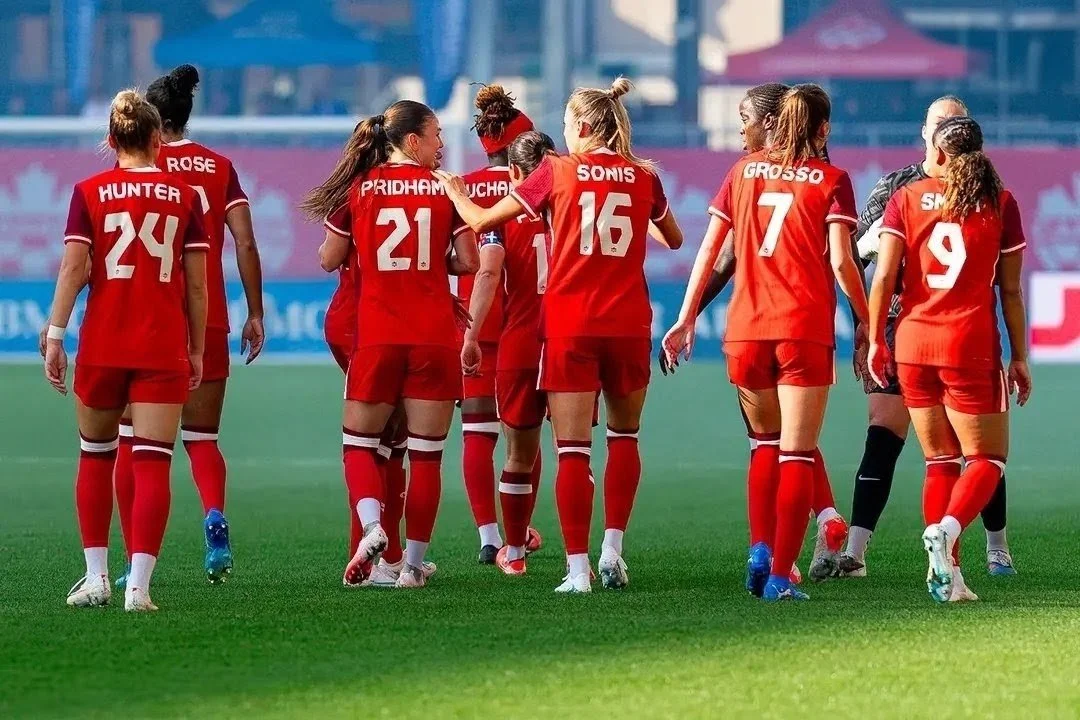
The current CanWNT is a mix of experience and new talent (Photo credit: Marc Eymé)
March Brings Another Meeting
The men's encounter will provide a fascinating continuation of the same relationship, although the regional landscape into which Canada and Panama will meet is considerably different from the one that existed only a few years ago.
Canada and Panama will meet on March 25 at SoFi Stadium in the Concacaf Nations League semi-finals.
Their respective quarter-final performances have earned them places among the competition's final four, with a meeting between two increasingly competitive regional sides offering the possibility of another major step forward.
But the wider context is important.
The traditional Concacaf hierarchy is experiencing pressure from several directions.
Mauricio Pochettino's departure from the United States national team, following the 2026 World Cup, leaves the federation searching for a successor as it begins another World Cup cycle.
Mexico, meanwhile, has entered a new phase under Rafael Márquez, who inherits a programme with considerable expectations but must now establish his own identity as head coach.
Beyond the traditional powers, the Caribbean is becoming increasingly difficult to overlook.
Haiti, Curaçao and Jamaica have arrived at this point through different footballing histories and development models, but their growing competitiveness is challenging assumptions about where Concacaf's next generation of international contenders will emerge.
Haiti and Curaçao qualified for the 2026 World Cup, while Jamaica came close to joining them, losing to DR Congo in extra-time in inter-confederation play-offs.
Their performances in the 2026/27 Nations League have reinforced that advancement, when they pushed Mexico all the way before bowing out of the quarter-finals on away goals.
In the September and October international window, Caribbean nations recorded nine victories in 16 meetings with Central American opponents.
The implications extend beyond individual results.
For years, the regional conversation was largely organised around the United States and Mexico, with Panama, Costa Rica and Honduras representing the most established Central American challengers.
That understanding is becoming increasingly difficult to sustain.
Canada and Panama occupy an interesting position within this changing landscape.
Both have developed into consistent competitors at the latter stages of regional tournaments, but neither can afford to assume that the opportunities available to them will remain exclusive.
For Canada, the Nations League represents another chance to demonstrate that its growing player pool and international experience can translate into regional silverware.
Panama, having established itself as Central America's leading men's programme, will want to show that its progress can extend beyond qualification campaigns and individual tournament performances.
The other semi-final, between the United States and Mexico, provides an appropriate backdrop. These remain two of the region's most influential footballing institutions, but their circumstances are changing too.
The March encounter will not be a simple repeat of Saturday's circumstances. The men's teams have different histories, personnel and competitive realities.
Yet the underlying question remains remarkably similar: how does a nation translate its resources, identity and footballing development into results against opponents with comparable ambitions?
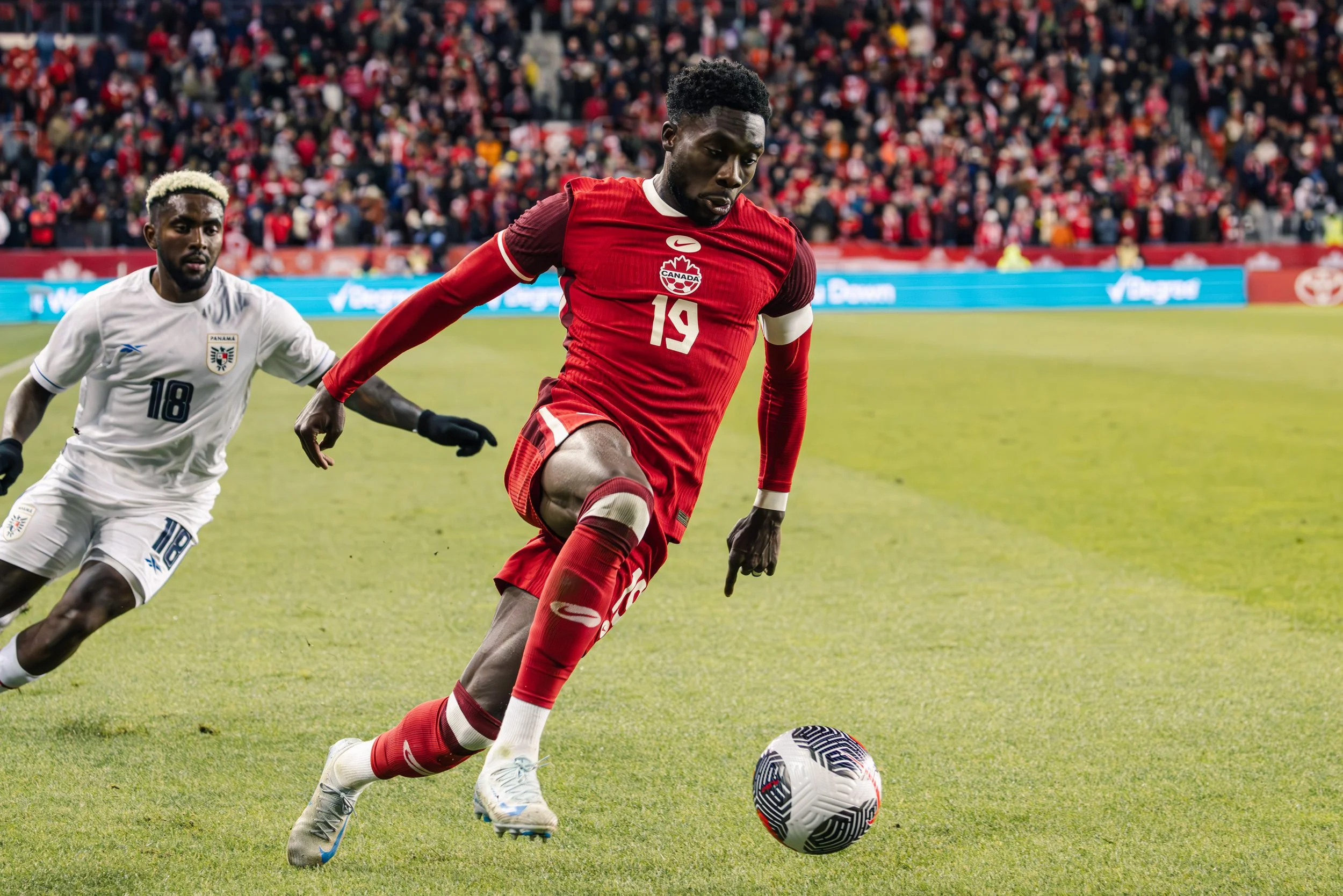
The CanMNT will be hoping to have Alphonso Davies fit and available for their next match against Panama (Photo credit: Curtis Wong)
A Regional Balance in Motion
Concacaf has traditionally been understood through the influence of the United States and Mexico. Their resources, histories and commercial reach have shaped the region's competitive identity.
But footballing hierarchies are not permanent.
Canada's growing international player pool and Panama's increasingly competitive national programmes suggest that the regional conversation is becoming more complicated.
Saturday's quarter-final will offer the first examination. March will provide another, this time through the men's game.
The teams will be different, but the question will remain remarkably similar: are Canada and Panama simply becoming more competitive participants in Concacaf, or are they beginning to change who gets to define the region?
Two meetings will not settle that question. They might, however, tell us considerably more about where the answer lies.
Sources:
Texi Smith, “Brimful of Asha as Sydney dive”, 18 October 2026
Casey Stoney, Canada head coach, press conference, 12 October 2026
Julia Grosso, Canada player, media scrum, 12 October 2026
Video Credits:
Riley Cohn goal v Adelaide, Ninja A-League, 18 October 2026 - Video courtesy of Ninja A-League on X
Photo Credits:
Corner placement, Marc Eymé, 12 October 2026 - Photo courtesy of assignment by PSP Media
CanWNT walking back, Marc Eymé, 12 October2026 - Photo courtesy of assignment by PSP Media
Alphonso Davies v Panama, Curtis Wong, 15 October 2025 - Photo courtesy of assignment by PSP Media
All photos are used with permission. All rights reserved to the creator.

Support PSP Media
Every contribution helps support independent research and reporting.