
A League in the Regional Neighbourhood
By Nii Wallace-Bruce
Canada’s professional women’s league is beginning to give new infrastructure to a football region whose players, cultures and identities have been restricted by borders
A Career Without a Straight Line
Jasmine Vilgrain's football journey does not fit neatly inside a border.
She grew up in Toronto, developed through Canada's system, built a professional career in France, chose Haiti at senior international level and, this year, returned home to play professionally for AFC Toronto. Her route has crossed two continents and several football cultures.
It also offers a useful way of understanding what the Northern Super League is becoming.
For generations of ambitious Canadian women footballers, the road to professionalism usually led outward. The NSL has not changed that reality completely.
What it has changed is what happens when a player comes back. It does not close the borders.
For CONCACAF football nations, that distinction could matter.
Canada is home to large Caribbean communities, a deep pool of players with dual nationality and an increasingly professional football environment.
Its new domestic league cannot replace the work that must be done in Haiti, Jamaica, Trinidad and Tobago or elsewhere across the region.
But it can add another layer to a football ecosystem that is already connected by migration, family, identity and international football.
“Canada can be an important bridge for Caribbean football,” Vilgrain told PSP Media.
The bridge was there before the NSL. The league gives it another road. As Vilgrain puts it, “There is no single pathway.”
One only needs to walk along the concourse at an AFC Toronto game to hear Tribal Rhythm Nation’s African and Caribbean rhythms, a reflection of the city’s wider cultural landscape. Their sound creates a festive atmosphere that often lifts the mood regardless of the result on the pitch.
The club also had a Caribbean themed match day in the summer to coincide with the city’s Caribana festival.
The Caribbean cultural influence in Canada is significant and that extends to the football culture.
That means the same league can contain players who were developed in Canada, players returning from Europe or the United States, and internationals representing CONCACAF countries.
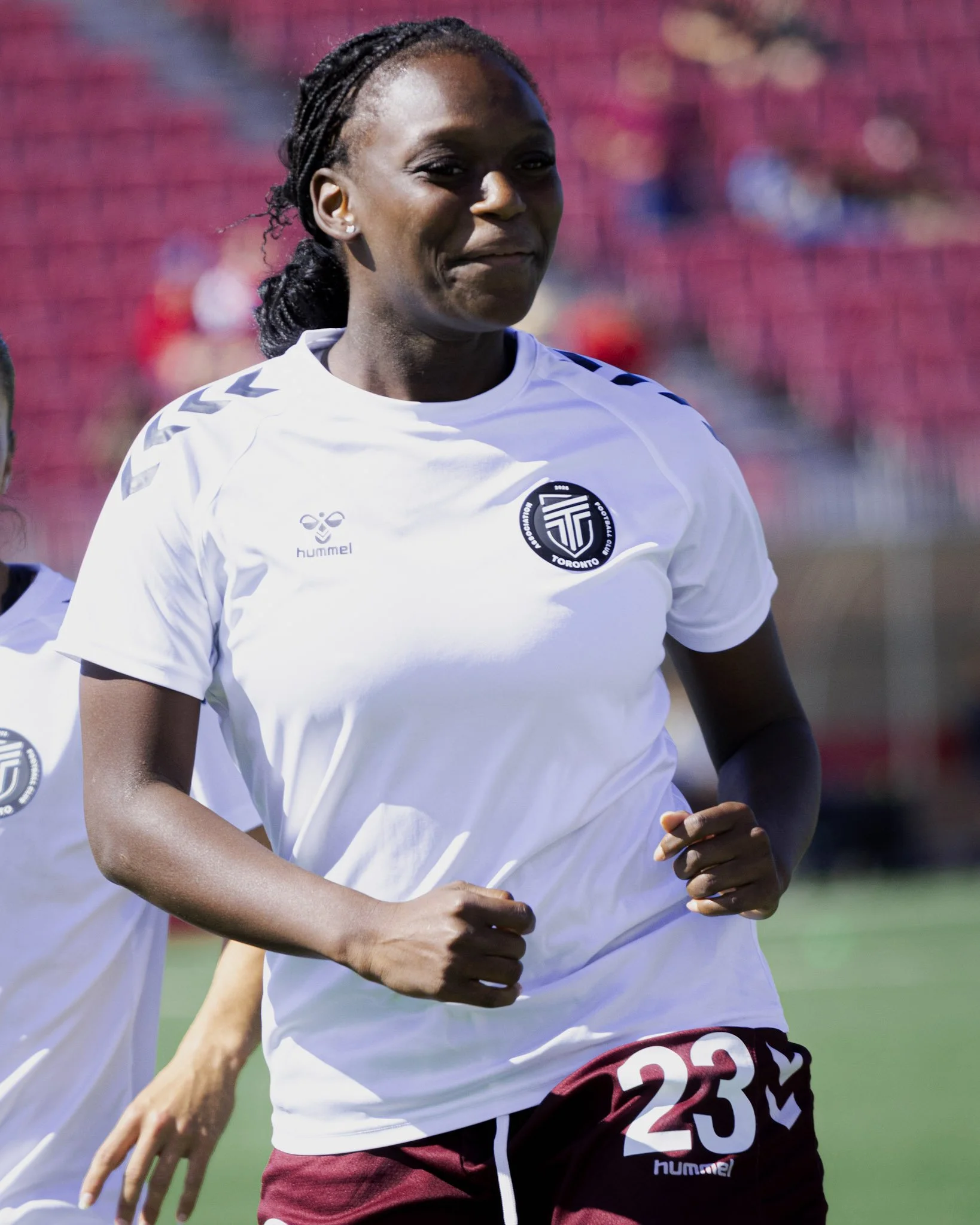
(Photo Credit: Zion Lawe)
Coming Home
Jasmine Vilgrain’s Haitian national team teammate has suddenly become her club rival, thanks to the NSL.
Amandine Pierre-Louis grew up in Montréal and like Vilgrain, had to leave Canada to become a professional. Now she can be a professional in Montréal with the Roses.
For her, having a league on home soil is impactful beyond the field of play.
“Back in my younger days I had to look online or watch men play for me to even dream about achieving this dream of mine”, she told PSP Media.
In the same way that Christine Sinclair’s initial childhood dream was to be a Toronto Blue Jay, due to limited visibility of women’s sports, Pierre-Louis also had her horizons narrowed when she was growing up.
Nowadays, with the NSL available on cable, linear and streaming platforms, young girls across Canada and beyond can see what is possible and be inspired to take up football.
For the Haitian community, there is an added layer this season.
At club level, Pierre-Louis and Vilgrain are in a head-to-head battle with their respective teams as the Montréal Roses and AFC Toronto chase the Supporters Shield.
At a national level, Les Grenadières will be aiming to build on their 2023 World Cup debut with qualification for 2027 via the CONCACAF W tournament in Houston.
The 2026 CONCACAF W Championship has eight teams. A quarter-final with Mexico awaits Haiti.
The four quarter-final winners automatically qualify for Brazil 2027, while the four losers enter a play-in for two places in the FIFA World Cup qualifying play-off tournament. The tournament also determines CONCACAF's Olympic places for competition in 2028 in Los Angeles.
Pierre-Louis says Montréal's Haitian community makes representing that culture a privilege.
A club in Montréal is operating inside a city with a substantial Haitian community.
A club in Halifax can sign a Jamaican international.
Players can train together in Canada and then disperse into CONCACAF national teams.
A League That Travels With Its Players
Jamaican international Tiffany Cameron was part of the inaugural Halifax Tides squad in 2025.
In 2026, Cameron was joined by her Reggae Girlz and now club teammate, Naya Cardoza.
Further, the Reggae Girlz are represented across the country through recently capped Nikki Small (after a one-time switch from Canada) at AFC Toronto and new signing Chantelle Swaby at Vancouver Rise.
“It’s exciting to see that more Jamaican national team players have gradually joined the league”, she told PSP Media. That’s regional integration in human terms.
After the club won its first ever Canadian Championship match over Vancouver, AFC Toronto captain Nikki Small told PSP Media that her tenacity to make tackles and win possession represents her leadership by example. Canada developed her. The NSL gave her a professional home. Jamaica then became the international destination.
Chantelle Swaby is currently the most capped Jamaican player in Reggae Girlz history.
Interim Vancouver Rise head coach Iain Darbyshire told PSP Media about the calmness and physicality that she has added to a Rise defense that had conceded 47 goals in the league at the end of September.
Despite her arrival at the end of the transfer window in August, Darbyshire was complimentary about the addition of Swaby’s experience to the squad.
That experience flows into the international scene.
For Jamaica, they will be seeking to reach Brazil 2027, which would be their third World Cup appearance.
They reached the round of 16 at the 2023 tournament in spite of administrative challenges. A playoff at the CONCACAF W tournament awaits against Costa Rica.
If Jamaica's joint bid to host the 2031 FIFA World Cup with the United States, Mexico and Costa Rica is ultimately successful, the 2026 cycle could be the last World Cup qualifying campaign the Reggae Girlz play for several years.
The next five years could be transformative for the region and those playing within it.
Naya Cardoza represents the present and future of Jamaican football. Making her international debut in 2024, she understands her role as a dual national.
“Canada raised me, but I’m always carrying my Jamaican roots with me”, she told PSP Media.
Like others in the league, Cardoza is a simultaneously Canadian-developed footballer and an international that represents another nation in the region.

(Photo Credit: Northern Super League)
Different Football Educations
Jamaica’s national motto is “Out of many, one people”. That diversity extends to the national team.
“Having a diverse makeup of experiences within a united team is only going to strengthen Jamaica”, Cardoza said.
Small's Toronto experience, Cameron & Cardoza's work in Halifax, and Swaby's arrival in Vancouver expose Jamaica's players to different demands within the same professional league. Different leagues expose players to different tactical environments. National teams gather those experiences together.
So the NSL isn't just supplying Jamaica with players.
It is potentially supplying Jamaica with players carrying another football education into camp.

(Photo Credit: Faiz Ahmad)
The Limits of a Bridge
While experience and education is important for development, Stephen Hart brings a level of caution. As he sees it, football is no different than any other education system.
“Experience cannot be coached, the environment plays such an important role”, he told PSP Media.
Hart is the head coach of the Halifax Tides.
He became the inaugural head coach for the club after previously managing the men’s national teams of Canada and Trinidad & Tobago as well as the Halifax Wanderers in the Canadian Premier League.
While the NSL's value to Caribbean football is being demonstrated in national team call-ups, he believes that the region must also take ownership for the development of its players. “The Caribbean cannot depend on other countries to create an environment for their benefit”, he said. The purpose of the NSL was to create opportunity.
However, it cannot be seen as a standalone solution for other nations in the region.
When it comes to the development of national teams, competition is key.
As Hart sees it, raw talent alone does not foster an environment that transfers to a successful national team program.
Such talent is refined through competition for call-ups, competition for the starting XI, and competition against different opponents.
Further, the ongoing preparation, recovery, travel and standards in a professional environment enhance players, benefitting their national teams.
The lessons learned week-to-week are transferable to a tournament or friendly camp environment, even if the tactics may be different.
In modern football, there is not enough time for international coaches to develop players in short windows.
The experiences of Christine Sinclair and the Canadian U19 side of 2002, where they trained together for almost a year before the inaugural FIFA U19 World Cup, are an extreme exception not the norm.
Progression and refinement must therefore come from a professional environment.
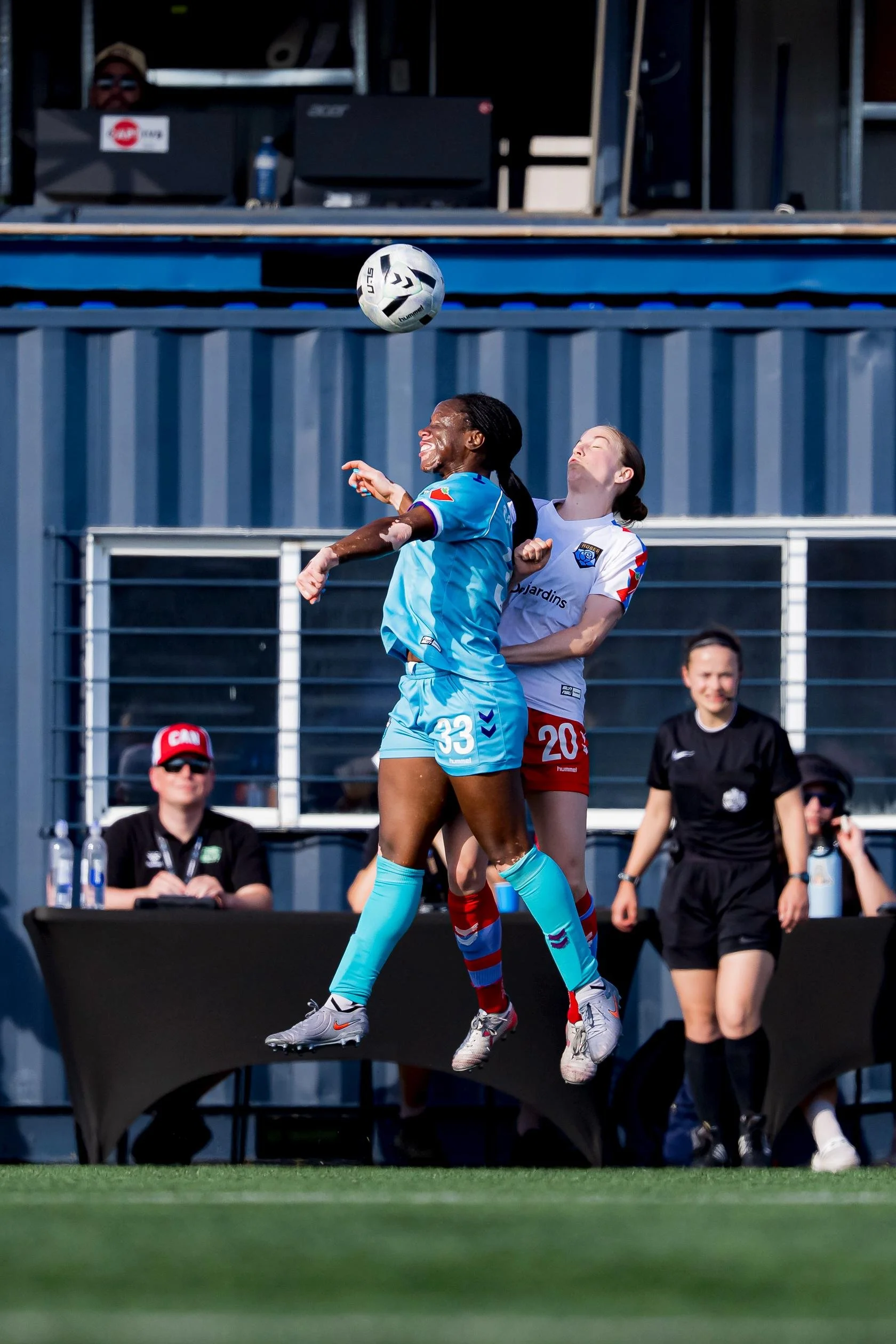
(Photo Credit: Northern Super League)
A Professional Home In the Neighbourhood
The league’s relationship with CONCACAF is therefore different from the relationship it is beginning to build with football beyond the confederation.
In Asia, Africa and Oceania, the question is how far a Canadian league can reach.
Closer to home, CONCACAF is already a region of movement: players move between countries, families span borders, national-team eligibility crosses generations and footballers carry one country’s football education into another’s shirt.
The NSL has arrived inside that existing network. A young person in Canada can access the league and see what is possible as a professional player.
Then, a professional player can see what it takes to be called up for their country. All of this taking place without having to leave home.
The Pathways are Becoming Less Linear
For Vilgrain, that is ultimately what the new pathway can offer.
“They do not have to choose between their different identities and that both can be part of their journey”, she said.
A young Haitian-Canadian player can develop in Canada, leave for Europe, represent Haiti and return home to play professionally.
Another can grow up in Montréal and carry Haiti into an international career.
A Jamaican international can arrive in Halifax and find a league in which other players from the region are beginning to follow.
The borders remain. The identities remain. So do the differences in football development across the region. But the pathways are becoming less linear.
That may be the NSL’s most interesting place in CONCACAF: not as a substitute for the leagues and development systems that already exist, and certainly not as a centre around which the rest of the region should revolve, but as another piece of professional infrastructure in a region whose football has always travelled.
The NSL is still young. Its long-term influence on the confederation is impossible to know. But the direction is visible.
Canada is no longer only a place players leave to pursue the professional game.
Increasingly, it can be a place they return to, pass through, develop in, represent, and carry with them — back into the neighbourhood.
Sources:
Video Credits:
Photo Credits:
All photos are used with permission. All rights reserved to the creator.

Support PSP Media
Every contribution helps support independent research and reporting.