
The Next Chapter of Canada's Attack: Hunter, Pridham and Life After Sinclair
By Nii Wallace-Bruce
Kaylee Hunter and DB Pridham offer a glimpse of Canada's next attacking generation, but their emergence raises a larger question: how can individual promise become a collective strength?
Delaney Baie Pridham’s journey to her first international goal included obstacles and recoveries. The moment was challenged by a stubborn Denmark backline. The goal was scrappy, the finish instinctive.
Kaylee Hunter sent a header back across the penalty area, Pridham turned with her back to goal and struck.
For a moment, amid the disappointment of Canada's 4-3 defeat to Denmark, two forwards offered a glimpse of what might come next.
For Pridham, it was a landmark. For Hunter, another step into senior international football. For Canada, a glimpse of an attacking partnership still taking shape.
“I've had a long journey to get here,” Pridham told reporters afterwards, wiping away tears as her emotions took over. She took a moment to reflect on scoring her first goal for the national team in front of her family. “To be able to play in front of my family and represent my family and my country is truly an honour.” DB Pridham’s path to her first international goal, like the goal itself, was not straightforward.
She had to overcome major injuries during her career to get into the CanWNT conversation.
Then, after winning the inaugural Northern Super League Golden Boot in 2025, Pridham endured the heartbreak of missing out on Canada’s tour of Japan, due to issues relating to her passport.
It was another setback that would test her resilience. The 2026 regular season was not without adversity either as Pridham worked her way back from injury just in time to be called up for the October window.
Pridham called the goal “the gate opener for many more to come”.
The sentiment was personal, but the possibility extended beyond one player's milestone.
As Canada moves into a future without Christine Sinclair, the question is no longer whether another forward can reproduce the career of the country's greatest goalscorer.
It is whether a new generation can develop the connections, variety and collective responsibility required to shape an attack of its own.
Sinclair's retirement from professional football closed a chapter defined by extraordinary longevity and an ability to shoulder responsibility across generations.
Her successor cannot simply be identified by finding the next prolific striker. The demands of the position, and of the team around it, have changed.
Hunter and Pridham's combination against Denmark was brief, but it illustrated something Canada will need more of: different players recognising the same moment and making it count.
Each individual offers two different starting points.
Hunter is still learning the speed and demands of international football. Pridham has taken a longer route to the national team, with the chance to establish herself at the highest level carrying particular significance. Their routes to the national team reflect different stages in Canadian women's football.
Pridham had to build her professional career away from home; Hunter belongs to a generation with the opportunity to begin that journey in the NSL.
Hunter’s club coach, Marko Milanović pointed out that September and October of 2026 have seen her play three different roles.
In Poland, she was part of an attacking tandem with Annabelle Chukwu as Canada’s U-20 side reached the quarter finals of the World Cup.
At home, she has been the focal point of the attack for AFC Toronto, carrying much of the scoring responsibility in the absence of Esther Okoronkwo.
For Canada’s senior team, she was playing a wide role alongside Pridham and Arsenal’s Olivia Smith.
At 18, Hunter has already had to adapt to three distinct attacking roles.
Pridham was quick to credit Hunter's contribution. “It was a scrappy goal, amazing header back, I think it was from Kaylee,” she said. “I was just ready, back to goal, turned and just hit it in.”
The finish required little time for deliberation. A striker's work often comes down to such moments: anticipating where the ball will fall, creating a fraction of space and acting before the defence can recover.
But the goal also depended on the delivery that preceded it, a reminder that attacking production is rarely the work of one player alone. Pridham believes those relationships are developing.
“I think it's growing, along with the rest of my teammates, that the connection is building and building,” she told reporters. “It's exciting, especially going into hopefully a really big year for us.”
That connection will need time and repetition. A single goal cannot establish an attacking identity, just as one promising performance cannot settle the questions facing a team in transition.
Yet the early signs matter, particularly when Canada's search for attacking solutions is taking place alongside a broader effort to develop the next generation of international players.
Learning the Demands of the Level
Canada's defeat to Denmark offered a useful illustration of the distance between attacking promise and a complete international performance.
Head coach Casey Stoney was encouraged by the team's ability to create chances and score three goals, but she was equally clear about the defensive problems that undermined the result.
Canada conceded four, with Denmark repeatedly finding opportunities to attack in transition. “We are scoring more goals, but we're giving up more opportunities,” Stoney told reporters after the match.
“So that's something I need to take responsibility for.”
Her assessment was not simply about the back line.
It concerned the balance of the team: how Canada attacks, what happens when possession is lost and whether enough players remain in positions to prevent an opponent from turning a promising attacking phase into a dangerous counter. In each of Denmark’s four goals, less than three passes were needed after gaining possession.
“We've gifted them a couple of goals,” Stoney said, while acknowledging Denmark's quality in decisive moments. “But you can't give up four goals and expect to get results.”
More attacking ambition can create more chances, but it can also expose a team if the structure behind the ball is not secure.
The challenge is not merely to find players capable of scoring more goals. It is to build a team that can sustain its attacking threat without making itself vulnerable every time an attack breaks down.
Casey Stoney’s system, which bears some similarities to Jesse Marsch’s CanMNT equivalent, demands pressing and movement out of possession from all outfield players. Part of a solidified national identity.
Forwards including Pridham and Hunter represent the first line of aggression when seeking to win the ball from opponents. In the first half in Toronto, Canada’s press was relentless against a compact Danish unit.
Stoney accepted responsibility for not getting that balance right. She said Canada would review its structure, the partnerships used during the matches and the decisions made in possession.
The intention, she explained, was to learn from difficult situations now rather than face the same problems in more consequential fixtures. Canada’s next fixture will be against Panama in Houston in the CONCACAF W quarter-finals. The winner will progress to the 2027 FIFA World Cup in Brazil.
For Hunter, the Denmark match was also an opportunity to experience the level at which those decisions must be made.
But Stoney also highlighted the demands that come with stepping into senior international football. “I think Kaylee needed to feel those levels tonight and the speed,” Stoney said.
“And the fact you can't wait for the ball. You've got to go and get it and that anticipation piece.”
It was a revealing observation. At international level, technical ability and promise are only part of the equation.
Players must recognise situations earlier, move before opportunities become obvious and execute under pressure against opponents who are quicker to close space.
Stoney nevertheless saw enough to remain optimistic for Hunter’s future. “She's got a really bright future,” she said. “If we don't put her in that today, she doesn't get exposed to it, she doesn't understand it.”
The message was clear: development requires opportunity, but opportunity must also come with the expectation that young players learn from the demands placed upon them.

DB Pridham and Kaylee Hunter - Northern Super League forwards that have connected for their country (Photo credit: Yassine Ziadi)
A Different Kind of Succession
For more than two decades, Sinclair provided Canada with a fixed reference point in attack.
Her goals and longevity made her a central figure in the national team's identity, but her influence also shaped expectations of what a Canadian forward should deliver.
For Kaylee Hunter, Sinclair’s career inspired what was possible for her own journey.
As Christine Sinclair played her final professional game in Vancouver for the Portland Thorns in 2024, Hunter was on the opposing side for the Vancouver Whitecaps Girls Elite in the CONCACAF Champions Cup.
At the time, she told Sportsnet that it was a dream come true to play against her idol. Further, Hunter has previously watched Sinclair’s final national team appearance at BC Place in 2023.
It was at that point that she felt the desire to follow in the footsteps of the player that had shaped her childhood.
The temptation after Sinclair’s departure is to search for a direct replacement. That approach risks overlooking the possibility that Canada's next successful attack may be built differently.
Christine Sinclair holds the all-time record for international goals at 190. That is a near insurmountable task for an incoming striker. However, such production could be replaced in the aggregate over time.
Rather than depend on one player to carry the scoring burden, Canada could develop a more varied frontline, with forwards offering different strengths and learning to complement one another.
The objective would not be to diminish the importance of an outstanding individual, but to ensure that the team's attacking threat does not depend on one player reproducing an exceptional career.
Pridham's enthusiasm for playing alongside Olivia Smith offered another glimpse of that possibility. “She's an unbelievably talented player,” Pridham told reporters.
“She's dominating so much in club, and then also internationally, and it's really fun to play with such a great player.”
For Pridham, the opportunity to play alongside Smith is both an honour and a source of excitement.
For Canada, the wider question is how to turn individual quality into combinations that can trouble opponents in different ways.
Smith's ability to influence games, Hunter's emergence and Pridham's instinct in front of goal need not be competing claims for the same role.
Ivy League champion Annabelle Chukwu’s ability to take up space and finish chances should also not be missed here.
Together, they could become complementary parts of an attack, provided the team develops the movement, timing and understanding to make those relationships effective.
That process is neither automatic nor linear. Players develop at different speeds, opportunities fluctuate and international football leaves little room for extended adjustment.
The defeat to Denmark demonstrated how quickly a match can turn when a team loses its structure.
The goal involving Hunter and Pridham showed, in miniature, how quickly an attack can become dangerous when players recognise the same opportunity.
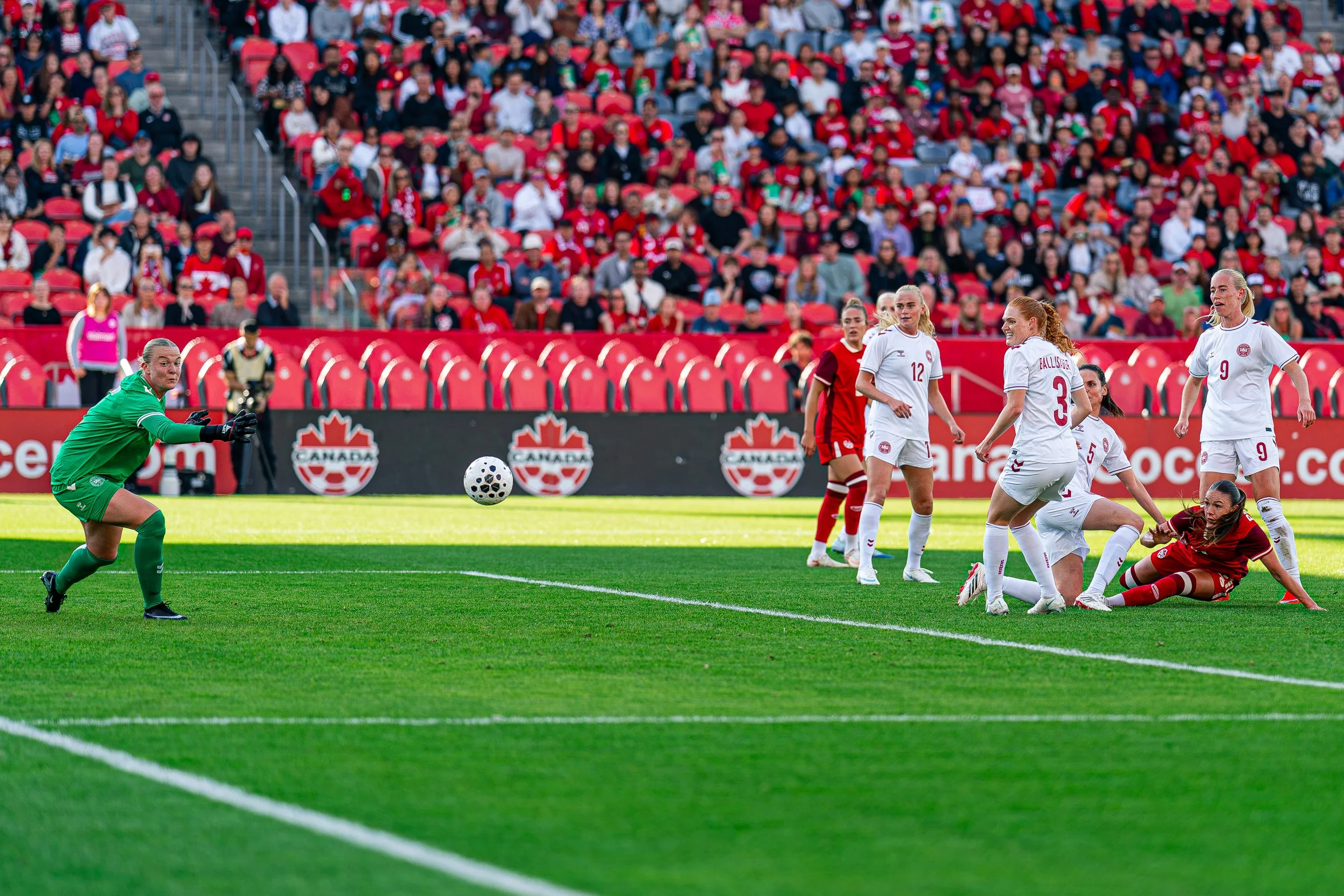
Hunter’s quick header and Pridham’s positioning allowed Canada to break through a robust Danish defense in Toronto (Photo credit: Marc Eyme)
The NSL and the Work Ahead
The Northern Super League provides another part of this story.
A domestic professional environment cannot guarantee that Canada will produce its next great striker, nor can a new competition manufacture international success on demand.
What it can offer is a setting in which Canadian players accumulate professional minutes, test themselves against experienced opponents and develop within a more established domestic game.
Hunter and Pridham represent different points along that path.
Their international connection provides an encouraging image of what might be possible, but the work of turning promise into consistency continues beyond the national-team camp.
Coaching, competition, individual ambition and the ability to translate club performances to the international stage remain essential.
Kaylee Hunter and DB Pridham represent two sides of what the Northern Super League can offer Canadian football.
Hunter belongs to a generation able to begin its professional journey at home, developing within the domestic game before stepping onto the senior international stage.
Pridham's route was different. After building her career away from Canada, she has returned to a domestic environment in which she can continue competing and pursuing her international ambitions.
The league does not need to have created either player's talent to matter.
Its significance lies in providing opportunities at different stages of a career: a starting point for players like Hunter and a place for players like Pridham to return.
As the regular season reaches its climax, both players face another test at club level, with AFC Toronto and Ottawa Rapid pursuing silverware.
Hunter and Pridham could go head to head in the NSL postseason while their respective clubs also have a chance to win the Supporters Shield. International teammates one week, domestic rivals the next.
The league is not just preparing players for Canada; players are also competing for their clubs, with their own ambitions and obligations.
Stoney's comments on Hunter reflected that understanding. Exposure to the level is part of development; the next step is learning to anticipate, make decisions and contribute consistently.
For Pridham, the first international goal was both a reward for a long journey and an invitation to build on it.
Neither player needs to carry the weight of Sinclair's legacy. Their task is to establish their own place within a team that must learn to share the responsibility she carried for so long.
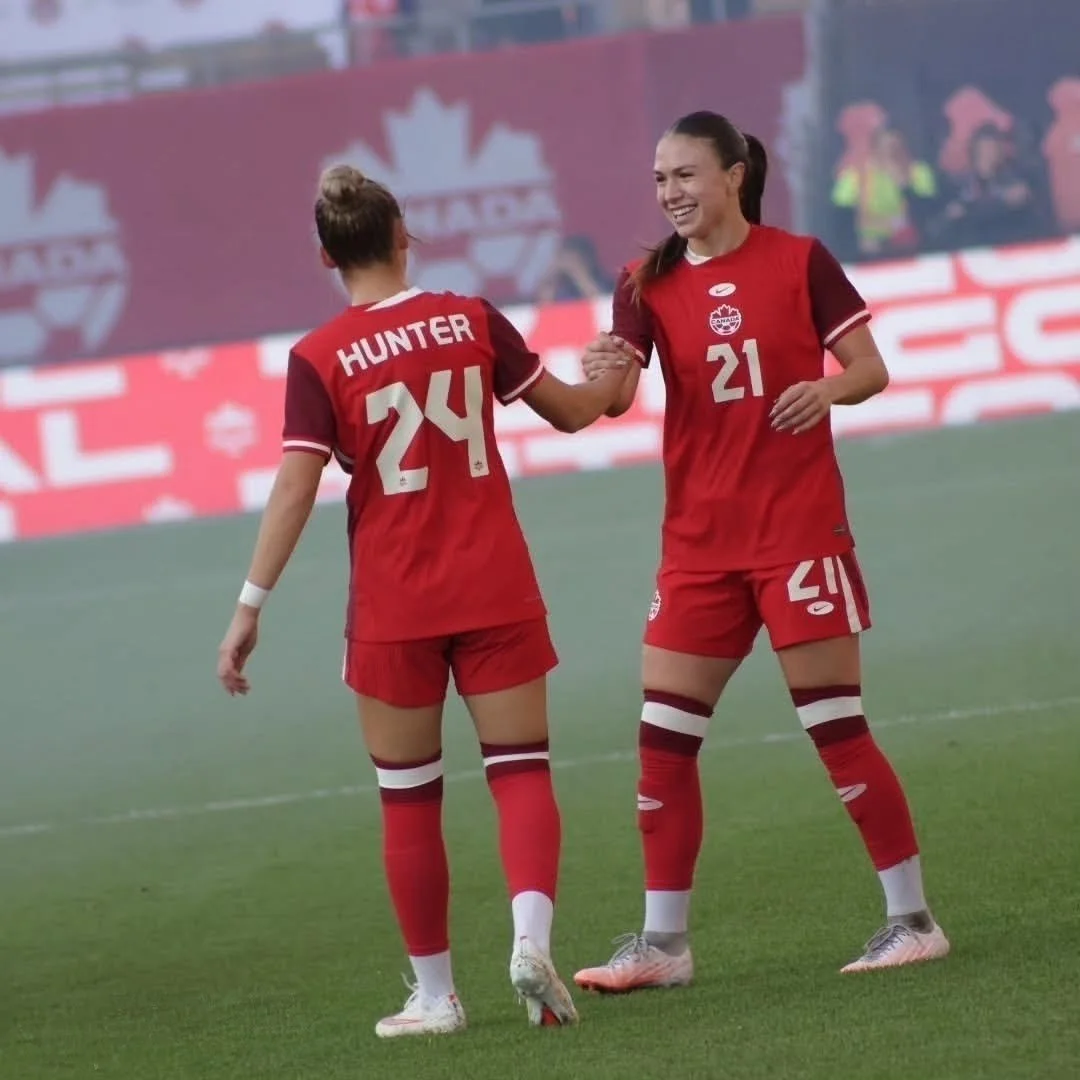
Kaylee Hunter and DB Pridham both achieved their first goal involvements during the October window (Photo credit: Jacob Garland)
Building What Comes Next
Pridham's first goal for Canada arrived in a defeat, a reminder that individual milestones do not always coincide with collective success.
She was proud of the moment, but also acknowledged that the team had lessons to take from the match. That balance between personal progress and collective accountability will define Canada's next phase.
It needs players who can develop their own strengths, understand one another's movements and contribute to an attack capable of adapting to different opponents and different circumstances.
The connection between Hunter and Pridham was only one moment in a difficult international window.
It did not answer the questions surrounding Canada's defensive transitions, its attacking structure or the challenge of replacing the production of a generational player.
But it offered a glimpse of a different future: one in which the next goal might come from a combination rather than a familiar name, and in which responsibility is shared across a generation rather than concentrated in one player.
Sinclair's era gave Canada a defining forward. What follows need not produce another version of her.
It must produce a team capable of finding its own way.
Sources:
Christine Sinclair with Stephen Brunt, “Playing the Long Game: A Memoir”, Vintage Canada, 2023
Canada Soccer, “CANW20 Roster Unveiled for FIFA U-20 Women’s World Cup Poland 2026™”, 20 August 2026
Casey Stoney, Canada Head Coach, press conference, 12 October 2026
Casey Stoney, Canada Head Coach, press conference, 8 October 2026
Marko Milanović, AFC Toronto Head Coach, press conference, 16 October 2026
Michèle Hozer, “The Pitch - Documentary”, TVO and The Cutting Factory, 2025
DB Pridham, Canada player, media scrum, 12 October 2026
Sportsnet, “Soccer legend Christine Sinclair set for final hometown game as Whitecaps host Thorns”, Canadian Press, 14 October 2024
Photo Credits:
Pridham scores against Denmark, Marc Eymé, 12 October 2026 - Photo courtesy of assignment by PSP Media
Hunter and Pridham shake hands, Jacob Garland, 12 October 2026 - Photo courtesy of assignment by PSP Media
Pridham guiding Hunter, Yassine Ziadi, 9 October 2026 - Photo courtesy of assignment by PSP Media
Video Credits:
DB Pridham first goal, Canada Soccer/CanWNT, 12 October 2026 - Video courtesy of @CanWNT via X
All photos are used with permission. All rights reserved to the creator.

Support PSP Media
Every contribution helps support independent research and reporting.