
WAFCON Ends. The Journey to Brazil Does Not.
By Nii Wallace-Bruce
For Evelyn Badu, Linda Owusu-Ansah and Esther Okoronkwo, WAFCON offered three very different journeys.
Together, they reveal just how far the Northern Super League's international reach is beginning to stretch.
There is a temptation, after a major tournament, to reduce everything to who lifted the trophy and who did not.
For Esther Okoronkwo, Evelyn Badu and Linda Owusu-Ansah, that would miss the point. Three players arrived in Morocco carrying very different expectations.
Okoronkwo came back as the forward who had helped Nigeria win the previous WAFCON, but also as a player still rebuilding after an interrupted period.
Badu arrived in the form of her club career, yet began the tournament on the periphery.
Owusu-Ansah was the least established of the three, stepping into a senior Ghana team for the first time.
They leave with three different stories. And, fittingly, none of them ends neatly.
The 2026 WAFCON has already guaranteed four African teams their places at the 2027 Women's World Cup in Brazil: Malawi, Cameroon, Morocco, and Algeria.
The losing quarter-finalists, meanwhile, were playing for two places in FIFA's World Cup Play-Off Tournament, where three final World Cup berths will be decided.
Six teams will enter the first phase in November and December, with the two survivors joining four higher-ranked nations — two from CONCACAF, one from CONMEBOL and one from UEFA — in a final six-team phase in February 2027. Three knockout paths will produce the final three qualifiers for Brazil.
That distinction kept the tournament alive for Ghana and Nigeria even after their quarter-final defeats.
The Super Falcons would fall to South Africa 2-1 in their playoff, with Okoronkwo watching from the bench. The 2027 FIFA World Cup will be the first without Nigeria.
Her last-ditch shot at equalising in the quarter-final against Cameroon proved to be her last act in Morocco. A haunting moment for Super Falcons fans.
Before the tournament, Okoronkwo ranked winning WAFCON above any individual honour.
Hopes of lifting the trophy evaporated on Sunday. Plans for Brazil were cancelled on Thursday.
The Super Falcons will almost certainly have a new coach when 2028 Olympic qualifiers commence in October 2026.
Pressure on Justine Madugu has peaked after this underwhelming result by Nigerian standards. With Nigeria's emerging talent in the final third, including Washington Spirit's Gift Monday, among others, it is fair to wonder what role Okoronkwo will have in the next World Cup cycle. She would be 34 by the time the 2031 tournament arrives.
Ghana secured one of CAF’s playoff routes by beating Côte d'Ivoire 2-1, with Badu and Owusu-Ansah entering from the bench as the Black Queens completed a comeback.
After the match, coach Lars Kim Björkegren talked about Ghana’s fighting spirit, while also highlighting the shift from possession (65%) to controlling the game after halftime. Ghana still have a road to Brazil. It is simply a much longer one.
Their tournament was also accompanied by a dispute that should not be dismissed as background noise.
Ghana's players came together during WAFCON to demand outstanding payments from the Ghana Football Association, including bonuses connected to WAFCON 2025, qualification and the group stage, as well as per diems. It was not the first time the Black Queens had been forced into this position.
In October 2025, they boycotted training ahead of a crucial WAFCON qualifier against Egypt over outstanding bonuses reportedly worth $9,500 per player.
Less than a year later, the issue had resurfaced on the biggest stage available to them.
And the problem extends beyond the women's team. Sports Minister Kofi Adams acknowledged in July that Ghana's national teams — including the Black Stars, Black Queens and youth sides — had outstanding bonuses, although he said the Black Stars had received most of theirs.
The government had released GH¢17 million in June to settle outstanding Black Stars qualification bonuses, while the minister said other national teams were still owed money.
That recurrence is important. This was not simply an unfortunate administrative delay during a major tournament.
It was another instance of players having to make their working conditions part of the public conversation while they were supposed to be concentrating on football.
And Ghana is hardly alone. A 2025 FIFPRO survey of 407 national-team players from 41 countries found that two-thirds earned less than US$20,000 a year from football and one in four had employment outside the sport. FIFPRO has continued to highlight delayed or unpaid salaries, short-term contracts and inadequate working conditions as persistent vulnerabilities in the women's game.
That broader context matters, but it should not obscure the gendered reality of the Black Queens' experience. Women's football can generate record crowds, growing commercial interest and increasingly valuable international competitions while players are still forced to make payment disputes part of the public story.
The Black Queens were not asking for special treatment. They were asking for the terms of their work to be honoured.
The NSL has established a professional women's football ecosystem in Canada while some its international players are simultaneously encountering the very institutional problems that women's football is trying to outgrow at the biggest tournaments.
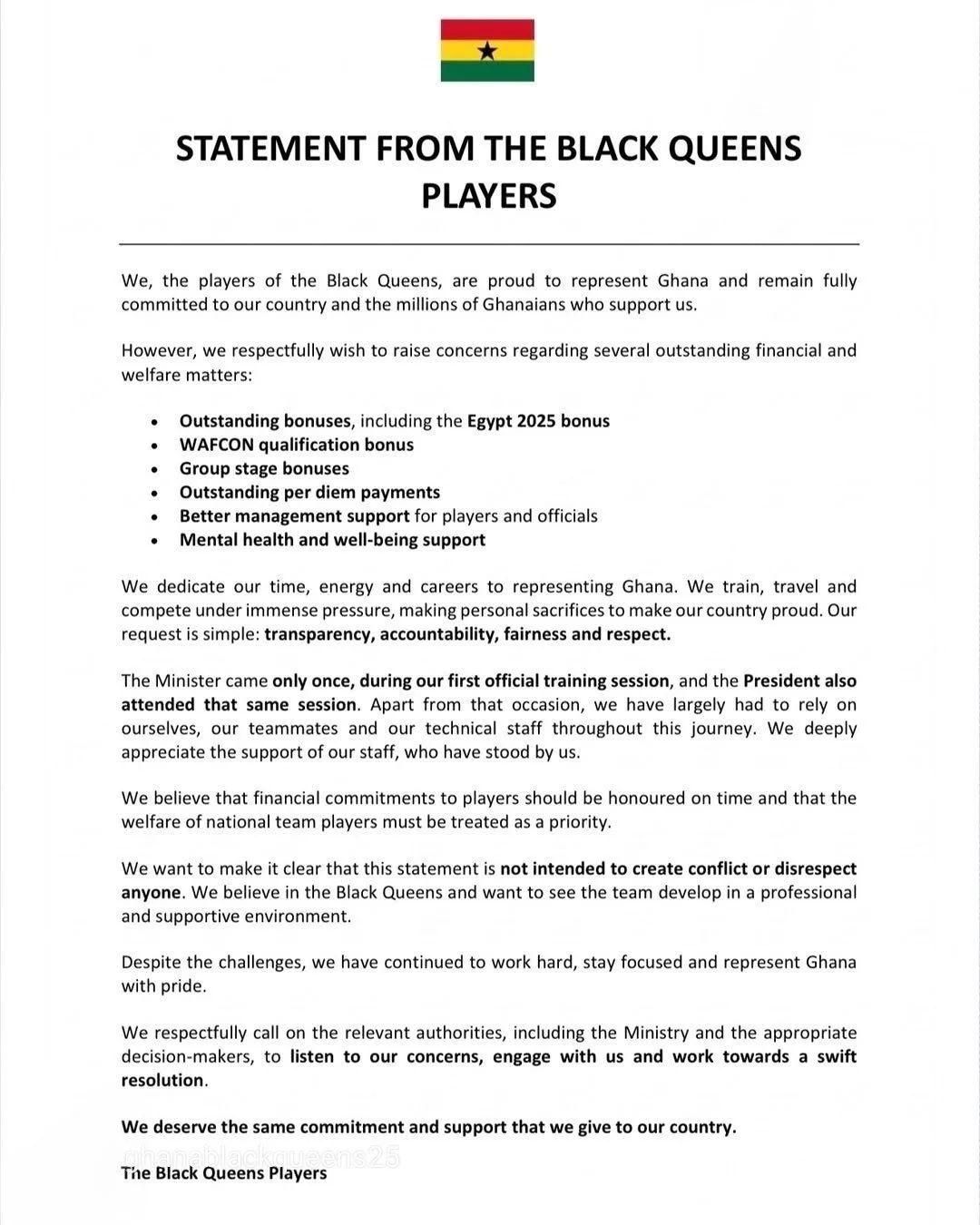
A statement issued by the 2026 Ghana WAFCON squad. (Photo credit: Ghana Black Queens players)
Badu's Tournament Changed the Conversation
Of the three NSL players, Evelyn Badu may have altered her standing most significantly.
She did not begin the tournament as Ghana's unquestioned central figure. In fact, she watched the opening match from the bench.
Then came the goal that sent Ghana into the knockout phase, a VAR-disallowed effort earlier in the competition and, increasingly, the sense that Badu was becoming one of the Black Queens' most consequential attacking players. That progression matters.
Badu had already arrived in Morocco with serious credentials. Montréal had seen them first-hand: four goals and an assist in nine appearances before her departure, including a hat-trick against Vancouver Rise that announced her arrival as one of the NSL's most dangerous attacking midfielders.
But international football gives a player a different examination. The spaces disappear. The margins narrow. Every touch carries more consequence.
Badu adapted. During the tournament, she was in regular contact with a mentor with similar experience in Ghanaian football.
Her uncle, Emmanuel Agyemang-Badu represented Ghana 78 times, reaching the men’s AFCON semi-finals twice in 2012 and 2013.
Evelyn Badu’s return to Montréal should therefore feel less like a player coming home from a tournament and more like the return of someone whose reputation has expanded while she was away. That is particularly welcome for the Roses, who have undergone their own changes around the edges of the organization this season.
The club moved on from head coach Robert Rositoiu after a shock exit to Simcoe County Rovers in the W Canadian Championship.
Badu's emergence gives Montréal another established attacking reference point as the NSL season reaches the business end.
There is a useful symmetry here. The NSL helped Badu arrive in Morocco in form.
WAFCON may send her back with another level of authority.
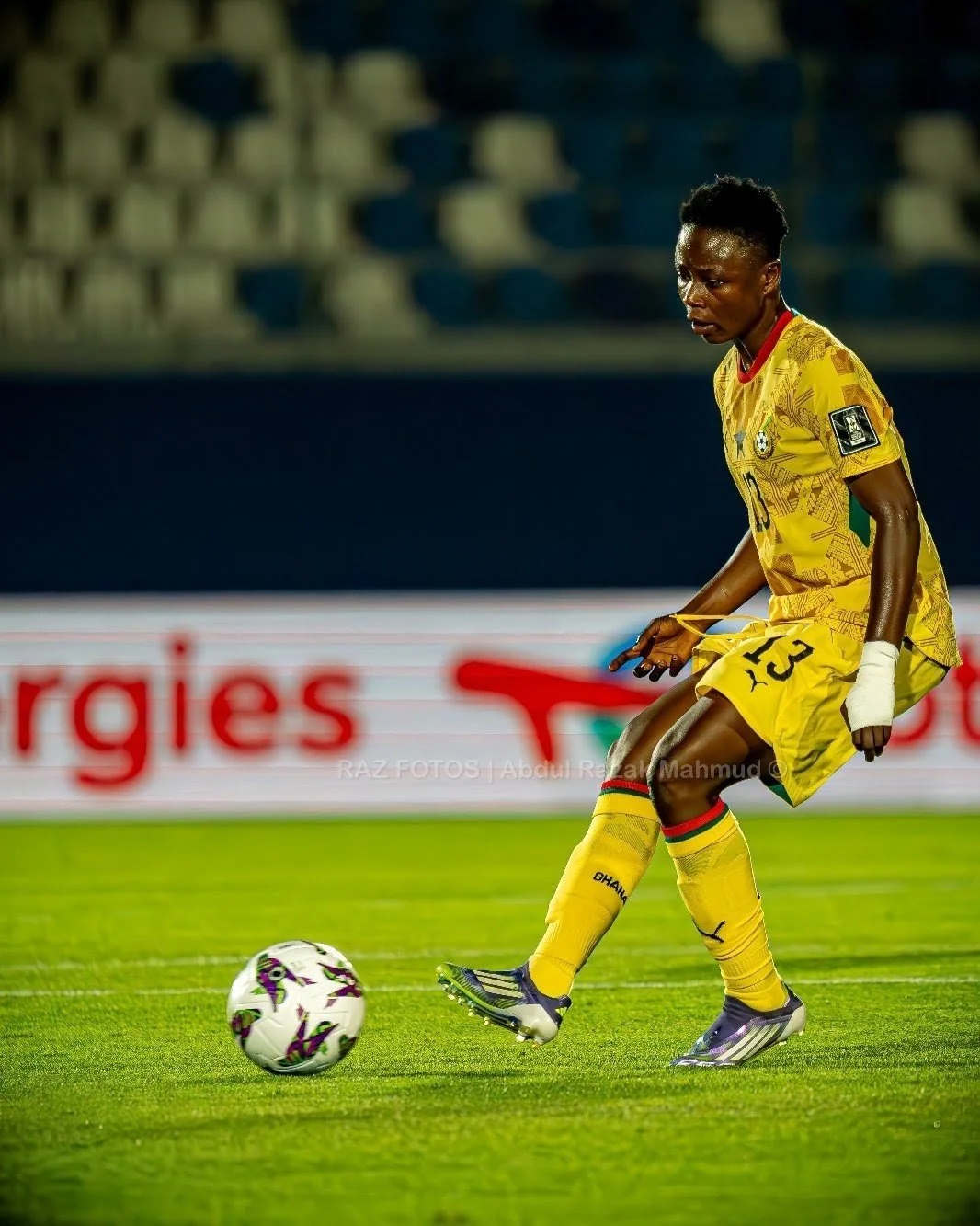
Evelyn Badu took a big step forward at WAFCON 2026 (Photo credit: Abdul Razak Mahmud)
Owusu-Ansah Gains Valuable Experience
Linda Owusu-Ansah's tournament was quieter, but that should not be confused with insignificance.
Her story was always going to be different. She entered the tournament without Badu's senior international profile and without Okoronkwo's history on the continental stage. Her senior Ghana debut was itself one of the defining details of the opening round for the NSL trio. Since then, her involvement has steadily made the picture more interesting.
Now she has experienced the demands of a major senior tournament, a knockout environment and a national team navigating pressure both on and off the pitch.
That education cannot be replicated in a league match. And it may have consequences beyond this tournament.
Before WAFCON, Owusu-Ansah's performances had already placed her as a leader in Ghana's youth setup and the country's U-20 journey towards the upcoming World Cup in Poland. The next step is not necessarily to become a star overnight. It is to make this feel normal.
Her Black Queens debut, followed by earning praise from Björkegren, gives her a foundation to build on.
In addition to her creativity and movement in the middle, Owusu-Ansah was also making defensive contributions for her country.
Senior national-team camps. International travel. Tournament pressure. Difficult matches. Expectations. Then back to Canada and the NSL.
That is how international experience compounds.
Nigeria's Disappointment is Different
Okoronkwo's tournament has a different texture.
A year ago, she was one of the defining figures of Nigeria's extraordinary comeback against Morocco, scoring and creating twice as the Super Falcons recovered to win their record-extending 10th WAFCON title. This time there was no repeat.
Nigeria were beaten 1-0 by Cameroon in the quarter-finals, ending their title defence and denying them automatic qualification for Brazil. South Africa then delivered the fatal blow in the World Cup play-off game. A Banyana side that Okoronkwo had helped to dispatch in the semi finals in 2025.
Yet there is an important detail for AFC Toronto supporters. Okoronkwo did get minutes earlier in the tournament.
Her 83 minutes against Malawi were the most she had played since getting injured against Halifax in May.
After an interrupted period and the inevitable questions about readiness, that may ultimately be the most useful part of this tournament for her club.
She is not returning to Toronto as the player who carried Nigeria to a title.
She is returning as a No. 9 who has been tested again at the highest level of African football, and whose fitness has been built in a competitive environment.
That distinction matters. A striker's rhythm is often difficult to manufacture.
It comes through repetitions: runs behind, duels with centre-backs, receiving under pressure, making the next movement after a failed chance.
Okoronkwo has been getting those repetitions.
For AFC Toronto, the more useful takeaway may be the minutes she accumulated if it means their leading forward returns sharper and healthier.
The club's own history with Okoronkwo underlines what she can provide.
She led the NSL in assists during the inaugural season, while also finishing among the league's leading scorers.
Now the challenge is translating another international tournament into domestic production.
The Tournament Ends Differently for All Three
Okoronkwo got the minutes. She got the tournament. She did not get the final opportunity. Badu and Owusu-Ansah, meanwhile, leave Morocco with Ghana still standing.
Their seasons are not over. Montreal and Toronto are both chasing Ottawa for the league title while also seeking to consolidate their positions for the postseason championship, which will also run through Ottawa.
Three players return from Morocco with three different trajectories.
Badu leaves with her stature enhanced.
Owusu-Ansah leaves with a senior international tournament behind her.
Okoronkwo leaves with minutes and match sharpness, but without the opportunity to influence Nigeria's final push towards Brazil.
Their stories, however, point beyond WAFCON.
By the time Brazil comes around, the Northern Super League could field a World Cup XI of its own.
Eleven NSL players are already attached to nations that have qualified — Korea Republic (3), the Philippines (2), Australia (2), Colombia (2) and New Zealand (2) — while Ghana, Jamaica, Haiti and Canada remain in the qualification picture. It is an extraordinary footprint for a league entering only its second season.
The NSL is no longer simply asking how many of its players can reach the international stage. It is beginning to ask how many can stay there.
The league's global footprint is no longer theoretical. It is walking onto pitches in Casablanca and Rabat, wearing the colours of some of Africa's most storied football nations.
And when the WAFCON lights finally go out, those players come home carrying a little of Morocco with them.
Sources:
Lars Kim Björkegren, Ghana Head Coach, press conference, 13 August 2026
ESPN, “Nigeria coach Justin Madugu rues missed chances against Cameroon at WAFCON", Colin Udoh, 10 August 2026
ESPN, “Ghana's Black Queens demand outstanding bonuses ahead of World Cup playoff", Colin Udoh, 13 August 2026
FIFPro, “PRECARIOUS WORKLOAD IN GLOBAL PROFESSIONAL WOMEN'S FOOTBALL”, 2025
FIFPro, “New women’s football national team player survey highlights advancements across confederations”, 17 October 2025
CAF, “Evelyn Badu: The Making of a Star from Seikwa”, 9 August 2026
CAF, “Esther Okoronkwo: 'Winning another WAFCON means more than any individual award'”, 16 July 2026
Montréal Roses, “MONTRÉAL ROSES ANNOUNCE HEAD COACHING CHANGE”, 13 August 2026
My Joy Online, “WAFCON 2026Q: Black Queens return to training, end threats of boycott”, Lawrence Degraft Baidoo, 27 October 2025
Daily Guide Network, “Sports Minister Confirms Outstanding Bonuses For National Teams”, Ransford Wletsu, 24 July 2026
Ghanaian Times, “Government releases over GHS 76 million for the Black Stars World Cup campaign”, 12 June 2026
Northern Super League, “History Made: Northern Super League Caps Transformational Inaugural Season”, 13 November 2025
Northern Super League, “ONE MATCH. ONE CHAMPION. Ottawa to Host the 2026 Northern Super League Final”, 9 August 2026
Photo Credits:
Evelyn Badu, Abdul Razak Mahmud, 10 August 2026 - Photo courtesy of Abdul Razak Mahmud
All photos are used with permission. All rights reserved to the creator.

Support PSP Media
If this article resonated with you, consider supporting PSP Media.
Every contribution helps support independent research and reporting