
By Nii Wallace-Bruce
A league's competitive order is rarely the whole story.
Beyond the standings, other forms of influence begin to emerge: through the players clubs produce, the recognition those players receive and the opportunities they find at international level.
The Northern Super League's second season offers an opportunity to examine three overlapping hierarchies.
The first is competitive: which clubs are winning, challenging for trophies and establishing themselves among the league's leading sides?
The second is one of recognition: which clubs are producing players whose performances are being acknowledged by their peers and through individual awards?
The third is international: which clubs are providing players with opportunities to reach the international game, whether through the Canadian national team or other national programmes?
These concepts are connected, but they are not interchangeable.
Competitive success does not automatically produce individual recognition, while international representation can reflect recruitment, eligibility and established experience as much as domestic development.
Taken together, however, they offer a broader picture of how influence is beginning to take shape across the NSL.
The Supporters' Shield, individual awards and preliminary rosters for the 2026 CONCACAF W Championship provide three different lenses through which to examine that development.
They also raise a more consequential question: how does a young professional league turn sporting achievement and individual accolades into a sustainable football ecosystem?
Recognition at Home
The individual awards offer a useful snapshot of the league's development.
Jessica De Filippo's season at Vancouver is an obvious starting point. The forward finished with 13 goals and four assists in 25 regular-season appearances.
Her performances in attack for the Rise enabled her to sweep the individual awards on offer to her, winning the Golden Boot, Forward of the Year, and NSL Player of the Year.
Her contribution was particularly significant given that Vancouver only secured the fourth and final playoff position and did so having conceded the most goals in the league alongside Calgary (55 goals)
At the other end of the pitch, Montréal's Anna Karpenko collected Goalkeeper of the Year and the Golden Glove for the most clean sheets.
Seven clean sheets and 63 saves helped underpin the Roses' regular-season success, culminating in the club’s first ever trophy.
Karpenko’s consistency and communication at the back became a reliable foundation for the Roses to turn defense into punishing attacking transitions.
Ottawa's Keera Melenhorst was named Midfielder of the Year following a campaign in which she recorded six goals and a league-leading seven assists.
Her award was determined by a vote of fellow players, giving additional significance. It reflects not simply statistical production, but the regard in which she is held by those competing against her.
After spending a season in Sweden with Linkopings, Melenhorst was able to thrive playing in front of family and friends.
Another endorsement for the league that has been built to create opportunities for Canadian players.
Halifax's Julianne Vallerand was recognised, an important counterpoint to the club's absence from Canada's preliminary international selection.
The right back was named Defender of the Year, playing on a team that conceded the least goals during the season (24), but she was influential when Halifax were in possession.
In 2026, Vallerand provided five goals and three assists in addition to her primary defensive duties.
As Halifax made one last push for the playoffs on the final night of the regular season in Toronto, Vallerand assisted the Tides equaliser and she was regularly involved in attacking phases.
Her performances for the Atlantic club caught the attention of peers from around the country.
These are different forms of excellence, but together they illustrate the increasingly varied sources of influence within the league.
The Team of the Season provides another perspective. AFC Toronto had four players selected — Colby Barnett, Sarah Rollins, Nikki Small and Kaylee Hunter.
Montréal had three (Karpenko, Charlotte Bilbault, and Elyse Bennett), while Vancouver had two (De Filippo and Tori Tumeth). Ottawa and Halifax were also featured through Melenhorst and Vallerand respectively.
The awards are not a league table, but they do offer an indication of where individual influence is being concentrated. Vallerand is a reminder that individual excellence can emerge outside the playoff places.
They also demonstrate why individual awards should not be understood exclusively through collective results. Vancouver's De Filippo and Halifax's Vallerand illustrate how individual excellence can emerge outside the clubs occupying the strongest positions in the standings.
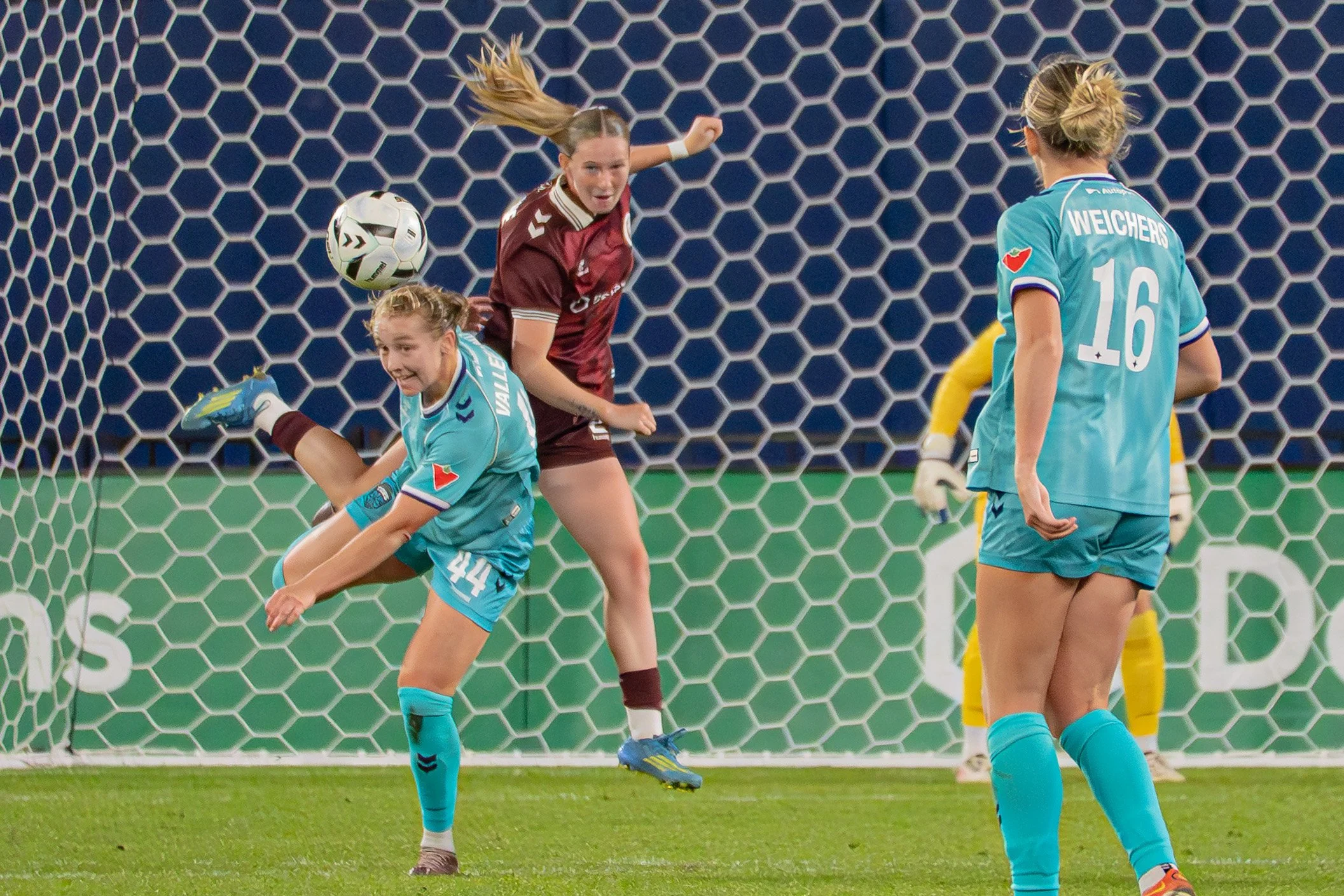
Julianne Vallerand (left) is no stranger to the attacking half, competing in air with April Lantaigne (middle) and also being involved (scoring + assisting) in eight goals for Halifax in 2026 (Photo Credit: Fiona Davidson)
The International Dimension: Recruitment, Development and Opportunity
The preliminary CONCACAF W Championship rosters provide a second, rather different measure of influence.
Where domestic awards recognise performances within the league, international selections offer a glimpse of how NSL clubs are connected to the wider global game.
Canada's preliminary 41-player roster includes eight NSL players: Sabrina D'Angelo, Melissa Dagenais, Shelina Zadorsky, DB Pridham, Kaylee Hunter, Marie-Yasmine Alidou, Olivia Chisholm and Jessica De Filippo. The final tournament squad will contain 23 players.
The distribution is noteworthy. AFC Toronto has three representatives, Ottawa Rapid two, while Vancouver Rise and Montréal Roses have one each. Calgary Wild and Halifax Tides have no players in Canada's preliminary selection.
But the Canadian roster tells only part of the story.
The wider international picture requires a broader understanding of what representation means within a league that recruits players from different footballing backgrounds and national programmes.
An international roster spot can represent several different forms of value.
For an established international like Charlotte Bilbault, it may reflect the attraction of the NSL as a professional destination and the experience they bring to their club.
For a Canadian player like Pridham, it can demonstrate the league's capacity to provide a domestic environment in which national-team ambitions can be pursued.
For a younger or less established player like Hunter, it may represent an important step in a longer development pathway.
International recruitment and domestic player development are complementary, but they are not interchangeable.
A club that attracts established internationals can raise the technical and competitive level of its squad, introduce different footballing experiences and strengthen its recruitment profile.
A club that helps develop players towards international recognition makes a different, equally important contribution to the league's long-term credibility.
The distinction is particularly relevant when examining the distribution of players across the eight national teams' preliminary rosters.
Calgary has no representatives in the selections, while Halifax has no Canadian selections, although its international picture must be considered separately from the CanWNT roster.
Halifax defender Naya Cardoza appears in Jamaica's preliminary roster. Further, AFC Toronto captain Nikki Small has also been included in the Reggae Girlz preliminary squad.
This should not be interpreted as a straightforward verdict on either club's quality. There is no single measure that captures a club's contribution to the league.
National-team selection is shaped by eligibility, positional competition, previous international experience, recruitment and the preferences of individual coaches.
Preliminary rosters are also not final tournament squads, and selection does not guarantee playing time.
Nevertheless, representation offers a useful indication of how the NSL's clubs are connecting with the international game.
It can increase a club's visibility, enhance its recruitment appeal and provide players with opportunities that extend beyond domestic competition.
There is also a broader significance for Canadian women's football.
The NSL's value should not be measured exclusively by how many Canadians it places in national-team squads, nor by how many established internationals it attracts. Its longer-term contribution will depend on whether those two functions can reinforce one another: bringing international experience into the domestic game while creating meaningful opportunities for Canadian players to develop, compete and progress.
In that sense, international representation is not simply another measure of recognition.
Calgary's absence, however, raises questions about the club's ability to translate domestic participation into broader visibility and influence.
The NSL is establishing an identity for itself. Patterns are beginning to emerge, and the differences between clubs are becoming harder to ignore.
It is part of a larger question about the league's position within the global women's game, and whether its clubs are becoming destinations for talent, environments for development and pathways to international football.
The challenge is to ensure that these functions are not concentrated in only a small number of clubs.
A healthy professional league needs teams capable of attracting established players, developing emerging talent and providing competitive opportunities across the entire domestic landscape.
More Than a Domestic Competition
The international selections also speak to a broader question about the purpose of the NSL.
For Canadian players, the league offers something that has historically been difficult to access at home: a professional environment in which they can develop, compete and potentially attract national-team selection without necessarily having to move abroad.
Melenhorst's return to Ottawa after playing professionally in Sweden is one example. De Filippo's domestic breakthrough and subsequent inclusion in Canada's preliminary roster is another.
The wider international picture also suggests that the league's influence need not be restricted to the Canadian programme. Its ability to attract and develop players from different footballing backgrounds can contribute to a more diverse and competitive domestic environment.
But the value of professional opportunity extends beyond the pitch.
Canadian Women & Sport's It's Time research series offers a useful framework for understanding the environment in which the NSL is developing. Its 2025 report, Leading the Next Era of Growth, estimated that Canada's professional women's sport market had reached $380–400 million, including revenue and start-up investment across five major professional sports and the women's Olympic programme. It projected growth to $570 million by 2030.
The figures are not an NSL valuation. Rather, they illustrate the broader commercial environment in which professional women's football is attempting to establish itself.
The research also challenges the assumption that women's sport lacks an interested audience. A separate Canadian Women & Sport study found that two-thirds of Canadians identified as fans of women's sport, with audiences demonstrating an appetite to watch, attend, follow and engage with athletes.
More recent research, published in October 2026, puts that figure at 75 per cent. Yet 62 per cent of those fans say they do not know where to find the professional women's sport they want to watch.
That tension is particularly relevant to a young league such as the NSL. Interest is growing, but interest alone does not guarantee sustained engagement. Visibility, accessibility and the ability to build relationships with supporters remain essential.
The question is therefore not simply whether the NSL can produce internationally recognised players. It is whether the league can turn such representation into a stronger relationship with its audience.
Canadian Women & Sport's research on fan motivations offers another important consideration. Its findings suggest that women athletes themselves are a significant driver of interest, with approximately half of surveyed fans saying they watch women's sport because they are inspired by its athletes. The opportunity for the NSL is to make its players more visible, not only as competitors but as individuals around whom supporters can build lasting connections.
For clubs, that means recognition must become something more than an award or a national-team call-up. It must contribute to a broader identity, a stronger supporter base and a sustainable professional environment.
The challenge for the NSL is to make that representation sustainable and more evenly distributed. A league's credibility is not established simply by the number of internationals it employs, but by its ability to develop players, retain talent and provide meaningful competition across all its clubs.
That process takes time, but it requires deliberate investment.
The Visibility Gap
Toronto presents an interesting case study in the development of professional women's sport.
It is one of only three North American cities, alongside New York and Seattle, with three professional women's sports teams represented across the WNBA, PWHL and NSL.
The arrival of the Toronto Tempo has added another dimension to a sporting landscape already being reshaped by the Toronto Sceptres and AFC Toronto.
The concentration of these competitions creates an opportunity that extends beyond individual clubs. Toronto has the potential to develop one of the continent's most significant ecosystems for women's professional sport, bringing together different audiences, commercial interests and sporting communities.
Yet the development of that ecosystem requires more than teams, investment and attendance.
There remains a considerable role for the media in establishing women's professional sport as part of the city's everyday sporting conversation.
AFC Toronto, despite its competitive achievements, has not consistently received the level of independent newspaper and radio attention that might be expected of a successful professional club operating in Canada's largest sporting market. This is not simply a question of match reports or broadcast exposure.
Rights holders and club communications serve important functions, but they cannot entirely replace independent journalism: the reporting, analysis, profiles and storytelling that give a club a place in the wider sporting culture.
Women's sport has intrinsic value. Its importance should not depend exclusively on commercial returns or comparisons with established men's competitions.
But the ability to tell its stories remains essential to building familiarity, sustaining interest and developing a deeper relationship with supporters.
For the NSL, this presents a challenge that extends beyond the quality of its football.
The league and its clubs must find ways to make their players, personalities and stories part of the cultural conversation in the cities they represent.
Toronto has the teams and an increasingly receptive audience. The next task is ensuring that the stories of those teams receive the attention necessary to make them an enduring part of the city's sporting identity.

With three professional women's sports teams playing in the Exhibition Grounds area, Toronto carries a big opportunity (Photo credit: Fiona Davidson)
The Next Measure
The semi-finals provide the immediate sporting context, but the more consequential story extends beyond the outcome of either tie. The awards recognise individual achievement.
International selections offer a measure of external recognition. The standings establish the competitive order. Together, they provide an early indication of the different ways clubs are beginning to shape the NSL.
But the playoffs are only one part of the assessment.
The awards recognise individual achievement. The international selections offer a measure of external recognition.
The standings establish the competitive order. The wider research on women's sport provides a reminder that the long-term success of a professional league depends on converting sporting achievement into sustained audience engagement and commercial support.
Taken together, they suggest that the NSL's second season has begun to produce a recognisable order, although not necessarily one that will remain unchanged.
For Montréal, Ottawa and Toronto, the challenge is to sustain their influence. Vancouver must demonstrate that its individual quality can translate into greater collective consistency.
Halifax and Calgary face different questions about how they can close the distance. The Winnipeg Ember will enter the competition in 2027, seeking to establish their own place in a growing ecosystem.
The league is still young. Its opening chapter is still being written.
The interesting question is no longer simply which club will lift the Diana B. Matheson Cup.
It is which clubs, and which players, will shape what the NSL becomes — and whether the league can ensure that its growing influence translates into a stronger future for women's professional football in Canada.
Sources:
Photo Credits:
De Filippo running at Toronto, Fiona Davidson, 4 October 2026 - Photo courtesy of assignment by PSP Media
Vallerand and Lantaigne, Fiona Davidson, 26 October 2026 - Photo courtesy of assignment by PSP Media
Toronto Watches Women’s Sports, Fiona Davidson, 26 October 2026 - Photo courtesy of assignment by PSP Media
Video Credit:
Melenhorst Goal, Northern Super League, 31 October 2026 - Video courtesy of @NorthernSuperLg via X
Bennett Assists Alidou Goal, Northern Super League, 1 November 2026 - Video courtesy of @NorthernSuperLg via X
All photos are used with permission. All rights reserved to the creator.

Support PSP Media
Every contribution helps support independent research and reporting