
A Fern Among Maple: Meikayla Moore Carries Oceania to the NSL
By Nii Wallace-Bruce
Part Three of a five-part series examining the connection between Northern Super League and international football
The mullet is unmistakable. So is the fern. One belongs to Moore. The other belongs to the country she has carried with her through a career spent crossing oceans.
Known around Calgary Wild's locker room as “Mouse”, Moore has spent much of her career away from New Zealand to find the professional environments she needed to develop. Now she is on the other side of that equation: helping to build one.
The Distance Was Never the Destination
New Zealand occupies the geographical centre of Oceania, but football does not always follow the map.
For players growing up there, the world's established football markets can feel impossibly distant. Europe is half a world away.
North America's professional game is another long journey. Even within the region, opportunities have historically been concentrated elsewhere.
For Meikayla Moore, that distance became part of her football education.
“Growing up so far from the game’s major markets meant I knew I had to leave early to test myself against a higher level and to better myself for the national team,” Moore told PSP Media.
There was no gradual introduction to the professional game.
Leaving home meant adapting quickly, learning new surroundings and competing for a place in unfamiliar environments.
“I had to sink or swim almost.”
That instinct has taken Moore a long way from Christchurch.
A New Zealand international since 2013, she has built a career across Germany, England and Scotland, playing for FC Köln, MSV Duisburg, Liverpool and Glasgow City before arriving in Calgary. She is also a three-time Olympian, having represented the Football Ferns at Rio 2016, Tokyo 2020 and Paris 2024.
The route is familiar to many footballers from countries on the game's periphery: leave home, find a stronger competitive environment, adapt, learn and return to the national team better equipped for the international stage.
For Moore, the important distinction is that distance did not close the door.
It pushed her through it.
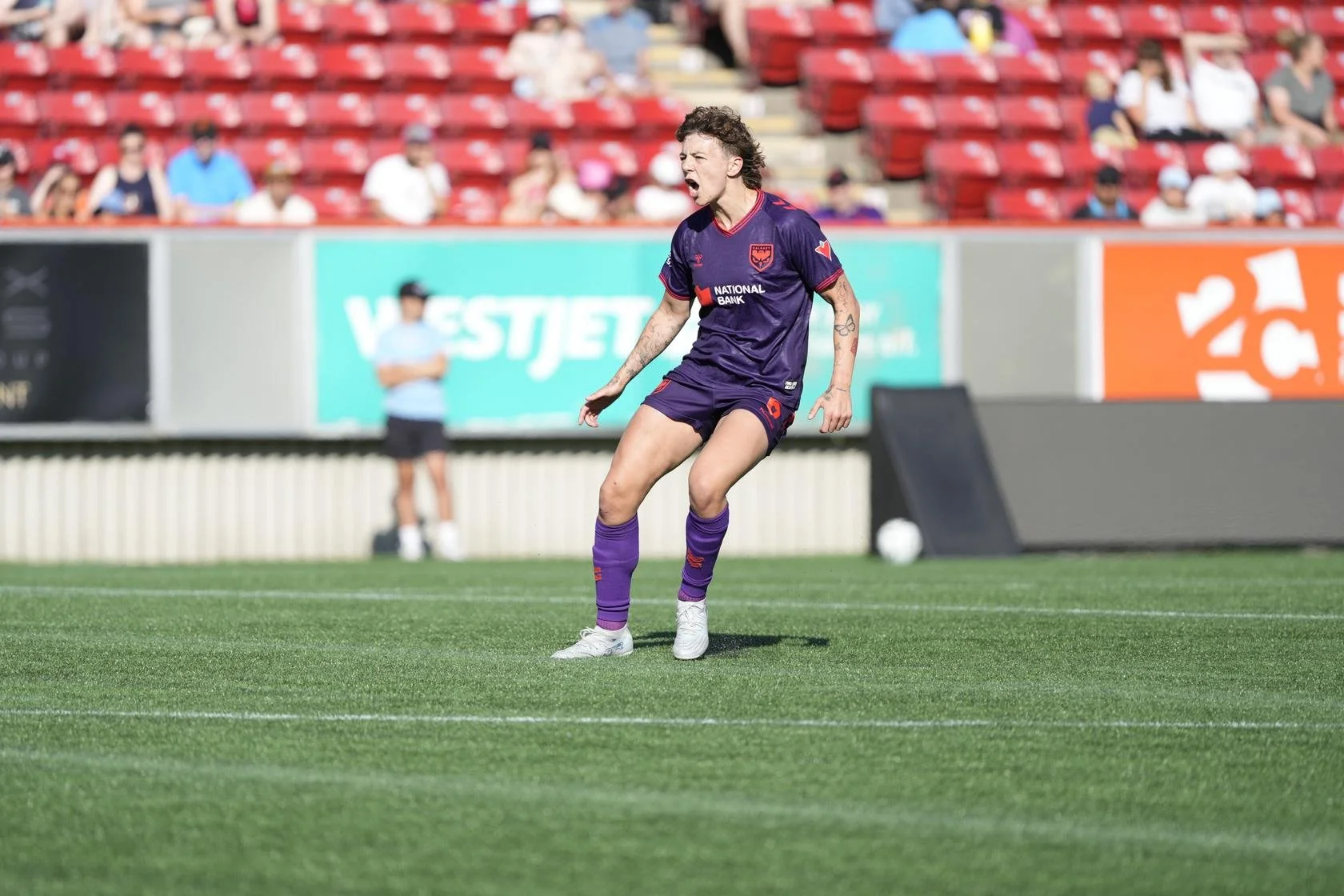
Meikayla Moore’s mullet has made her a cult figure in Season Two of the Northern Super League (Photo credit: Northern Super League)
Different Countries, Similar Issue
For all the differences between Canada and New Zealand, there is an intriguing symmetry.
Before the Northern Super League began, Canada had produced generations of international players while lacking a fully professional domestic women's league.
New Zealand has faced a similar problem.
The Football Ferns have become one of the most consistent representatives of Oceania on the global stage, appearing at six consecutive Women's World Cups while also establishing a regular Olympic presence.
New Zealand's dominance should not be mistaken for Oceania's lack of depth.
Papua New Guinea has emerged as another significant force, while the Solomon Islands broke through to win their first Oceania Women's Nations Cup in 2025.
The Football Ferns have set the region's international benchmark. Others are beginning to close the gap.
Wellington Phoenix's arrival in the A-League Women competition in 2021 offered a professional foothold closer to home.
Auckland FC's planned entry to the A-League Women competition (2027-28) adds another opportunity. Both Kiwi clubs are also building pathways through talent development.
New Zealand has historically lacked a fully professional club-based domestic league, and its elite players have therefore often had to look abroad.
That landscape is now beginning to change.
New Zealand and Canada have both had to build international football identities before they had fully professional domestic leagues.
A Little Piece of Home in Calgary
There is something reassuring about hearing an accent from home on the other side of the world.
Calgary has developed its own Trans-Tasman pocket, with Moore joined by New Zealand-born Tilly James and Australia's Kahli Johnson, alongside members of the coaching staff. The result is a small cultural bridge inside a new Canadian football environment.
“There’s a shorthand you get with people who understand where you’re from,” Moore told PSP Media. “It certainly does make Calgary feel less foreign for sure.”
The comfort extends beyond football.
There has been, naturally, the question of pavlova—the great dessert fault line of the Tasman—and whether the rest of the Calgary dressing room has yet been converted.
“Not yet I believe!” Moore says. “I’m sure it would certainly be a big topic of conversation between the Kiwis and the Aussies though!”
It is a small detail, but it captures something larger about the NSL's international character.
The league may be Canadian in geography and identity, but its dressing rooms are increasingly shaped by football cultures from elsewhere.
The exchange runs in both directions.
Taking the Long Way Home
Moore's résumé reflects a rich football journey: Germany, England, Scotland, then Canada.
At Liverpool, she helped win promotion to the Women's Super League; at Glasgow City, she won the Scottish Women's Premier League.
Each stop added another football culture to the one she had left behind in New Zealand.
Now Canada presents a different challenge: helping shape a professional league while it is still defining itself.
The present season has had its challenges yet the Wild are still in the running to become inaugural winners of the W Canadian Championship.
The Northern Super League began its inaugural season in 2025, giving Canadian players and internationals alike a new professional platform.
Moore has already etched her name into Calgary Wild folklore. She has the distinction of scoring the club’s first ever goal & being a part of the inaugural Wild starting XI.
In addition Meikayla Moore received the first yellow card in NSL history.
Moore sees her move to Calgary not as a departure from the journey she began in New Zealand, but as its continuation.
“For a long time players like myself from home had to go looking for opportunity rather than have it knocking on your doorstep,” she says.
That landscape is changing in New Zealand too. But Moore's career illustrates why overseas experience remains valuable.
“Playing in a new professional league in Canada is part of that same pattern really, taking what I’ve garnered over the years and bringing all I’ve learnt and experienced to help grow the game here.”
Her experience has been accumulated elsewhere. Her influence is now being applied here. Moore’s leadership is reflected in the armband that she often wears on match days.
That is the international exchange at the heart of the Global NSL story. Players are not simply arriving in Canada to play football.
They are bringing football experiences with them. And then they leave something behind.
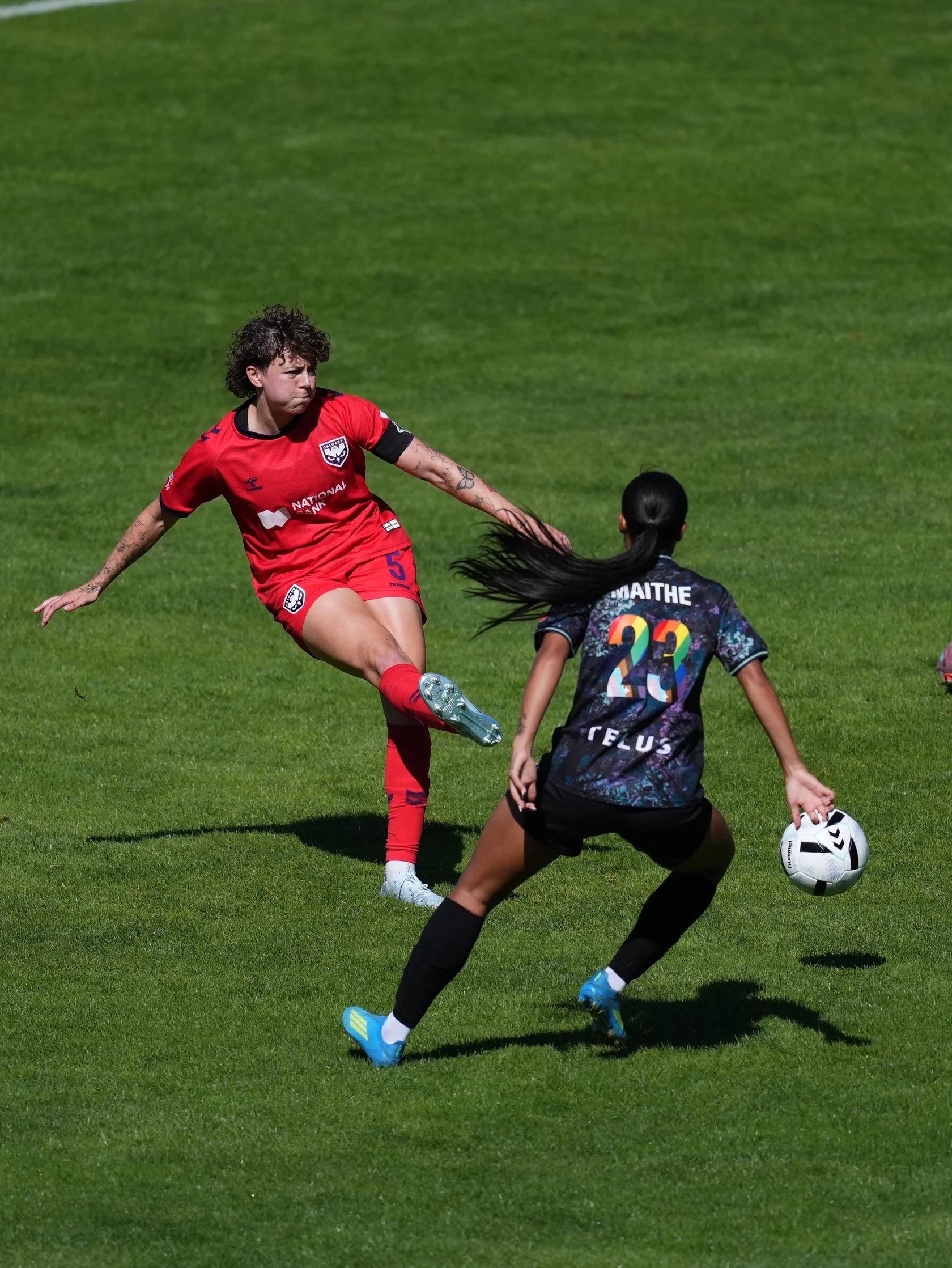
New Zealand’s Meikayla Moore and Colombia's Maithé López are part of the Global NSL (Photo credit: Vancouver Rise)
The Fern Still Feels Different
For all the airports, clubs and changing football cultures, there is one constant.
The fern on Moore's chest.
Her international career began as a teenager, and the shirt has remained the clearest connection between the player she was in New Zealand and the professional footballer she became abroad. Asked what still feels most like home when she puts on that shirt, Moore does not talk about geography. She talks about people.
“To represent my family and friends and my country will always be my greatest achievement.”
There is a particular feeling, she says, in being around the national team and other New Zealanders that is difficult to translate into words.
“Every time I get to see that fern on my chest it grounds me.”
That grounding matters because Moore's career has been defined by movement.
The farther she has travelled, the more valuable that point of connection appears to have become. It is also why her message to the next generation is so simple.
For a young girl in New Zealand—or anywhere else in Oceania—watching a Football Fern play professionally in Canada, Moore wants the geography to look less like a barrier and more like part of the adventure.
“The distance isn’t a disadvantage and to follow your heart.”
The path, she says, does not need to resemble anyone else's. That may be the most fitting lesson from Moore's journey.
Football did not become accessible to her because the world moved closer to New Zealand. She learned to cross the distance herself.
Now, in Calgary, she is part of a league trying to build the kind of professional environment that players from football's distant corners have long had to travel to find.
The fern and the maple may sit at opposite ends of the football map.
But they are beginning to share a similar story: building at home, learning abroad, and bringing the game back with them.
Sources:
Meikayla Moore, Calgary Wild player, personal interview, 25 August 2026
Michèle Hozer, “The Pitch - Documentary”, TVO and The Cutting Factory, 2025
New Zealand Football, “National Competition Plan”, October 2025
Stuff, “NZ Football announces national league shake-up, historic first for women’s game”, Andrew Voerman, 29 October 2025
Oceania Football Confederation, “Papua New Guinea learn FIFA Women’s World Cup 2027™ Playoff Tournament fate”, 21 August 2026
Oceania Football Confederation, “Solomon Islands write history with first OFC Women’s Nations Cup crown”, 19 July 2025
Photo Credits:
Meikayla Moore, Northern Super League - Photo courtesy of Northern Super League
Coin Toss in Calgary, Sandi Huynh/Calgary Wild,15 August 2026 - Photo courtesy of Calgary Wild
Meikayla Moore passing again Lopez, Vancouver Rise, - Photo courtesy of Calgary Wild
Meikayla Moore in possession, Sandi Huynh/Calgary Wild, - Photo courtesy of Calgary Wild
All photos are used with permission. All rights reserved to the creator.

Support PSP Media
Every contribution helps support independent research and reporting