
By Nii Wallace-Bruce
The Northern Super League's regular season has identified its four contenders. What it has not established is which of them can handle the demands of a championship race.
Montréal Roses enter the playoffs as Supporters' Shield winners, Vancouver Rise as defending champions, while Ottawa Rapid and AFC Toronto arrive with an opportunity to make history of their own.
Four clubs remain, but their routes to the Diana B. Matheson Cup could hardly be more different.
For Canadian forwards DB Pridham and Kaylee Hunter, the postseason offers a particularly personal subplot.
The pair linked up for Canada during the October international window, combining for Pridham's first senior international goal against Denmark.
Now, with their clubs on opposite sides of Saturday’s semi-final first leg, the connection that offered a glimpse of Canada's attacking future becomes a point of contrast.
Elsewhere, two interim coaches arrive at the knockout stage with different achievements behind them and a shared opportunity ahead.
Montréal's Maryse Bard-Martel has guided the Roses to the Supporters' Shield after taking charge in the aftermath of an unexpected Canadian Championship exit.
Vancouver's Iain Darbyshire has helped the Rise secure fourth place, keeping the defending champions' hopes of retaining their title alive.
The two-legged format adds another layer. Neither club can treat the first meeting as an isolated contest.
The opening leg must be approached with an understanding of what remains to be played, while the return leg may demand a different balance between patience and urgency.
The questions are no longer simply about who has been strongest across the season. They concern who can adapt, withstand pressure and make the decisive moments count.
From International Connection to Domestic Rivalry
Hunter and Pridham's recent work together for Canada gives the Toronto–Ottawa semi-final a human dimension beyond the standings.
The October international window offered a glimpse of what the partnership might become.
Against Denmark, Hunter's awareness and execution created the opportunity, and Pridham supplied the finish for her first senior international goal.
It was a small moment in a difficult 4-3 defeat, but an important one for two players navigating their respective routes into Canada's attacking picture.
Their circumstances now change. At international level, they had a shared objective and the freedom to recognise each other's movements.
In the NSL semi-finals, that understanding becomes part of the opposition's problem to solve.
Hunter and Pridham will be looking to deliver for different clubs, with the possibility that the qualities which made their combination effective for Canada could become decisive in a contest between them.
The semi-final field also offers a snapshot of the different ways NSL clubs connect with international football.
Several of the remaining sides have players with senior Canadian national-team experience, while others are represented through different routes.
The two forwards have arrived at the international stage by different routes.
Pridham's career has involved setbacks and a longer journey into the senior national team, while Hunter represents a younger generation developing within Canada's expanding professional environment.
Their connection is still taking shape. A single goal cannot establish a long-term partnership, but it can reveal the possibilities that emerge when players recognise the same opportunity.
At club level, however, their responsibilities diverge. Hunter has carried significant attacking responsibility for AFC Toronto, while Pridham's contribution for Ottawa forms part of a different collective structure.
When asked about Ottawa, AFC Toronto's coach and 2026 NSL Coach of the Year Marko Milanovic said, “It all starts with DB up top, her ability to hold the ball up, to make runs in behind. She’s versatile that way so you have to be careful”.
Their international combination is relatively new, but neither forward is unfamiliar with influencing this particular domestic rivalry.
Across the ten all-time meetings between Toronto and Ottawa, Hunter has scored six times and Pridham five. Both finished the NSL regular season with 11 league goals each.
Their respective clubs will need that production again, although this time each forward must find a way to hurt the other side.
For both forwards, the test is whether individual quality and developing international confidence can make a difference in a domestic tie where the consequences are immediate.
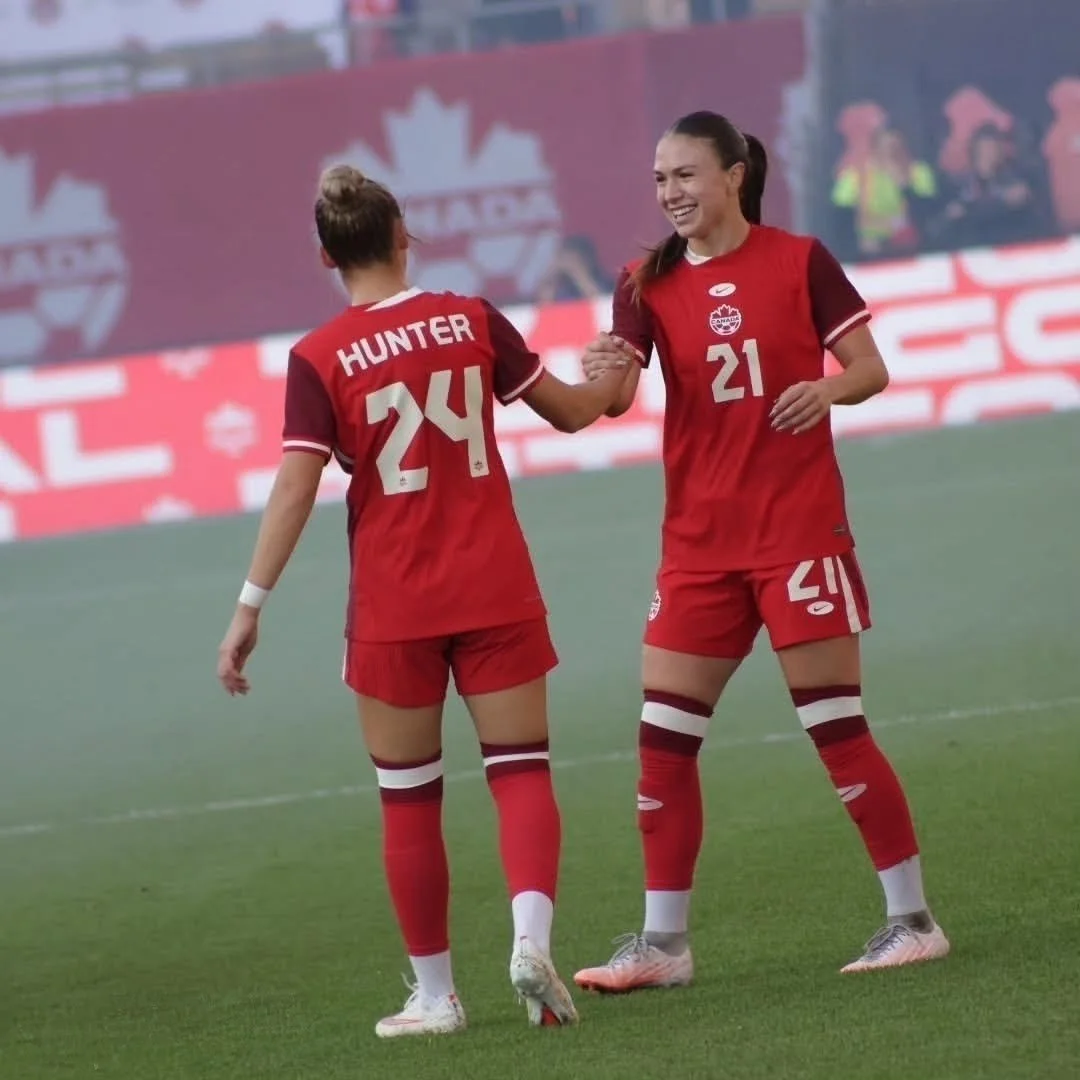
Hunter and Pridham’s international partnership will give way to club duties in the NSL semi-finals (Photo credit: Jacob Garland)
Bard-Martel's Balancing Act in Montréal
Montréal's position presents a different challenge. The Roses finished atop the standings with 45 points, establishing themselves as the league's most consistent side over the regular season.
They also completed the campaign unbeaten away from home, a record that could prove particularly valuable with the first leg against Vancouver taking place at Swangard Stadium.
Maryse Bard-Martel's achievement carries additional context. Appointed interim head coach on August 13, following Robert Rositoiu's departure in the aftermath of Montréal's Canadian Championship defeat to Simcoe County Rovers, she inherited a team facing an important transition.
By the end of the regular season, the Roses had secured the Supporters' Shield and established themselves as the leading contenders for the league championship.
The achievement demonstrates her ability to maintain the team's competitive level through a period of change.
The challenge now is different: translating that consistency into success over two matches, where the consequences of an individual mistake can be considerably greater.
Lisa Pechersky occupies a unique position in the NSL's short history. The Montréal winger is the only player to have won both the Diana B. Matheson Cup, with Vancouver, and the Supporters' Shield.
As she returns to Swangard Stadium with a different club and a different ambition, she brings first-hand experience of what both sides are trying to achieve.
The Roses will be relying on her pace and ability to link up with leading striker Elyse Bennett and fellow midfielders Evelyn Badu and Mimi Alidou in attacking moments.
Further, the first leg provides the Roses with a familiar source of confidence: their away form. Montréal finished the regular season undefeated away from Stade Boréale.
In a league that requires extensive travel over six months, that statistic matters.
The previous five regular-season meetings suggest that defensive discipline could prove decisive. The matches produced 26 goals, with Montréal scoring at least twice in each encounter.
The Roses' pace and ability to exploit the space behind advanced defensive lines have been recurring features of their attacking play.
For Vancouver, the challenge will be to improve its defensive organisation without sacrificing the attacking threat that helped secure a playoff place.
The Roses' 1-0 victory over Ottawa on the final weekend, with the Supporters' Shield at stake, provided a useful reminder of their capacity to deliver under pressure. But Vancouver offer a different examination.
The defending champions bring postseason experience and an opportunity to disrupt Montréal's ambitions before the decisive return leg at Stade Boréale.
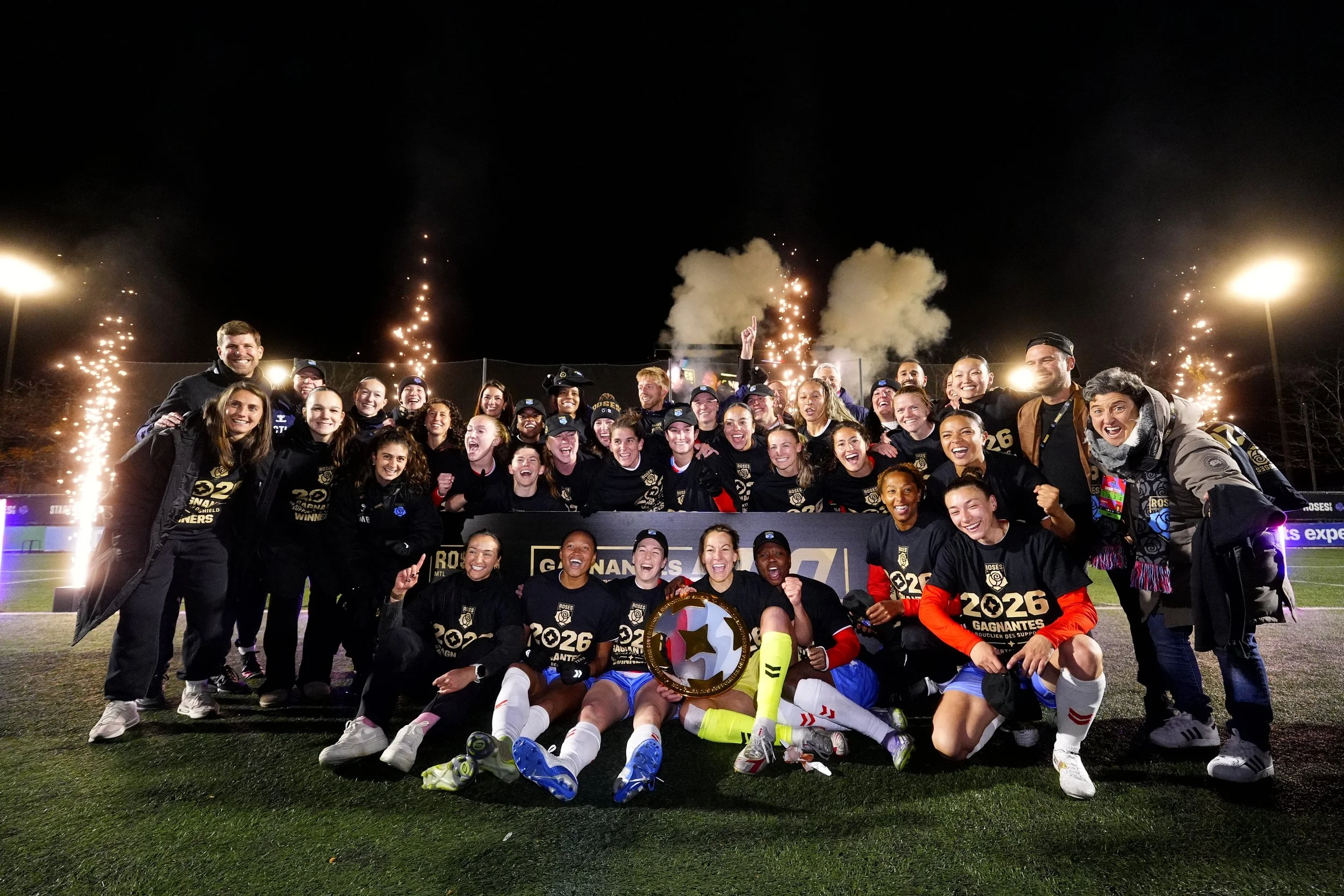
The Roses turned an early Canadian Championship exit into a Northern Super League triumph, winning the Supporters Shield under Maryse Bard-Martel (Photo credit: Northern Super League)
Darbyshire and Vancouver's Opportunity
For Darbyshire, the immediate objective is to take Vancouver beyond the semi-finals and preserve the club's championship defence.
Fourth place is a different platform from Montréal's first-place finish. The Rise had to wait until the final night of the regular season to be confirmed participants, edging Halifax Tides for the final playoff berth.
They enter the postseason with significant domestic and international experience.
Vancouver's squad brings considerable international experience, although through different routes.
Quinn arrives as an Olympic gold medallist, Latifah Abdu has senior CanWNT experience, while Golden Boot winner Jessica De Filippo has strengthened her credentials for future consideration.
The club also has connections to international football through players representing Algeria, Australia, Colombia, Haiti, Jamaica and the Philippines.
The distinction is worth noting, but it is not a measure of relative success.
Senior international selection, youth development and domestic results reflect different stages of a player's career and different aspects of a club's work.
Vancouver's presence among the final four is a reminder that there is more than one route to building a competitive NSL side.
Darbyshire also carries the context of his predecessor Anja Heiner-Moeller's achievement.
After a last-gasp winner from Halifax Tides in September, Heiner-Moeller’s reign came to an end, with Darbyshire replacing her on an interim basis.
Vancouver have already shown that the club can win the championship; the question is whether this group can reproduce that success under different circumstances and with Darbyshire guiding the team through the decisive stage.
Emulating a predecessor is a useful ambition, but it is not a tactical plan. Vancouver must find a way to make the tie competitive on its own terms, rather than relying on the reputation of the defending champions. Darbyshire's priority has been to rebuild Vancouver's defensive structure without losing the attacking threat that carried the team into the playoffs.
Tactically, Jamaican international Chantelle Swaby has formed a new centre back pairing with Matildas player Tori Tumeth.
While the sample size is small, Vancouver has moved from conceding 2.31 goals per game in 2026 before Darbyshire took over to 1.83 goals conceded per game in his six matches in charge.
Darbyshire has made pace and aggression features of the Rise identity and he has shifted Mia Pante from left full back to a winger role, utilising her movement and attacking threat with the ball as well as her pressing out of possession. Jessica De Filippo remains a significant source of goals, but the Rise face an opponent that has repeatedly demonstrated its ability to punish space on the counter-attack.
The balance between defensive security and attacking ambition could determine whether Vancouver can make the tie competitive.
The contrast with Bard-Martel is striking. Montréal must convert regular-season authority into knockout success. Vancouver must make the most of a route that has left little room for error.
Both coaches face the same underlying demand: prepare their teams to solve problems over two matches, not simply reproduce the performances that brought them to this point.
Their interim status adds another dimension, although its significance will depend on the decisions and relationships behind the scenes.
The postseason offers both an immediate sporting objective and an opportunity to strengthen their cases through results. For now, the football must take priority.
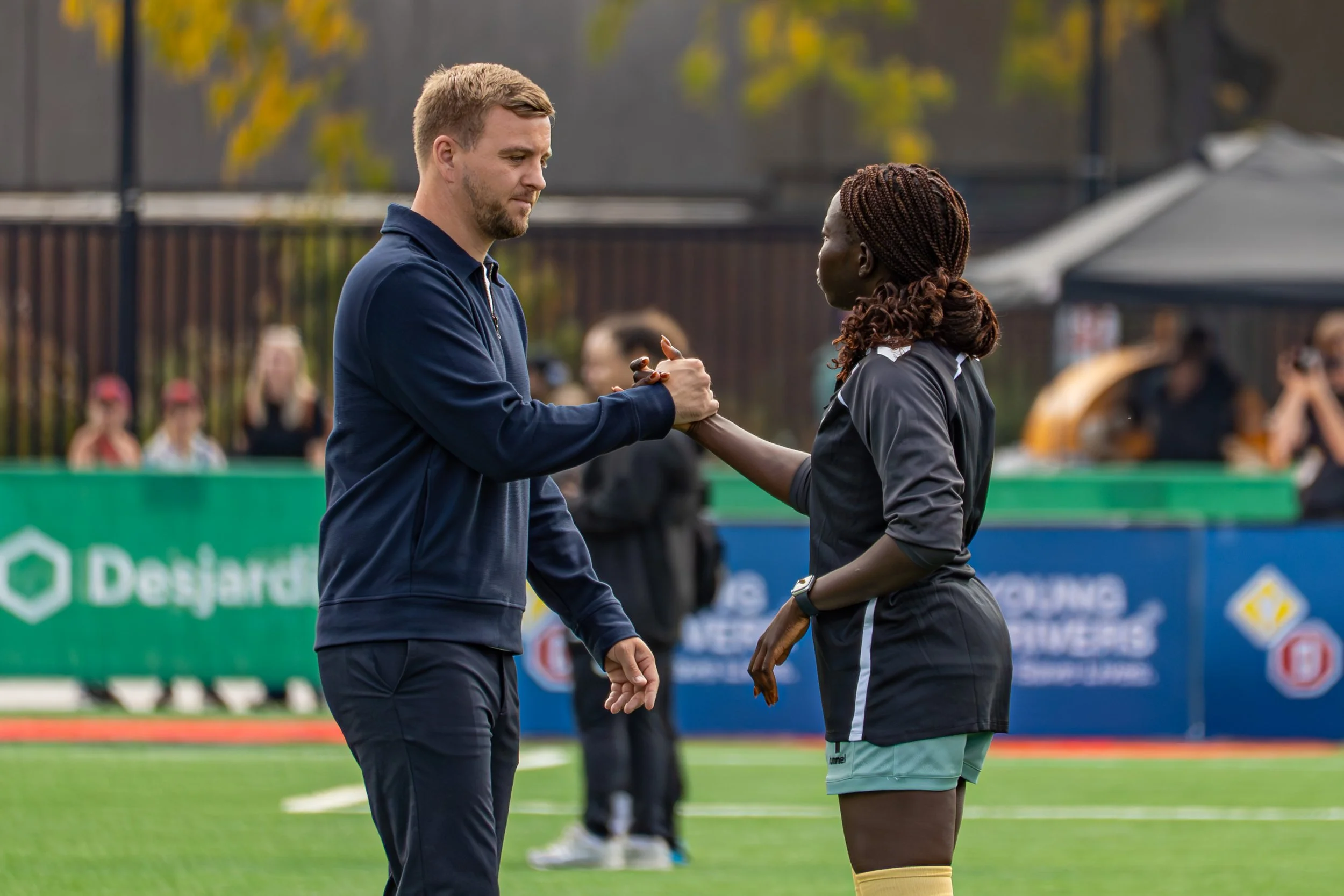
Iain Darbyshire will be looking to build on Vancouver’s momentum heading into the semi-finals against Montreal (Photo credit: Fiona Davidson)
The Season's Verdict is Still Unwritten
The semi-finals bring the NSL's competing ambitions into focus.
Toronto and Ottawa offer a meeting between two clubs separated by only one point in the final standings, with Hunter and Pridham's international connection providing an added personal thread.
Vancouver and Montréal offer a more direct test of the relationship between regular-season consistency and championship experience.
Neither tie is simply a referendum on the standings. Montréal's Shield establishes what the Roses have achieved; it does not settle what they will achieve next.
Vancouver's fourth-place finish defines the challenge ahead, but does not remove the possibility of a successful defence.
Toronto and Ottawa, meanwhile, have their own opportunity to turn a strong league campaign into a place in the final.
The semi-finals begin on October 31, with Toronto hosting Ottawa, before Vancouver welcome Montréal on November 1.
The return legs follow on November 7 and 8, and the championship will be decided at TD Place in Ottawa on November 14.
For Hunter and Pridham, the transition from teammates to rivals captures one of football's familiar tensions: players can share ambitions for their country while pursuing incompatible goals for their clubs.
For Bard-Martel and Darbyshire, the semi-finals offer different routes to the same prize, shaped by the contrasting circumstances of their seasons.
The regular season has established the contenders. The postseason will determine which of them can finish the job.
Sources:
Marko Milanović, AFC Toronto Head Coach, press conference, 30 October 2026
Iain Darbyshire, Vancouver Rise Head Coach, press conference, 25 October 2026
Photo Credit:
Hunter and Pridham shake hands, Jacob Garland, 12 October 2026 - Photo courtesy of assignment by PSP Media
Pridham guiding Hunter, Yassine Ziadi, 9 October 2026 - Photo courtesy of assignment by PSP Media
Darbyshire shaking hands with Yekka, Fiona Davidson, 4 October 2026 - Photo courtesy of assignment by PSP Media
Mounted Police with Diana B. Matheson Cup, Northern Super League, 25 November 2025, - Photo courtesy of Northern Super League
Roses celebrate with Supporters Shield, Northern Super League, 23 October 2026, - Photo courtesy of Northern Super League
Video Credits:
DB Pridham first goal, Canada Soccer/CanWNT, 12 October 2026 - Video courtesy of @CanWNT via X
All photos are used with permission. All rights reserved to the creator.

Support PSP Media
Every contribution helps support independent research and reporting.