
A Mirror in the Stadium: Toronto at the World Cup
By Nii Wallace-Bruce
A Setting Like No Other
Former Toronto mayor John Tory once described the city as somewhat nonchalant in the lead-up to major events. The 2026 FIFA World Cup was expected to test that reputation in a city often described as where the world lives within a single skyline. The first week of the tournament would offer early clues.
On June 12, at Toronto Stadium, red-and-white Canada shirts mingled with blue-and-yellow Bosnia flags. Groups of teenagers switched effortlessly between English and Bosnian. Gordon Karacic, a Bosnian-Canadian and owner of World Moss, said it was unreal to see Bosnia back at the World Cup, let alone playing the opening game in his city.
And perhaps that's the point.
For generations, Toronto has been described as one of the world’s most multicultural cities. Yet major football tournaments have often happened elsewhere—watched in cafés, event centres, and living rooms scattered across the Greater Toronto Area.
Now the World Cup is here. And as Canada faced Bosnia, the city seemed to be staring into a mirror.
This is not simply Canada against Bosnia. It is Toronto against itself.
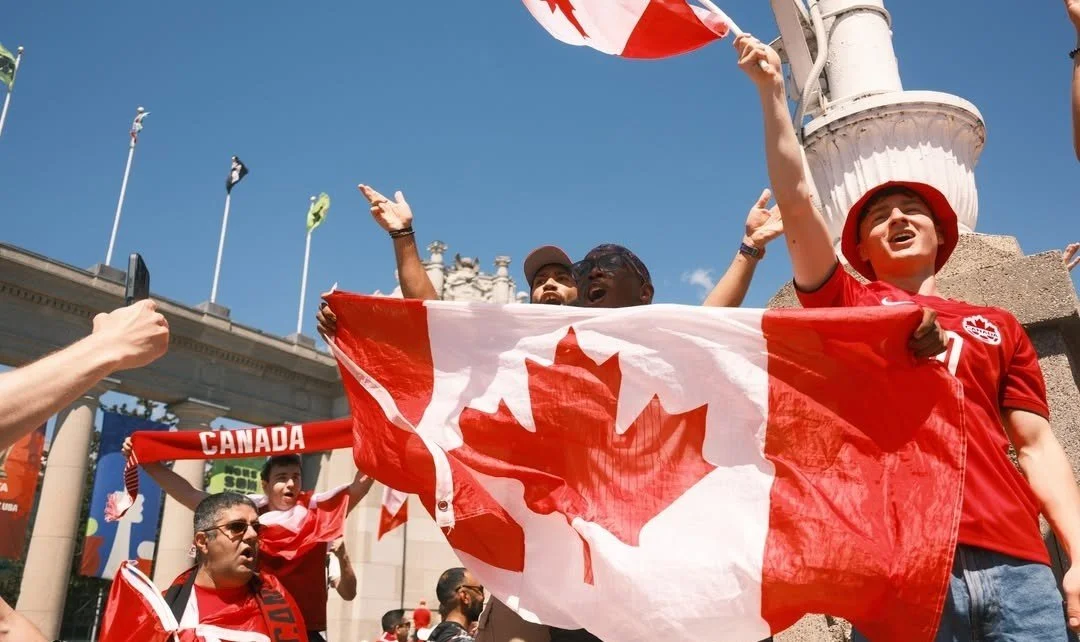
At this World Cup, many Torontonians support a country in addition to Canada, reflcting the diaspora roots. (Photo credit: Kofi Yeboah)
The Bosnian Toronto
The Greater Toronto Area is home to one of the largest Bosnian communities outside Bosnia and Herzegovina, largely built by families who arrived during and after the wars of the 1990s. Sarajevo, Mostar, and Tuzla may be thousands of kilometres away, but their stories are woven into neighbourhoods across the city.
Inside the stadium, those histories sit side by side. For 90 minutes, old divisions subside in a unified and unapologetic support for Bosnia and Herzegovina.
Some supporters sing "O Canada." Others belt out Bosnian songs passed down through generations. Many know both. Karacic noted that in Europe it is common for fans to congregate in cities and show passionate support at major events. By contrast, fans in Toronto seemed passionate, but more restrained.
A Toronto Stadium worker remarked that fans were well behaved on the day, despite divided loyalties. There is something quietly revealing in that.
The question is not how many people support Canada or Bosnia.
The more interesting question is how many support both.
Bosnia fans sing and march towards Toronto Stadium in anticipation of the FIFA World Cup match against Canada (Photo credit: Gordon Karacic)
Did Toronto Show Up Elsewhere?
After an electric Friday in the city, a sense of nonchalance returned over the weekend. Football’s crown jewel appeared to be competing with NHL and NBA Finals for attention in the city.
A walk around fan festivals in the downtown area reflected interest, community and energy. An ambience that could be found at a street festival, concert, or a Sunday at the SkyDome. The week ahead would be informative.
Wednesday brought another game at Toronto Stadium: Panama and Ghana. Two nations shaped by Atlantic migration. Converging in Canada’s cultural hub.
Panamanian fans were numerous in the stands. The sound of Los Canaleros supporters outmatched Black Stars fans, mirroring Panama’s dominance in possession. With Panama’s training camp based at Nottawasaga, Ontario, it felt like a home game in more ways than one. Even so, the atmosphere reflected the colourful fabric of Toronto.
Across Toronto, Ghanaian fans were out in full force. At multiple live sites—Fort York, Nathan Phillips Square and Sankofa Square at Yonge & Dundas—there was excitement and anticipation for one of Africa’s most followed teams at the World Cup.
Sankofa Square resembled Accra’s Makola Market. Festivities were punctuated by a royal visit from the Asantehene, the King of the Ashanti people. Food stalls offered jollof rice, red red, and other West African dishes. The smell of cooked meat wafted into the evening. That would prove only the beginning. When Caleb Yirenkyi scored a dramatic winner to guide Ghana to victory over Panama, fans spilled from the square into the streets, with an outpouring of joy usually reserved for playoff victories by the Raptors and Blue Jays. On this night, Toronto was showing up for the World Cup through the diaspora.
The aroma of food was joined by the faint scent of cannabis—legal in Canada. Older fans gathered in praise and worship, indicative of Ghana’s Christian heritage. All of this unfolded under massive billboards featuring Alphonso Davies and Richie Laryea—Canadian players with ties to Ghana. More fans joined in from the stadium and the other areas. Adam and his daughter had travelled from Mississauga to watch at the square. While Adam lamented the underwhelming performance by the Black Stars, he was pleased to see so many Ghanaians and fans coming together. And yet, many of them would have a second team to cheer for in under 24 hours. Canada would be in action the following evening.
With Wednesday’s energy and euphoria echoed in news reports across the country, it was time for Canada’s men’s national team to take to the field again in Vancouver. But would Toronto show up for the country even if the game was elsewhere? With the NHL and NBA seasons in recess, there were no excuses—the city was on notice. There was also a rising undercurrent of one-upmanship from Vancouver. Unnecessary for a global event yet evident.
Thursday compressed the previous few days into a few hours. As Canada’s men broke through for a famous maiden victory at the World Cup, there was pleasure and pain. The record win (6-0) over Qatar, brought an outpouring of joy at the FIFA Fan Festival as well as Canada Soccer House and Nathan Phillips Square. Football fans were invested and invigorated, and it showed at designated locations. However, just like the game, which was muted after an injury to Ismaël Koné, there was a muted response in other parts of the city. There would be no outpouring at major intersections. There were a few cars honking horns intermittently. However, for a first-ever win by Canada’s men at the world’s biggest sporting event, Toronto seemed somewhat subdued overall. There is also a section of the city that feels disenfranchised by the World Cup due to cost and accessibility. An inconvenient truth.
Like a good barbecue, good things take time. The city can still come alive again later in the tournament. On a broader level, football in Canada is still coming alive, with a little help from elsewhere.
Ghanaian fans celebrate victory in Toronto, next to billboards of Canadian players Alphonso Davies (birth) and Richie Laryea (parents) - both connected to Ghana (Video credit: Nii Wallace-Bruce)
The Game That Arrived With the People
For decades, immigration has quietly transformed Canadian football. Communities from every corner of the world carried the game with them—building clubs, filling parks and passing on traditions. Long before Canada became a World Cup nation again, those communities kept football alive.
Now they are helping shape what Canadian football looks like. Karacic believes this will take time, but 2026 is already bringing people together.
A match between Canada and Bosnia becomes more than a contest. It becomes a portrait of a city where identities overlap rather than compete.
For ninety minutes, supporters may choose a side.
The City in the Stands
After the final whistle, most will head home to the same neighbourhoods, the same workplaces, the same city.
That may be the most World Cup thing of all.
Because the tournament is often described as a meeting of nations.
In Toronto, it feels more like a meeting of communities. Red, white and blue mixing in Canada’s cultural calabash.
And perhaps that is the real significance of this night: not that the World Cup has come to Toronto, but that Toronto—in all its complexity, contradiction, and cosmopolitan composure—has come to the World Cup.
Sources:
John Tory, Former Toronto mayor, personal interview, 12 December, 2025
Gordon Karacic, Canadian-Bosnian business owner, personal interview, 17 June 2026
Toronto Stadium worker, personal interview, 12 June 2026
Andrew, Ghana supporter, personal interview, 17 June 2026
Photo Credits:
Canada fans at Exhibition Place, 12 June 2026 - Photo courtesy of Kofi Yeboah via Instagram @imkofiyeboah
Video Credits
Bosnia fans march to Toronto Stadium, 12 June 2026 - Video courtesy of Gordon Karacic
Ghana fans celebrating in Toronto, 17 June 2026 - Video courtesy of Nii Wallace-Bruce
All photos are used with permission. All rights reserved to the creator.

Support PSP Media
If this article resonated with you, consider supporting PSP Media.
Every contribution helps support independent research and reporting.