
Chile in Toronto: Living With the Standard of a Golden Generation
By Nii Wallace-Bruce
Jose Vega had driven with family and friends from Boston to Toronto to watch Chile play Canada.
He knew the team arriving at BMO Field was not the Chile of 2015 or 2016. Alexis Sánchez and Arturo Vidal belonged to another stage of the country's football history now, along with Gary Medel and the other players who had turned Chile into a continental power.
For Vega, that was not necessarily something to mourn. “It’s normal in any part of life, especially sport,” he told PSP Media.
Generations change. Players move on. New ones are given their chance. But the old generation has not disappeared. Not really.
It remained in the shirts worn on the bus to BMO Field, in the memories of supporters who had followed Chile through its greatest period, and in the excitement of seeing Alexis Sánchez only a short trip away in Montréal. While the Copa América triumphs are now more than a decade in the past, the passion and vibrancy of Chilean fans remains.
A ride on the bus down Dufferin Street from North York to the Exhibition Grounds was revealing.
One could witness Colo Colo, Universidad de Chile and other Chilean club jerseys in addition to La Roja.
Multiple generations of fans could be found on the bus, wearing different versions of the red and white, from the iconic Reebok jerseys of the late-90s to Vidal and Sánchez jerseys from the fabled era. The atmosphere was festive rather than mournful. The supporters were not travelling to Toronto to say goodbye to Chile's golden age.
They were carrying it with them. The mood on the bus would be reflected in the stands. A strong contingent of Chilean fans in fine voice, matched by a healthy number of Canadian fans wanting to cheer on their team after a successful World Cup campaign.
But a golden generation leaves something more complicated behind than memories.
Chile had great players before — Elías Figueroa, Carlos Caszely, Iván Zamorano and Marcelo Salas among them.
What made the 2010s different was that several generations of elite talent arrived together, matured together and won together.
Sánchez, Vidal and their teammates did more than win Chile's first major international trophies in decades. They changed the country's expectations of its national team.
The next generation is not simply replacing famous players. It is inheriting a standard.
On a September night in Toronto, the past and future of Chilean football occupied the same stadium.

While Chile played in Toronto, Alexis could be found a few hundred kilometres away playing in Montréal. (Photo credit: Yassine Ziadi)
A Legacy That Crossed Borders
Chile's North American tour also offered a glimpse of the diaspora shaping the next generation of La Roja.
Thomas Coulombe was born in Chile and has represented Chile at U20 level, but is eligible to play for Spain.
Jetzen López was born in Australia to a Chilean father and was brought into Córdova's North American group.
Zidane Yáñez was born in New Jersey and is a Chile youth international. Further, among the incumbents, Nils Reichmuth was born in Switzerland and is eligible for Chile through his Chilean mother. Lawrence Vigouroux and Ben Brereton Díaz were both born in England and are eligible to represent Chile through their parents.
There is another reason the old generation still feels close to Chileans in Canada.
While the present generation of La Roja was playing in Toronto, Alexis Sánchez could be found playing simultaneously at Stade Saputo in Quebec for CF Montréal.
For Vega, that changes the relationship between the icon and the community.
Sánchez is not simply a player remembered through old highlights and Copa América celebrations. He is now a short trip away.
“People want to be close to idols,” Vega told PSP Media.
Vega believes that young Canadian players will be able to learn from Sánchez's experience in Europe, playing for Arsenal, Barcelona and other clubs.
Chile isn't an isolated case. Modern national-team identity increasingly operates through diaspora, eligibility, migration and football academies outside national borders.
On the other side of the pitch, Jesse Marsch and Canada Soccer worked to increase the depth of the men’s national team through discussions with dual nationals such as Marcelo Flores, Rayan Elloumi, and Niko Sigur.
But legacies can become burdens as well as sources of pride.
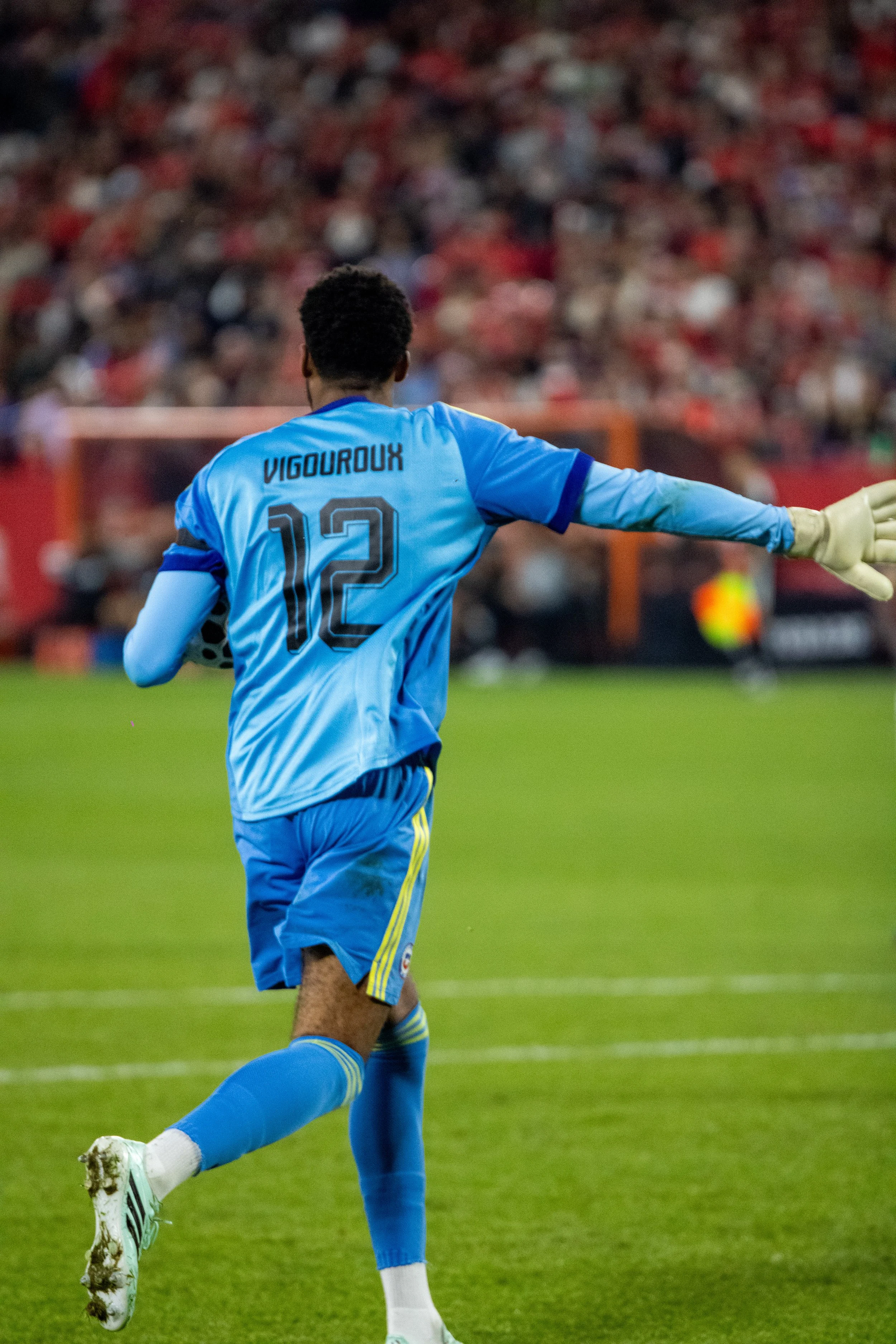
Players such as Lawrence Vigouroux are expanding La Roja’s recruitment potential beyond Chile’s borders (Photo credit: Alisa Tran)
The Generation That Changed the Expectation
Rodolfo Chisleanschi is a journalist for Argentina’s La Nación. He believes Chile failed to turn that fortunate convergence into a sustainable football project.
The national team won two Copa América titles and enjoyed strong World Cup campaigns, but the development system beneath it did not keep pace.
Chisleanschi points to corruption within the Chilean Football Association and at club level, as well as the corporatisation of several clubs and an emphasis on first-team success at the expense of youth development.
His reference includes Sergio Jadue, the former Vice-President of CONMEBOL, former President of the Chilean FA and former member of the FIFA Associations Committee.
In November 2015 he left Chile for the United States and became a cooperating witness in the US investigation into corruption in international football.
After pleading guilty to racketeering conspiracy and wire-fraud conspiracy related to the awarding of marketing rights for South American competitions, FIFA subsequently banned him for life.
Chile won the 2015 and 2016 Copa América while Jadue was president of the ANFP.
The golden generation’s success overshadowed the existence of corruption at an administrative level.
However, Chile has repeatedly struggled to build institutions capable of converting its enormous football culture and occasional exceptional generations into a stable, sustainable football system.
What Comes After the Golden Generation
Chile's new players are not starting from zero. They are starting from a standard.
Nicolás Córdova has been tasked with rebuilding the senior team while continuing to oversee the U20 side.
His decision to bring younger players into the North American tour reflected a team in renewal.
But renewal in Chile comes with a particular complication: the players who came before them showed the country what its national team could achieve.
The question is no longer whether Chile can produce another Sánchez or Vidal. It is whether the next generation can create a new definition of what Chilean success looks like.
Vega sees the transition of La Roja less dramatically. “The CEO won't be the same CEO for 100 years,” he said. “Eventually you need to get a new one.”
For supporters like Vega, the golden generation has earned its place in history.
Two national teams arrived at BMO Field at different points in their histories.
Canada is dealing with the pressure of fulfilling new expectations.
Chile is dealing with the pressure of replacing old ones.
The Chilean supporters eventually went home to Boston, North York and elsewhere. The golden generation stayed where it has been for years now: in memory.
Sources:
Jose Vega, Chilean fan, personal interview, 26 September 2026
Rodolfo Chisleanschi, journalist, La Nación, personal interview, 30 September 2026
DSports, “Nicolás Córdova comparó el presente de la Selección de Chile con Uruguay y Alemania: ‘Pasa en todos lados’“, 28 September 2026
Efe, “ANÁLISIS | El «annus horribilis» de la gestión del fútbol chileno que le alejó de la elite mundial”, María José Rey and Lázaro García, 9 December 2024
Diario Concepción, “Pay up or don't play: Deportes Concepción and their agreement with the ANFP”, 20 February 2025
ADN Radio, “Deportes Melipilla accuses player of possible bribery, which prompted Deportes Concepción's complaint”, Carlos Madariaga, 3 December 2024
Department of Justice (USA), “Sixteen Additional FIFA Officials Indicted for Racketeering Conspiracy and Corruption”, 3 December 2015
Photo Credits:
Alexis at national anthem, Yassine Ziadi, 26 September 2026 - Photo courtesy of Yassine Ziadi
Alexis on the ball, Yassine Ziadi, 26 September 2026 - Photo courtesy of Yassine Ziadi
Lawrence Vigouroux instructing, Alisa Tran, 26 September 2026 - Photo courtesy of assignment by PSP Media
All photos are used with permission. All rights reserved to the creator.

Support PSP Media
Every contribution helps support independent research and reporting.