
Canada Came Home. It Wasn’t the Same Team
By Nii Wallace-Bruce
Canada’s homecoming was supposed to be simple.
After the most successful World Cup in the history of the men’s national team, Jesse Marsch’s players returned to Canada to be celebrated by the supporters who had followed them through a summer that changed the scale of the sport around the country.
But “homecoming” has another meaning here. The team that returned to Canada was not quite the team that had left it.
Some players had returned from injury. Others, including Jonathan David, Cyle Larin, and Liam Millar had found club rhythm. Younger players had moved closer to the senior picture.
Established players Junior Hoillett and Samuel Piette were celebrated for their contributions to the program over the years.
The squad was becoming more familiar. The football was not.
That is the more interesting story of Canada under Marsch between 2024 and 2026: an inheritance becoming an identity, and an identity beginning to accommodate more of the players capable of expressing it.
The World Cup made the progress visible. The months since have begun to test what it means.
From Inheritance to Identity
When Marsch arrived in 2024, he did not inherit a blank sheet.
He inherited the residue of the 2022 World Cup, the end of John Herdman’s cycle, a group of players whose international reputations had grown faster than the infrastructure around them, and a younger generation beginning to demand consideration. He also arrived with a different football vocabulary. Canada already possessed speed, athleticism and players comfortable attacking space.
Marsch wanted to turn those qualities into a more systematic pressing game: aggressive without the ball, vertical with it, and willing to commit numbers forward.
The challenge was not simply teaching Canada to press. It was teaching the team when, where and why to press — and how to survive when the first action failed.
That distinction became increasingly important over the next two years.
By 2025, Canada was becoming recognisable before it had become settled.
The pressing was clearer. The verticality was clearer. The defensive aggression was clearer. So were the risks.
Injuries interrupted combinations. Club minutes fluctuated. Players moved in and out of the national-team picture.
The attacking structure remained subject to experimentation, including the question of how best to use Jonathan David.
The team had a footballing personality before it had a settled cast.
The Players Came Back to a Different Canada
The 2026 World Cup did not erase those uncertainties. It made them easier to see.
Canada reached the knockout stage for the first time, won its first World Cup match and scored six against Qatar.
The run ended against Morocco, but even that defeat contained a contradiction that now defines the next stage of Marsch’s work. Canada's first half in Houston may have been its clearest expression yet.
It pressed high. It disrupted Morocco’s buildup. It attacked with numbers.
It played with conviction against an opponent whose technical level and recent tournament experience demanded that Canada be more than physically competitive.
Rodolfo Chisleanschi of Argentina’s La Nación, who watched Canada throughout the tournament, saw the same evolution.
He explained to PSP Media the difference from what he had seen in 2024 as one of “intensity and ambition”, with Canada playing with greater determination to win.
The crucial point in his assessment was not fitness or tactical organisation. It was what comes after those things.
Football, he argued, still requires technically superior players — particularly in attack — to turn the opportunities created by a team structure into goals.
When it comes to chances, Canada could turn an incisive cross into a chance. The team could create high value chances when moving upfield. It could also do so while changing the point of the attack.
However, these moments were seldom reflected on the scoresheet at the World Cup. This is even more pronounced when removing the outlier result against Qatar.
That is the next problem.
The system has become good enough to create the situations.
The question is increasingly whether Canada has the right combinations to exploit them.
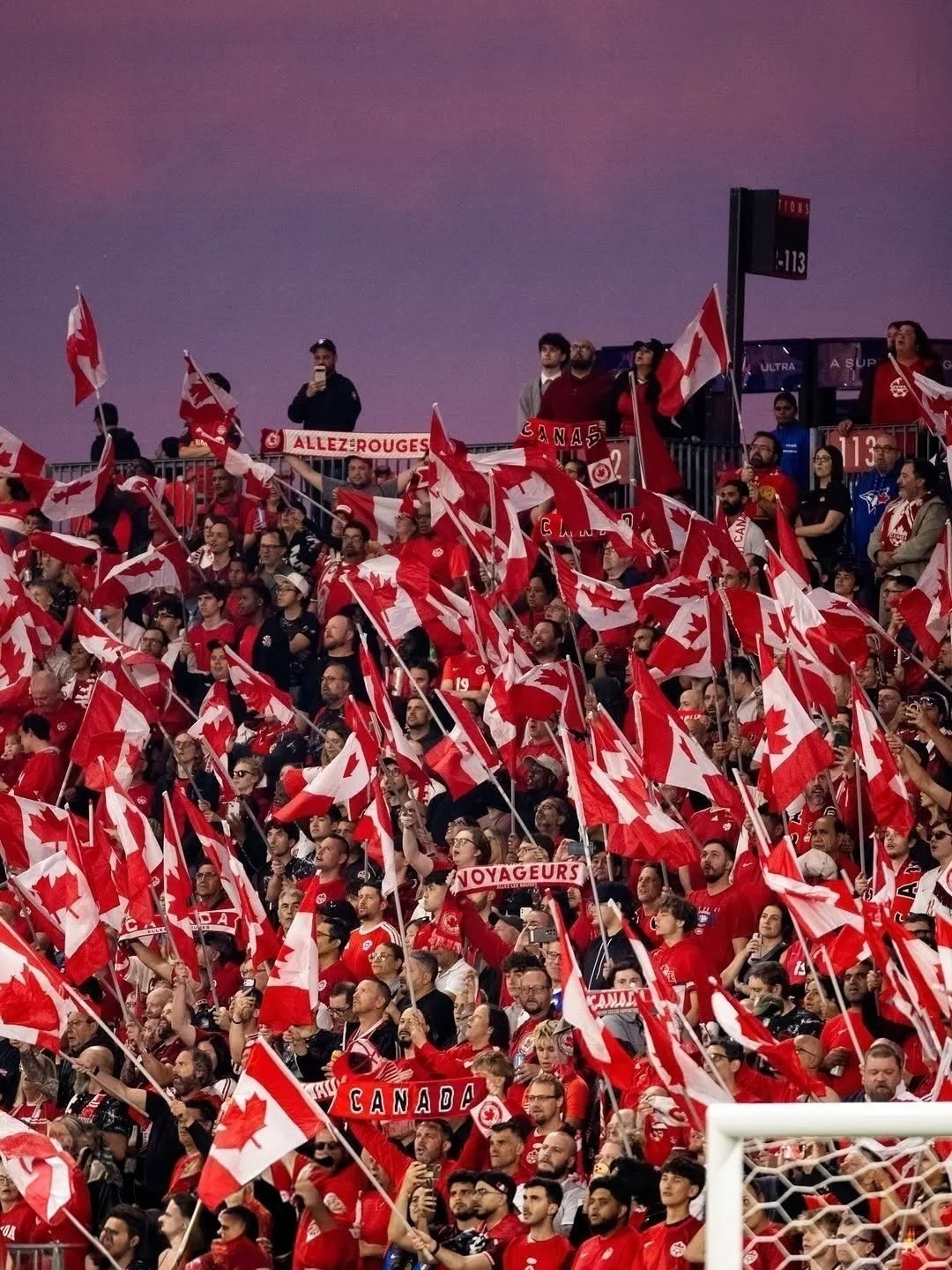
Canada’s supporter group “The Voyageurs” gave the men’s team a heroes welcome in Toronto and Montreal (Photo Credit: Alisa Tran)
The Press is No Longer Just a Weapon
There is a tendency to describe Canada’s evolution under Marsch through intensity.
That is understandable. The team runs. It presses. It counter-presses. It attacks space quickly.
But the more significant development is the intelligence underneath it.
Chile coach Nicolás Córdova described Canada as a team that pushes opponents physically while remaining orderly and tactically disciplined after Canada defeated Chile 1-0.
Peru coach Mano Menezes provided another perspective after Canada’s 2-0 win in Montréal, acknowledging that Peru struggled to find ways through the Canadian press.
Chile and Peru had both faced Canada at the 2024 Copa América. Canada's progress is visible in both the results and the performances.
In 2024, Canada battled to a scoreless draw with Chile and scraped past Peru with a 1-0 win.
Both matches involved significant periods of pressure, during which Canada had to withstand sustained attacks from its South American opponents.
In 2024, Canada completed 51% of total passes in Chile’s half. Further, Canada made 28 touches in the opposition box in the same game.
In the corresponding fixture in this window, Canada completed 63% of total passes in Chile’s half as well as having 60 touches in La Roja’s box.
In 2024, Canada completed 54% of total passes in Peru’s half as well as having 20 touches in Peru’s box. In the corresponding fixture, Canada completed 76% of total passes in Peru’s half while having 30 touches in Peru’s box.
In this window, Canada controlled both matches. If anything, the issue was that this control wasn’t reflected on the scoresheet.
Canada's pressing game was not built on intensity alone. FIFA's post-tournament data placed the team among the leaders in distance covered and sprints per 90 minutes.
Its defensive numbers also reflected the demands of an aggressive approach, with a high line and immediate pressure after possession was lost.
The physical output mattered, but so did the collective movement that made it useful.
Canada has spent two years learning how to make its aggression functional.
Marsch put it more explicitly after the Peru match, describing the need to understand how experienced players from different football cultures “find ways to gain an edge.”
The lesson is not simply to press harder. It is to understand the opponent, the referee, the moment and the consequences of the next challenge.
Marsch said Canada had spent more than two years trying not to be a naive team against opponents who are “savvy” and difficult to play.
That is the experience accumulating around the system.
And it is why the homecoming matters.
The players returning are not simply returning to the same coach and the same formation. They are returning to a team that has learned things without them.
More Players, More Choices
The deeper Canada becomes, the less Marsch’s central problem is discovery.
It is optimisation. The run up to the 2026 World Cup saw an aggressive push to bring in Canadian dual nationals who could contribute to the roster.
Marsch mentioned that one of his goals was to increase the depth of talent available. The goal has been achieved, yet it is not finite.
Who can play for Canada is increasingly obvious. Which combination makes Canada better is harder. That distinction is particularly important in attack.
Jonathan David remains central, but his role changes depending on who plays around him. Canada can use two forwards. It can ask David to move away from the centre.
It can pair him with a more physical reference point or another mobile attacker.
Each choice changes the team’s relationship with space.
A focal-point striker can give Canada somewhere to play into. A second mobile forward can give David freedom to drift.
More attacking numbers can create pressure around the box, but they can also increase the space left behind them.
David’s running mate must also have a working understanding of Canada’s pressing triggers, as the forwards often lead the way for the rest of the outfield, an observation from FIFA’s Technical Study Group this summer.
The No. 9 question therefore isn't simply about finding a striker.
It is about deciding what Canada wants its attack to be. Marsch has said he is testing different pairings, to find the best combination for when it is needed most.
That is a more encouraging problem than the one Marsch inherited.
It is also a harder one to solve.
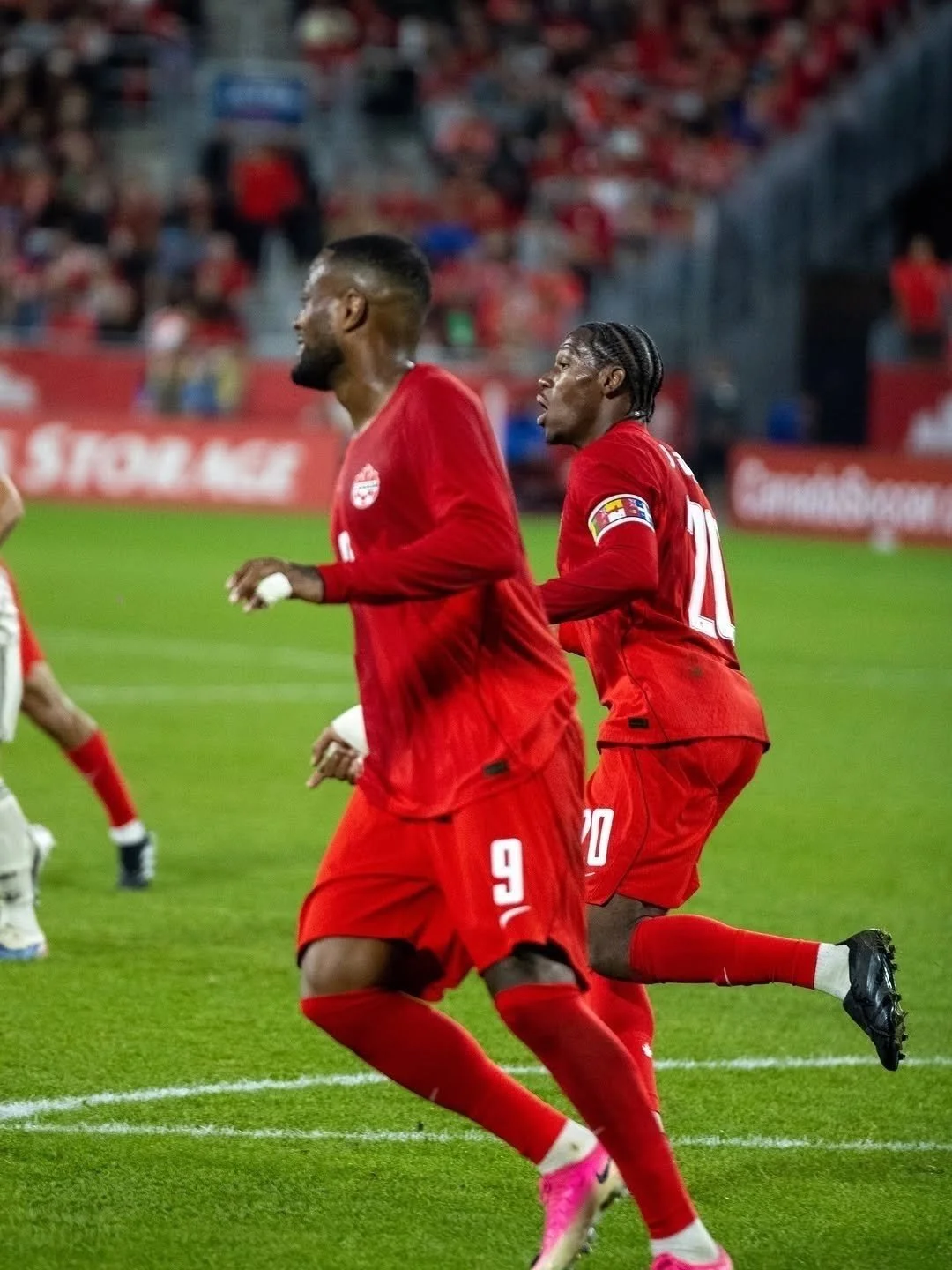
Cyle Larin and Jonathan David are both prolific scorers in their own right but the optimal forward pairing is also influenced by the opponent (Photo credit: Alisa Tran)
Morocco Was the Paradox
Canada played its best football of the tournament before losing its knockout match.
FIFA’s post-match report noted that Canada began with “impressive energy and intensity”, pressing high and forcing Morocco into uncomfortable positions.
Chisleanschi, writing for La Nación, went further, describing it as Canada’s best 45 minutes of the tournament and praising Marsch’s tactical design.
The comparison with Morocco offers a different measure of Canada's progress.
When the teams met at the 2022 World Cup, Canada struggled to impose itself for long periods. In Doha, Canada completed 45% of total passes in Morocco’s half while making 12 touches in the Atlas Lions’ box.
Four years later, the opening half in Houston showed a team better equipped to disrupt Morocco's buildup, advance into attacking areas and sustain pressure.
The improvement should be visible not only in the eye test, but in the underlying numbers: passes in Morocco's half, touches in the penalty area and the shots those actions produced.
Over 90 minutes in Houston, Canada made 57% of total passes in Morocoo’s half and they had 33 touches in Morocco’s box.
That does not make the 3–0 defeat any less significant. It makes it more revealing.
Canada had developed a way to trouble a technically accomplished opponent, but had not yet developed the consistency to turn that territorial progress into a decisive advantage.
Morocco's response exposed the other side of the same approach: when Canada failed to convert its pressure into a goal, the spaces left behind became opportunities for its opponent.
The comparison is not a simple story of progress or regression. It is a measure of how far Canada had come, and of what remained unresolved.
However, the second half in Houston provided lessons for the future.
Canada conceded from a set-piece routine early in the second half. When Canada pushed forward looking for an equaliser, Morocco found the transition space it needed.
The second goal arrived from a counterattack; the third came late. Morocco coach Mohamed Ouahbi identified the space Canada left behind as decisive.
That is the paradox.
Canada's aggressive identity was good enough to make a top opponent uncomfortable.
It was also aggressive enough to give that opponent a route back into the game.
The result was 3-0. The performance told a more complicated story.
Marsch himself resisted the idea that Canada had simply been overwhelmed.
His assessment was that Canada had been the better side for much of the first half and lacked the final-third quality to turn its advantage into a lead. He also pointed to the finer details that decided the match.
FIFA’s post-tournament report in October 2026 showed that Canada was fourth overall when it came to progress into the final third per 30 minutes of possession.
The inverted full-backs alter the team's positioning and create different passing options. Those rotations can help Canada advance into the final third and create crossing opportunities.
The data suggests that the structure generated promising attacking outcomes at the World Cup.
A successful outcome for measuring purposes was in the form of a shot on goal, a corner or an entry into the opposing penalty box.
Morocco demonstrates why those outcomes still need to be converted into goals, while the defensive risks of an aggressive structure must also be managed.
That is where the homecoming leads.
The system is no longer the only question.
The Cost of Continuity
International football has an inconvenient habit of interrupting its own development.
Canada’s homecoming has therefore contained an irony.
The squad is deeper at precisely the moment when there is still very little time to develop the combinations that depth makes possible.
In some respects, that is why the push for national footballing identity is important.
The wide rotations of Tajon Buchanan with Alistair Johnston and Liam Millar with Richie Laryea were noticed by the world this summer. These players come from different clubs and respective roles.
Yet when they pull on the red and white, they understand the assignment. When Laryea moves centrally as an inverted full back, it draws wide opponents with him.
This opens up space on the left for the rotating midfielder to run, regardless of whether it is Millar, Ali Ahmed or Jacob Shaffelburg.
On the other side, Buchanan’s rotating arrangement with Johnston resulted in more space for cut back passes and crosses as well as overloads.
A two-week window is not enough to build every relationship from scratch, but international coaches can teach patterns, establish pressing triggers and develop new combinations.
The point is that the more complex and coordinated the relationships become, the more valuable accumulated familiarity is.
The national team can bring players together, but it cannot replicate the daily work of club football.
It also cannot recreate club form.
That makes the convergence of Canada's players one of the more important stories of the next cycle. The pieces are increasingly available.
The challenge is keeping enough of them healthy, playing and together for long enough to understand one another.
Home Again, But Not Finished
Canada's first task under Marsch was to establish an identity. The next was to prove that it could compete with it.
The work now is to make that identity more adaptable: to turn territorial control into goals, to integrate new players without losing the relationships already established, and to find answers when opponents escape the press.
The World Cup showed that Canada's approach could trouble a technically accomplished opponent.
The matches against Chile and Peru suggest that the team has become better equipped to impose its game over longer periods. Morocco, however, remains the reminder that control is not the same as mastery.
Canada has more options than it did two years ago. The next challenge is making those options add up to a better team.
The homecoming was not a return to where Canada began.
It was a return to a team that had moved on without standing still.
Sources:
Rodolfo Chisleanschi, journalist, La Nación, personal interview, 30 September 2026
La Nación, “Cómo disfrazar la realidad: Canadá y Bosnia mostraron la otra cara del Mundial multitudinario”, Rodolfo Chisleanschi,12 June 2026
DSports, “Nicolás Córdova comparó el presente de la Selección de Chile con Uruguay y Alemania: ‘Pasa en todos lados’“, 28 September 2026
Trome, “Mano Menezes apuntó a diferencia física ante Canadá: ‘Se vio reflejado’”, 3 October 2026
FIFA, FIFA World Cup 2026: Player Statistics, 20 July 2026
FIFA, FIFA World Cup 2026: Team Statistics, 20 July 2026
FIFA Training Centre, Post-Tournament Report, 2 October 2026
FIFA Training Centre, Canada 0 Morocco 3 - POST MATCH SUMMARY REPORT, 4 July 2026
Jesse Marsch, Canada Head Coach, press conference, 4 July 2026
Mohamed Ouahbi, Morocco Head Coach, press conference, 4 July 2026
Jesse Marsch, Canada Head Coach, press conference, 13 November 2025
FIFA Training Centre, Canada 6 Qatar 0 - POST MATCH SUMMARY REPORT, 18 June 2026
Murray Mollard, “The Canadian Men’s Soccer Team at the World Cup and Beyond”, Harbour Publishing, 2026
Canada Soccer, “EXCLUSIVE INTERVIEW | Jesse Marsch Reflects on World Cup, U-20 Championship, and Upcoming Matches”, 19 August 2026
Jesse Marsch, Canada Head Coach, press conference, 26 September 2026
Jesse Marsch, Canada Head Coach, press conference, 3 October 2026
FotMob, Canada 1 Morocco 2 - Match Statistics, 1 December 2022
FotMob, Peru 0 Canada 1 - Match Statistics, 25 June 2024
FotMob, Canada 0 Chile 0 - Match Statistics, 29 June 2024
FotMob, Canada 0 Morocco 3 - Match Statistics, 4 July 2026
FotMob, Canada 1 Chile 0 - Match Statistics, 25 September 2026
FotMob, Canada 2 Peru 0 - Match Statistics, 3 October 2026
Video Credit:
Jonathan David goal and build up, OneSoccer, 26 September 2026 - Video courtesy of OneSoccer via X
Photo Credits:
Jonathan David and Cyle Larin, Alisa Tran, 26 September 2026 - Photo courtesy of assignment by PSP Media
Voyageurs fans in stands, Alisa Tran, 26 September 2026 - Photo courtesy of assignment by PSP Media
All photos are used with permission. All rights reserved to the creator.

Support PSP Media
Every contribution helps support independent research and reporting.