
Three Teams, Three Identities: Inside the NSL Title Race
By Nii Wallace-Bruce
Sixteen points was the gap. Now it is three.
The 2025 league winners have spent much of the 2026 Northern Super League season looking up at the leaders. On Sunday, they beat one of them.
AFC Toronto's 2–1 victory over Ottawa Rapid did more than add three points to the standings. It transformed the shape of the title race.
Montréal are top on with 34 points. Ottawa has 33. Toronto has 31.
Three teams. Three points. And seven rounds left to settle the final standings.
The Northern Super League title race is no longer a race Toronto are trying to join.
They are in it. The timing matters.
The three contenders have spent the season arriving at the same place by very different routes.
Montréal have built their challenge around patience, defensive sacrifice and devastating transitions.
Ottawa have the league's most productive attack, but their defensive vulnerabilities have begun to cost them.
Toronto have constructed the league's best defensive record around a collective pressing game while quietly turning a 16-point deficit into something that suddenly looks manageable.
Now the schedule is going to force those identities together.
Five direct meetings remain between the three teams. The most recent has already gone Toronto's way.
The next could change everything.
Montréal: Absorb, Survive, Strike
There is something slightly deceptive about Montréal's position.
They are top of the table. They have the best goal difference among the three contenders. They have Elyse Bennett, the league's leading scorer.
But the Roses do not need to dominate a game to control its outcome.
Maryse Bard-Martel's philosophy is built around absorbing pressure, staying together and waiting for the moment when an opponent's commitment creates space.
It is a style that asks for patience. It also asks for work.
Bennett, despite being the player opponents most fear when Montréal win possession, contributes defensively.
The Roses' transition game begins with their willingness to defend collectively.
Then comes the reward.
Bennett has scored all three of her goals against Montréal's two closest title rivals, Ottawa and Toronto, in the final 20 minutes of those matches.
That is where her individual qualities become particularly useful.
She finds space off the ball. She is comfortable using her frame when the ball arrives.
And as games stretch, those qualities become increasingly difficult for tired defenders to manage. For Montréal, that is the attraction of patience.
They do not necessarily need to win the territorial battle.
They need to stay close enough to the game for the spaces to appear. Tanya Boychuk, Evelyn Badu and Mimi Alidou help to turn a compact defensive shape into an expansive threat.
Then Bennett can attack them.
The Roses remain unbeaten away from home, too — a valuable quality with the run-in increasingly filled with difficult trips.
The question now is whether they can continue to make patience a strength when every opponent knows exactly what Montréal are protecting.
Ottawa: The Attack is Not the Problem
Ottawa's problem is almost the opposite.
Rapid by name, Rapid in nature. Ottawa has the league's best attack, led by DB Pridham. For much of the season, that firepower allowed them to set the pace.
But the closer the title race has become, the more attention has shifted to what happens when Ottawa does not have the ball.
Head Coach Katrine Pedersen identified the issues herself when asked by PSP Media: too many shots conceded and too many entries into the penalty area.
The paradox is straightforward. A team can score its way out of trouble for a while. Eventually, it has to stop creating trouble in the first place.
Even Sunday's defeat to Toronto offered some encouragement.
After conceding heavily in recent matches, the defensive performance represented a step in the right direction despite the result.
That may prove more important than the three points they lost.
Ottawa does not need to become a different team. Their attacking numbers already tell us what they can do.
They need to make that attack sustainable. That means reducing the amount of defending it has to rescue.
Because in a title race this tight, there is a difference between being capable of scoring three goals and being capable of winning the game.
Toronto: From Chasing to Believing
Toronto's story is the easiest to measure.
Sixteen points. Three points. The gap has collapsed.
But the more interesting question is how AFC have done it — and whether the qualities that brought them this far are the ones that can take them all the way.
Marko Milanović keeps returning to depth. Next player up.
Injuries, suspensions and international call-ups are unavoidable over a long season. The final stretch tests whether a squad can maintain its level when its preferred XI cannot.
Toronto have also built the league's best defensive record.
Sarah Rollins has played every minute of AFC's season so far, but her assessment after a win over Halifax was stripped of any sense of celebration:
“We just know we need to win every single game.”
That is the mentality of a team that knows the gap has disappeared but the work has not. Toronto's pressing system is central to it.
Defending, for AFC, does not begin when the opposition reaches the final third. All 11 players contribute to the press.
The aim is to deny opponents time and territory before those dangerous situations develop.
That creates another contrast with Montréal. The Roses are comfortable absorbing pressure before attacking the space that follows.
Toronto want to prevent opponents from building that pressure in the first place.
One asks: Can you break us down?
The other asks: Can you get out?
But there is a second challenge for Toronto. They must turn that level of control into goals.
Possession has to become chances. Territory has to become pressure. Pressure has to become goals.
The comeback has put Toronto in the race.
Finishing it will require something more.
The Window May Have Changed the Equation
The title race has not developed in isolation.
The squads have changed, too.
Montréal and Toronto moved early in the transfer window, giving their additions time to settle into systems that were already beginning to take shape.
In Ontario's capital, AFC made headlines with the signing of CanWNT defender Shelina Zadorsky and goalkeeper Sabrina D'Angelo.
The addition of attacker Lena Silano could prove just as valuable during the stretch run, with sharpshooter Kaylee Hunter heading to the FIFA U-20 World Cup.
Montréal responded with CanWNT attacker Mimi Alidou and Haitian international full-back Amandine Pierre-Louis.
Ottawa made its moves later, with Rapid addressing areas that had become increasingly difficult to ignore as the season progressed.
Centre-back Hannah Chown made her debut at BMO Field on Sunday, and her arrival offers Ottawa another option in an area that has become a concern: limiting the chances and territory opponents have been able to generate.
The timing is notable. Toronto's gap to the leaders has fallen from 16 points to three. Montréal remain top. Ottawa remain within a point of them.
It would be too neat to say the transfer business explains the turnaround. Football rarely offers that kind of clean causation. But the correlation is difficult to ignore.
Since Zadorsky and D'Angelo made their debuts, AFC have conceded just five goals in seven matches.
They have dropped points twice in that span: a draw against Ottawa and a defeat to Montréal, with Bennett scoring for the Roses.
The changes have not made Toronto infallible. They may, however, have helped give the team the defensive platform required for its late-season charge.
Montréal's additions offer another dimension. Alidou scored from the penalty spot in the Roses' victory over Toronto and has added four goal involvements since arriving, giving Bennett another source of production in attack.
That matters for a team whose title challenge is built around transition.
If opponents devote more attention to Bennett, Montréal now have another player capable of punishing them.
Ottawa's late additions are different again.
For Rapid, the recruitment is less about reinforcing a team that lacked attacking firepower than addressing the vulnerabilities that have emerged behind it.
And now those recruitment decisions are about to be tested.
The transfer window is no longer about adding pieces for the future.
It is about who has the pieces to survive October.
Then the Schedule Takes Over
The table is tight enough.
The schedule is tighter still. Five meetings remain between Montréal, Ottawa and Toronto, creating the possibility of points moving directly from one contender to another.
It starts with Ottawa hosting Montréal on Sept. 6.
The one-point gap makes the significance obvious. Ottawa can take the lead from the team above them; Montréal can create breathing room; a draw leaves the race compressed.
Four days later, Toronto visits Montréal.
For AFC, it is another chance to turn a remarkable comeback into something more tangible.
For the Roses, it is an opportunity to put distance between themselves and the team that has spent the summer chasing them.
Then comes Toronto–Ottawa on Sept. 26.
By then, the standings may look completely different. That is the point.
The direct meetings are not simply important because they are worth three points. They allow one contender to take those points away from another.
And then Montréal and Ottawa meet again. And again.
Their Oct. 2 and Oct. 23 meetings mean the two current leaders will face each other three times in the final stretch.
That is a race within the race. The September meeting could establish the order. The October meetings could determine whether that order survives.
But there is another danger. The title will not be decided exclusively by games between the three contenders.
Toronto still has Vancouver and Calgary to navigate. Ottawa faces both as well. Montréal has Vancouver among their remaining challenges.
Those games do not carry the same headline. They may carry the same consequence.
The teams outside the title race do not need to care who finishes first. They only need to win the match in front of them.
And so the run-in will test these three teams in two ways.
They must beat each other.
And they must avoid being beaten by everyone else.
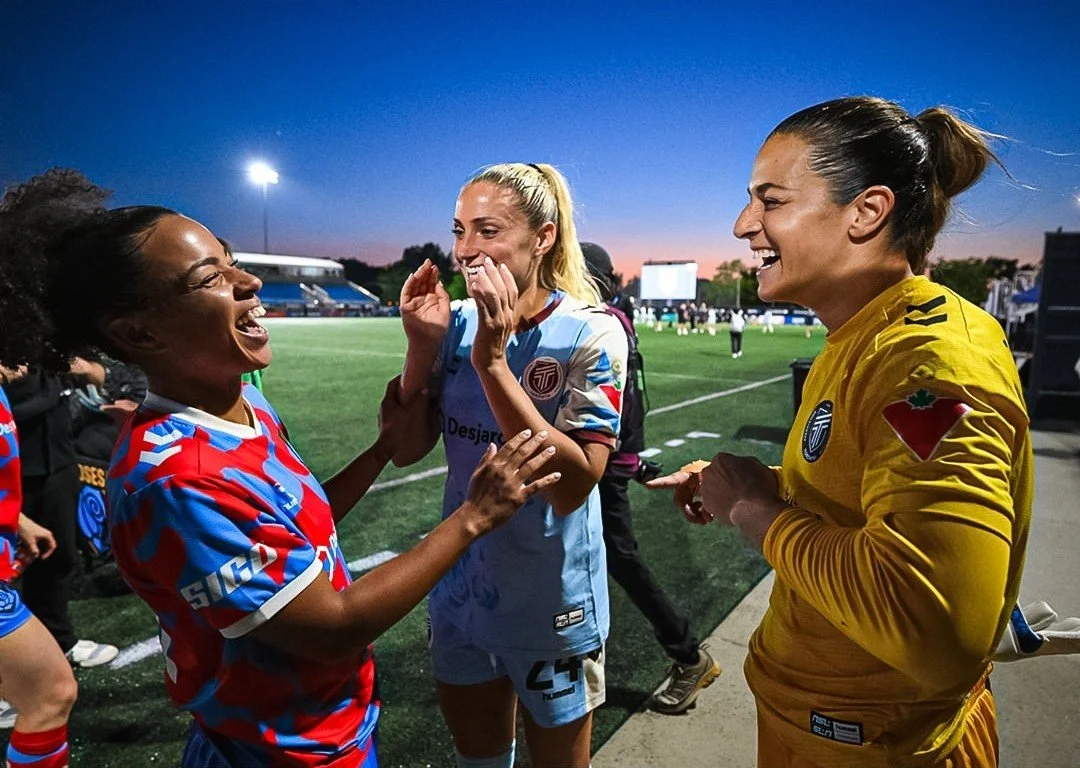
Montréal’s Alidou (left) or Toronto’s Zadorsky (centre) and D’Angelo (right) could have the last laugh at season’s end (Photo credit: Northern Super League)
Which Identity Survives?
That may be the most compelling way to understand the final stretch.
Montréal must prove that patience can survive pressure.
They have the lead, the league's leading scorer and an unbeaten away record. But every opponent now knows what the Roses are trying to protect.
Ottawa must make their attack count while repairing the defensive vulnerabilities that have opened the door to their challengers.
They were once the team setting the pace. Now they are chasing again.
Toronto must finish the comeback.
Closing a 16-point gap to three is impressive. Closing the final three is something else entirely.
The calendar will provide the drama. The direct meetings will provide the swings.
But eventually, the title race will come down to something simpler.
Which team can preserve its identity when preserving it becomes hardest?
Montréal will want to absorb.
Ottawa will want to attack.
Toronto will want to press, control and turn possession into chances.
The title will belong to whichever identity survives the pressure.
Sources
Katrine Pedersen, Ottawa Rapid Head Coach, press conference, 30 August 2026
Marko Milanović, AFC Toronto Head Coach, press conference, 30 August 2026
Sarah Rollins, AFC Toronto player, press conference, 23 August 2026
Maryse Bard-Martel, Montréal Roses Head Coach, press conference, 16 August 2026
AFC Toronto, “Olympic Gold Medallist Shelina Zadorsky Signs with AFC Toronto”, 8 July 2026
AFC Toronto, “Canadian International Sabrina D'Angelo Comes Home to AFC Toronto”, 26 June 2026
Montréal Roses, “ROSES SIGN TWO INTERNATIONAL STARS”, 8 July 2026
Montréal Roses, “AMANDINE PIERRE-LOUIS COMES HOME WITH THE ROSES”, 29 July 2026
Ottawa Rapid, “Ottawa Rapid FC adds defenders Hannah Chown and Elise Bell through 2026“, 21 August 2026
Photo Credits:
Alidou, Zadorsky, and D’Angelo, Northern Super League, 23 July 2026 - Photo courtesy of Northern Super League
Katembo holds up the belt, Jacob Garland, 30 August 2026- Photo courtesy of Jacob Garland
Video Credits:
Elyse Bennett match winner, Northern Super League, 10 May 2026 - Video courtesy @northernsuperleague via X
Nyo Katembo sliding block, Northern Super League, 30 August 2026 - Video courtesy @AFC_Toronto via X
All photos are used with permission. All rights reserved to the creator.

Support PSP Media
Every contribution helps support independent research and reporting