
Africa’s World Cup Moment: Depth, Discipline and the Test That Still Matters
By Nii Wallace-Bruce
A Continent No Longer Waiting For Permission
African football has long been framed through interruption: the breakthrough run, the surprise qualification, the singular team carrying continental expectation.
Cameroon in 1990. Senegal in 2002. Ghana in 2010.
Morocco in 2022 fitted that template. A historic semifinal. A disciplined defensive structure that unsettled Europe’s elite. Hakimi, Amrabat, and Bonou reaching folklore status.
A story widely treated as the exception. But that reading is increasingly incomplete.
Morocco’s clean sheets against Spain and Portugal once looked singular, almost impossible. Four years later they looked less like anomalies than precedents. Cabo Verde frustrated Spain with Vozinha in goal. DR Congo frustrated Portugal. Ghana denied England with a collective effort. The names are different. The pattern remained.
What united those performances was not simply defensive discipline but the confidence to attack with purpose when opportunities appeared.
What is arriving at this World Cup is not another isolated success but the visible outcome of longer-term institutional change. African football is no longer producing one exceptional team. It is producing several different kinds of competitive teams.
CAF’s allocation of nine automatic places has produced visibility with nine African members making it to the Round of 32. But the more significant development is not numerical. It is structural.
South Africa and the Middle Layer of Change
South Africa’s presence at this stage, on the eve of a knockout tie against Canada, captures a more subtle shift.
Not as a singular breakthrough story, but as part of a broader strengthening of CAF’s middle tier.
At first glance, this is a squad rooted in the South African Premier Soccer League. And in a Eurocentric frame, that can be misread as limitation.
But the reality is more complicated. The spine of this team comes from Mamelodi Sundowns and Orlando Pirates—clubs that no longer live purely in domestic cycles. They operate as regular fixtures in continental football, where tempo shifts, refereeing styles vary, and tactical certainty is rare. Mamelodi’s performances against Dortmund, Fluminense and Ulsan at the 2025 Club World Cup were a demonstration of this on an international level.
That changes the psychology of this squad. Bafana Bafana do not arrive in North America as unknown quantities to themselves. They arrive as a group accustomed to adaptation.
South Africa’s patience with Hugo Broos over the last six years was rewarded on the continent with a bronze medal at AFCON 2023. Bafana Bafana became organised rather than expansive.
This has subsequently been converted into a debut appearance in the knockout stages in North America, 16 years after becoming the first host nation to exit the World Cup at the group stage.
That recalibration in itself is validation.
Beyond Morocco: From Exception to Reference Point
Morocco’s 2022 run is often treated as a deviation from African football’s norm. Yet that interpretation now feels too narrow.
Not because Morocco was predictable—but because the conditions that enabled it were already in motion: improved coaching education, stronger tactical literacy, diaspora integration, and sustained exposure to elite European environments.
The mistake is to view Morocco as the beginning. It may have been the first fully visible expression of a longer process.
Morocco did not redefine African football in 2022. It revealed what had already been changing within it.
A diversified continent, not a unified style. What has changed is not simply the quality of African footballers, but the institutional environments in which they are developed, coached and prepared for major international competitions.
What distinguishes this CAF cohort is not a single golden generation, but a widening distribution of competence.
Across the six teams already examined in this cycle—Senegal, Côte d’Ivoire, Ghana, Egypt, Tunisia and Cabo Verde—a pattern emerges, but not a uniform one.
Senegal: structure, control, defensive discipline
Côte d’Ivoire: adaptability and resilience
Ghana: transitional identity, still stabilising
Egypt: conservative organisation and game management
Tunisia: compact structure, low-event control
Cabo Verde: system clarity despite resource limits
Taken together, this is not convergence toward one identity. It is divergence within competitiveness.
That distinction matters.
Because it suggests CAF is no longer defined by a shared stylistic label—athletic, expressive, unpredictable—but by the coexistence of multiple tactical models capable of functioning at World Cup level.
Not every trajectory has been upward. Tunisia's group-stage exit coupled with an abrupt coaching change was a reminder that progress remains uneven across the confederation. Yet one underperforming campaign does not negate the broader trend any more than Morocco's semi-final in 2022 defined an entire continent. The significance lies in the distribution of competitive teams, not universal excellence.
African football, in other words, is no longer a category. It is an ecosystem.
The Tactical Shift: From Individual Brilliance to Tournament Logic
For years, African teams were discussed in terms of individual quality set against structural vulnerability. That framing is no longer sufficient.
Across multiple CAF sides there is now visible fluency in tournament football:
Teams are defending with greater collective clarity, pressing from recognisable triggers and controlling matches after taking the lead rather than merely surviving them.
These are not aesthetic changes. They are survival mechanisms.
The change is not simply that African teams defend better. It is that they recognise when to defend, when to press and when to slow matches. Those decisions, once treated as signs of experience associated with Europe's elite, are becoming increasingly common across CAF's strongest sides.
And survival is the currency of knockout football. CAF’s decision to expand the men’s African Cup of Nations from 16 to 24 teams proved invaluable. The gruelling compact group stage conditions and qualifying scenarios have translated directly into World Cup experience. Eight of the nine African members of the World Cup 2026 knockout stage were quarter-finalists at either of the 2023 or 2025 Cup of Nations. Ghana’s Black Stars were the exception.
The more significant development is that these behaviours are no longer isolated.
They are distributed.
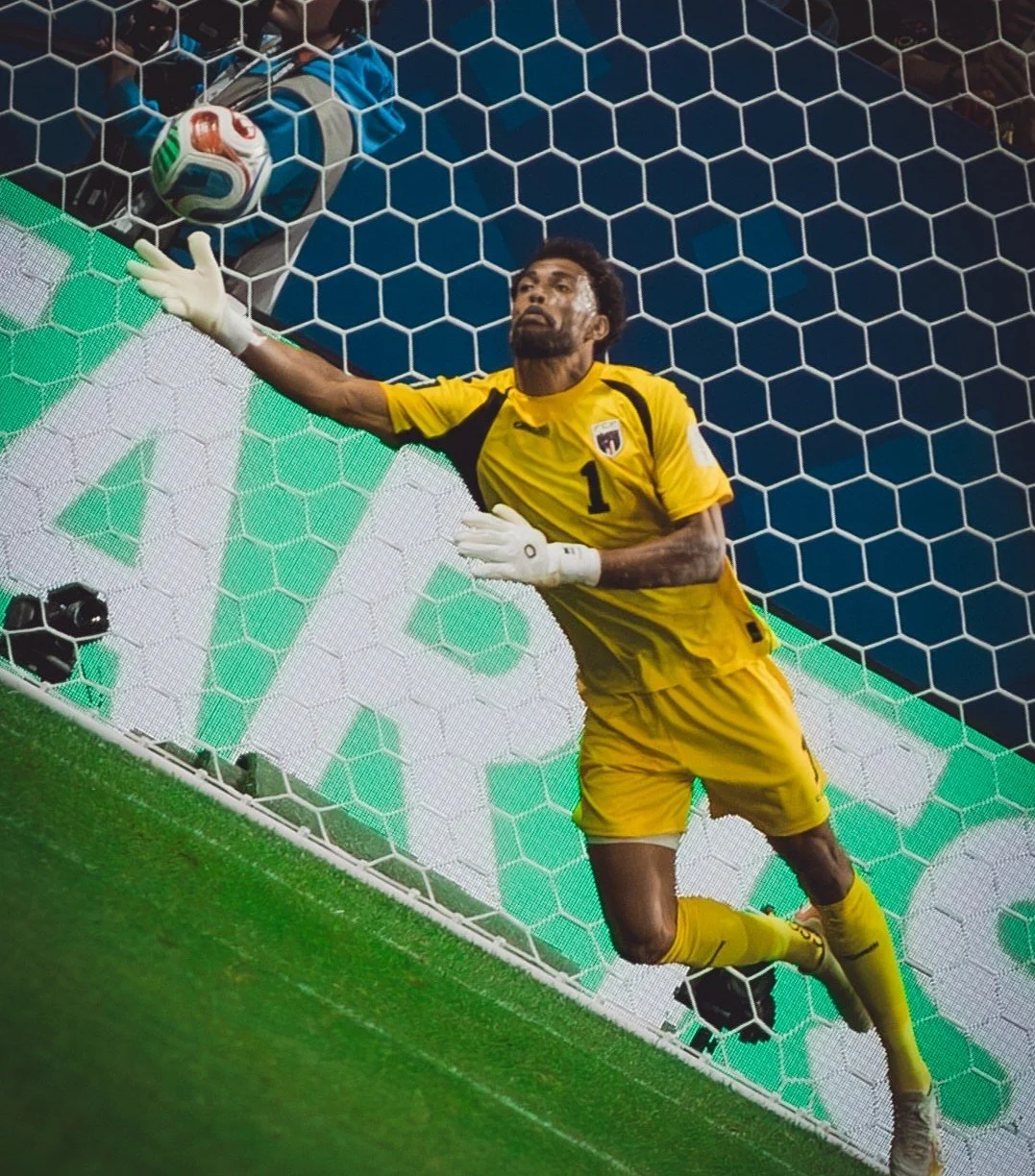
Vozinha’s international career includes two quarter-final finishes with Cabo Verde at the African Cup of Nations. (Photo Credit: Grzegorz Wajda)
The Illusion and Limitation of Volume
CAF’s numerical presence at this World Cup is its most visible headline. Nine teams reaching the Round of 32 suggests strength in depth.
Especially when considering the recent editions had an entry quota of 32 teams. But volume is not validation.
The expansion to 48 teams changes the baseline of qualification. It raises representation, but it does not automatically raise competitive standards at the decisive stage.
That distinction will matter in the coming days. Because World Cup history is not written in participation. It is written at thresholds.
And CAF’s current threshold is not qualification. It is conversion. The real test: conversion under knockout pressure
The next seven days will compress years of development into binary outcomes.
If multiple African teams reach the Round of 16, the interpretation of this era will shift decisively. If most are eliminated at the first knockout round, the narrative will likely revert to familiar language: potential, promise, and “learning experience.”
That is the harsh logic of the FIFA World Cup. It does not measure trajectory. It measures survival.
And survival at scale is the only meaningful confirmation of change.
Comparative Context: No Confederation is Static
This is not a story of African progress against global stagnation.
Asia continues to produce consistently competitive teams, with Japan being the standout. Australia remains tactically resilient under Tony Popovic. If anything, the 2026 edition exposed deficiencies in West Asia relating to homegrown players. CONCACAF heavyweights benefit from structural qualification advantage and increasing investment, particularly in North America. Mexico, Canada and the USA will be tested in 2030 when there won’t be the benefit of host seeding. Europe’s depth at elite level remains unmatched.
But CAF’s distinguishing feature is not superiority. It is density.
Coaching stability has quietly underpinned much of this progress. Seven of CAF's nine knockout qualifiers retained the coaches who guided them through qualification (Ghana and Morocco did not), giving tactical ideas time to mature beyond simply reaching the tournament. South Africa's patience with Hugo Broos is the clearest example, but it is part of a broader trend: continuity is increasingly replacing the managerial churn that once characterised many African national teams.
Multiple African teams now arrive at tournaments with similar levels of tactical preparation and experience, even in the absence of elites such as Cameroon and Nigeria.
That combination is new.
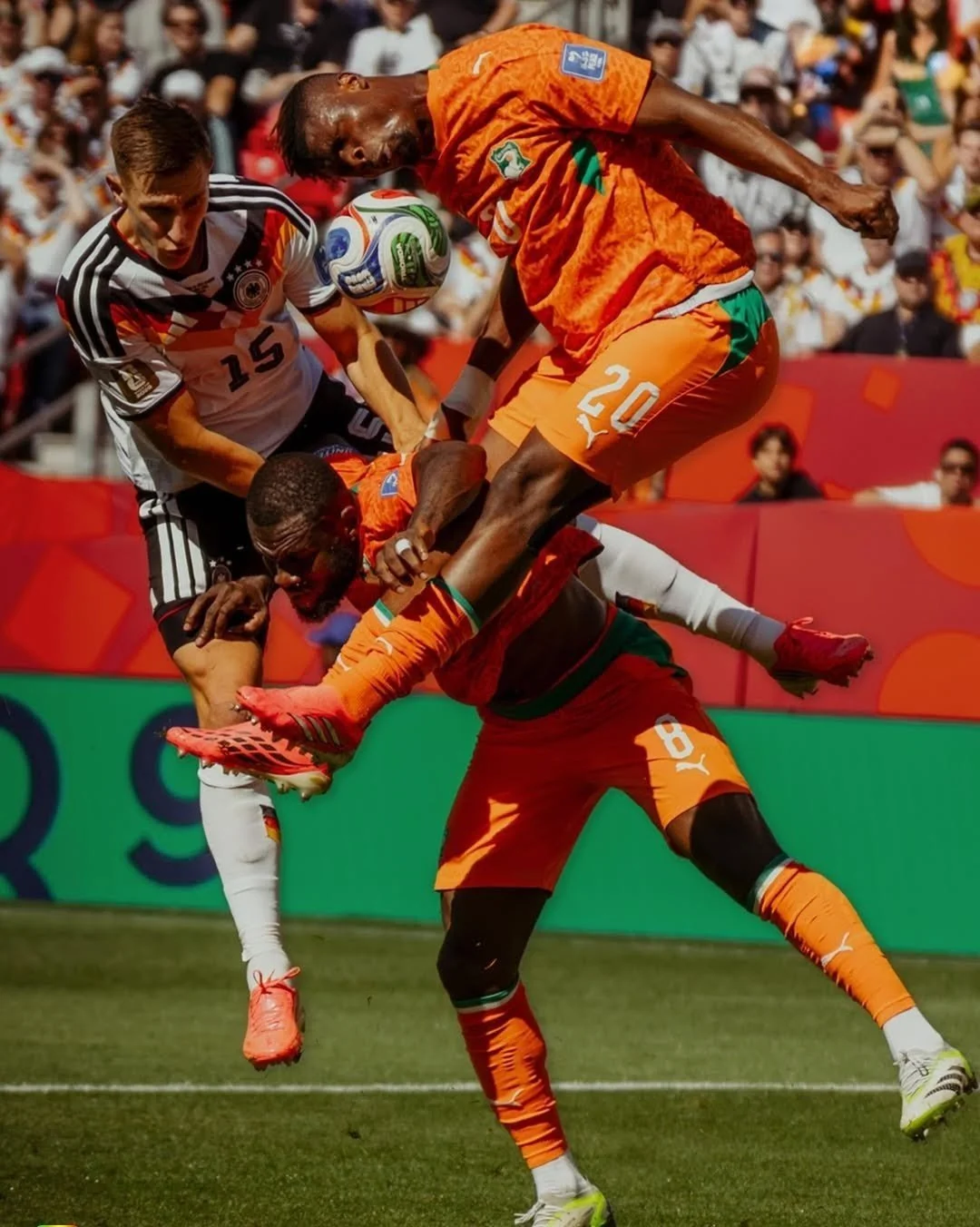
Nico Schlotterbeck and Germany felt the full force of Côte d’Ivoire when the teams met in Toronto during the group stage (Photo credit: Max Galys)
A Continent Under a Single Examination
There is a temptation to treat CAF’s teams as separate narratives unfolding in parallel. But knockout football collapses those narratives into a single outcome-based framework.
In that sense, Africa arrives not as a collection of individual stories, but as a bloc under examination. It is a competitive ecosystem.
Yet unlike past cycles, the examination is no longer about whether African teams belong. That question has largely been answered.
The question now is more precise:
Can that belonging survive contact with the final stages of the World Cup?
Conclusion: From Emergence to Evidence
Africa no longer needs permission to belong. The only remaining question is how often it can stay.
What this World Cup offers instead is something more demanding: confirmation.
An examination of whether tactical evolution, investment and player development can now be consistently converted into knockout success. Morocco provided one answer in 2022.
This FIFA World Cup will determine whether that answer stands alone—or becomes the first chapter in a broader transformation of African football’s place at the top level.
Either way, the next week will not define the continent.
The story of African football no longer hinges on whether one team can surprise the world. It rests on whether a continent can make excellence feel routine.
Photo Credits:
Vozinha save, Grzegorz Wajda, 15 June 2026 - Photo courtesy of Grzegorz Wajda and Maciej Rogowski - @ball.raw via Instagram
Yamal and Semedo, Grzegorz Wajda, 15 June 2026 - Photo courtesy of Grzegorz Wajda and Maciej Rogowski - @ball.raw via Instagram
Players collide, Max Galys, 20 June 2026 - Photo courtesy of Max Galys
Video Credits:
John Walker, UEFA Licensed Coach and Scout, 28 June 2026 via Twitter @johnwalker_1986
All photos are used with permission. All rights reserved to the creator.

Support PSP Media
If this article resonated with you, consider supporting PSP Media.
Every contribution helps support independent research and reporting