
Cabo Verde's Draw With Spain Wasn't a Miracle. It Was a Warning.
By Nii Wallace-Bruce
The Easy Narrative Misses the Point
The easy story writes itself. Spain, one of football's aristocrats, held by Cabo Verde, a nation of barely half a million people making history on the World Cup stage.
The headlines almost compose themselves: shock, upset, giant-killing, miracle.
Yet football rarely rewards those who stop at the surface.
Spain were favourites in Atlanta. They possessed the deeper squad, the greater resources and the heavier history. But a draw was never outside the plausible range of outcomes. Not if you had been paying attention.
Not if you had followed Cabo Verde's journey. Not if you had noticed how the global game is changing.
A Project Years in the Making
For years, Cabo Verde have been constructing something deliberate. Their emergence did not begin at this World Cup. It did not begin in qualifying. It did not even begin this decade.
Of the four World Cup debutants, Cabo Verde arrived with one of the strongest competitive records within its confederation.
The foundations were laid through a targeted and intelligent use of the diaspora, connecting talent developed across Europe to a national project with clear purpose. When considering that Portuguese legend Nani was eligible for Cabo Verde, the talent was available. Contact was required, even if it meant unusual methods. The rewards became visible at the Africa Cup of Nations. Quarter-final appearances in 2013 (on debut) and 2023, separated by a round of 16 finish in 2021, demonstrated that the Blue Sharks were becoming far more than a romantic underdog. Their 2013 quarter-final run arrived in the same year a FIFA suspension prevented Cabo Verde from reaching the final round of qualifying for Brazil 2014, despite finishing ahead of Tunisia on the field. Goalkeeper Vozinha was a mainstay throughout those formative years.
Tournament football leaves clues long before the wider world notices.
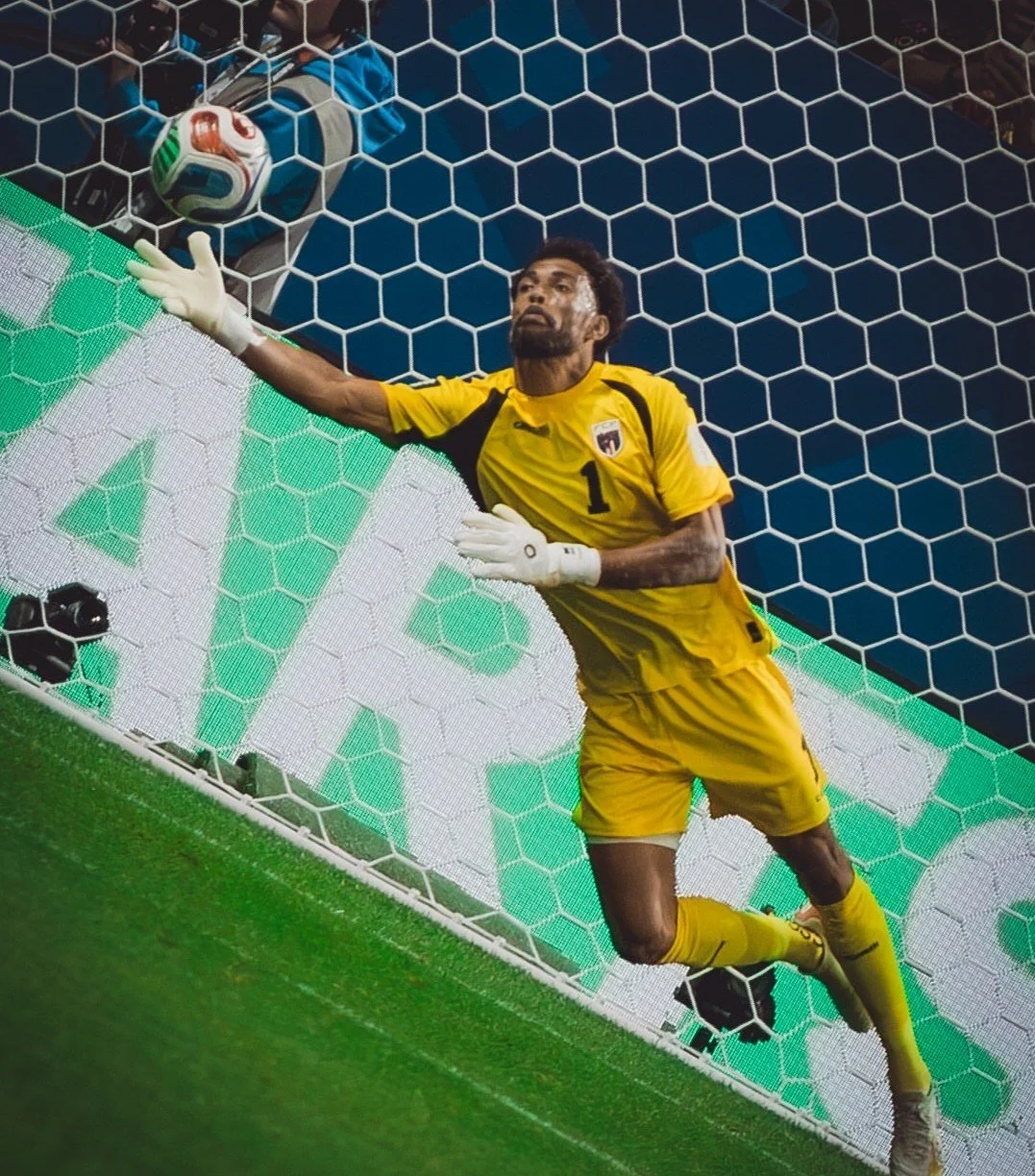
Vozinha’s international career stretches all the way back to the beginning of Cabo Verde’s major tournament history. (Photo Credit: Grzegorz Wajda)
Why Cabo Verde Were Ready
Cabo Verde's progress has been built on organisation, athleticism and tactical discipline, but reducing them to a defensive side would be misleading. During qualification they consistently used rotational movement to create attacking angles, accelerating vertically whenever opportunities appeared. Their set-piece execution became a genuine weapon, helping dispatch opponents including Cameroon. They are capable of hurting teams in multiple ways.
Yet the foundation remains their defensive structure.
Compact. Patient. Relentless.
Cabo Verde coach Bubista has been in the role since 2020—an eternity in modern international football. That patience off the pitch is reflected in the patience his team shows on it. Qualification repeatedly demonstrated the point. Cabo Verde were comfortable defending deep, but equally comfortable breaking lines when opportunities emerged. Set pieces became a source of both goals and control, while rotational movement in attack prevented opponents from simply sitting on crosses and direct balls. This was not a side built to survive. It was a side built to compete.
Against Spain, that low block was not an act of desperation. It was a strategic choice. Every metre conceded was calculated. Every passing lane closed carried purpose. Every transition carried a threat. This was expected of the Blue Sharks. What may not have been expected was the bravery with which Cabo Verde stood up to Spain from kick off. Through build-up play as well as pressing out of possession, the Tubarões Azuis were coming to play, rather than participate. In a Man of the Match display, the evergreen Vozinha showed defensive brilliance with crucial saves as well as discipline when building play from the back.
The surprise was not that Cabo Verde could execute such a plan.
The surprise was how many people seemed unaware they could.
There is another side to this story, too.
Spain's Vulnerabilities Were Already Visible
This is not the Spain side of a decade ago. Nor is it even the 2024 edition of La Furia Roja that lifted the European Championship in Germany.
The midfield remains technically gifted but lacks some of the control and incision that came from having players such as Pedri at full strength. Rodri’s road back from a knee injury has had potholes. Gavi's struggles for rhythm have altered the balance. Dani Carvajal is no longer present. Marc Cucurella’s advanced positioning has occasionally contributed to Spain's lack of attack clarity, with possession often outweighing creativity in the final third. Possession remains abundant. Penetration is not always. Álvaro Morata has exited the international stage, leaving persistent questions about who exactly carries the burden of goals through the middle. Lamine Yamal is already a Ballon d’Or candidate and yet an established nation is asking a lot of him at such a young age.
Spain still monopolise possession. They still dominate territory. They still move opponents around the pitch with enviable precision.
What they no longer possess is the suffocating inevitability of their greatest generations.
The old "death by a thousand passes" is gone.
The blueprint for frustrating Spain has already existed. Iraq offered a glimpse in a pre-tournament friendly, using a disciplined defensive block, rapid counters and calculated disruption to expose vulnerabilities. Spain may well solve those problems as this tournament develops. Their technical quality remains immense.
But Cabo Verde did not discover an entirely new weakness.
They exploited one that was already visible.
That matters.
Because this result belongs to a broader trend unfolding across the tournament.
The Global Game Is Catching Up
Five days into the competition, UEFA nations have found life considerably more difficult than many predicted. European teams have stumbled repeatedly. Several arrived burdened by assumptions that no longer match football's reality.
The old hierarchy still exists. It is simply less absolute.
The CONMEBOL quartet of Paraguay, Ecuador, Brazil, and Uruguay discovered that.
The days of pencilling in victories based on confederation alone are disappearing.
Football globalisation has reached a point where expertise, tactical sophistication and elite player development are no longer concentrated within a handful of traditional centres of power. Coaching ideas travel faster. Data travels faster. Players travel faster.
Styles travel faster.
A well-drilled national team from Africa, Asia, or CONCACAF can now reproduce many of the tactical principles once associated exclusively with Europe's elite. The differences increasingly emerge in depth, not understanding.
The gap has narrowed.
Not vanished.
Narrowed.
Morocco announced that reality to the world in Qatar. Their run was interpreted by some as an exception. It may prove to have been an early chapter.
Other versions are coming.
Perhaps Cabo Verde are one of them.
That possibility explains why this draw resonates beyond a single afternoon in Atlanta.
The reaction reveals how strongly football remains influenced by Eurocentric assumptions. Even now, many discussions begin from the premise that success by nations outside of the traditional power centres requires extraordinary explanation, while success by established powers is treated as football's natural order.
Yet history rarely moves according to established opinion.
The global game is becoming more global.
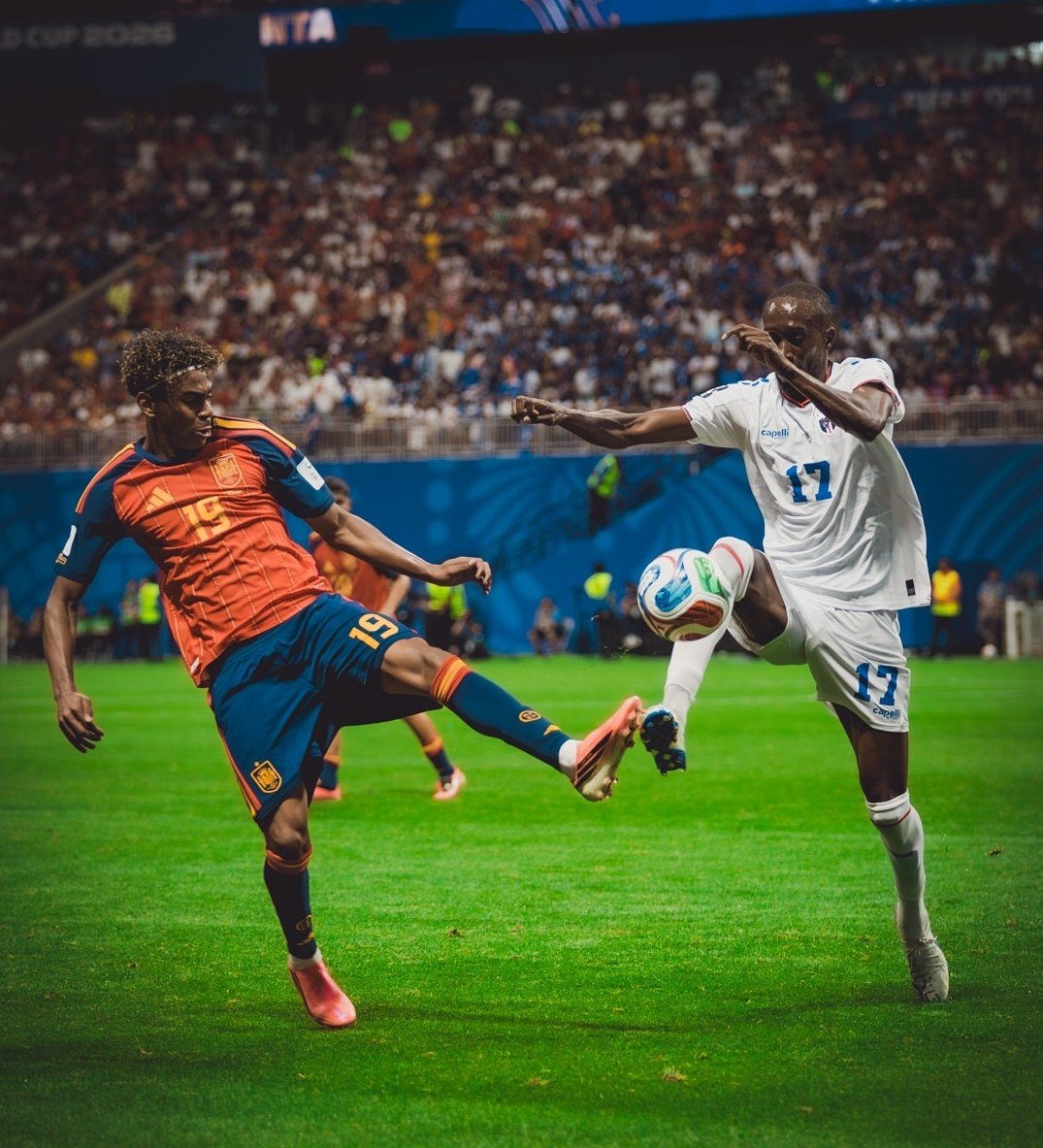
Spain’s Lamine Yamal, born to Moroccan parents, contests the ball with Cabo Verde’s Willy Semedo, born in France. (Photo Credit: Grzegorz Wajda)
Beyond the Myth of the Upset
The evidence is visible in scouting networks, migration pathways, coaching education and player development systems stretching across continents. It is visible in the narrowing margins between teams. It is visible in results that once seemed impossible and now merely feel surprising.
Cabo Verde did not arrive at this World Cup by accident.
They arrived through planning.
Through patience.
Through years of steady competitive growth.
And when the final whistle sounded against Spain, the result felt less like a miracle than a reminder.
The world is catching up.
The powers of football's Global North were put on notice by Morocco.
They are still being put on notice now.
The next warning may come from somewhere else entirely.
But on this day, it came from a volcanic archipelago in the Atlantic that has spent years preparing for the moment when the world finally started paying attention.
Sources
The Guardian, Cape Verde Islands thrown out of Africa World Cup qualifiers by FIFA, 12 September 2013
Reuters, How LinkedIn led Lopes on World Cup adventure with Cape Verde, Phillip O’Connor, 13 June 2026
John Walker, UEFA Licensed Coach and Scout, 15 June 2026 via Twitter @johnwalker_1986
FIFA Training Centre, Spain 0 Cabo Verde 0 - POST MATCH SUMMARY REPORT, 15 June 2026
Photo Credits:
Vozinha save, Grzegorz Wajda, 15 June 2026 - Photo courtesy of Grzegorz Wajda and Maciej Rogowski - @ball.raw via Instagram
Yamal and Semedo, Grzegorz Wajda, 15 June 2026 - Photo courtesy of Grzegorz Wajda and Maciej Rogowski - @ball.raw via Instagram
Video Credits:
Raees Mahmood, Sky Sports Analyst, 15 June 2026 via Twitter @pythaginboots
All photos are used with permission. All rights reserved to the creator.

Support PSP Media
If this article resonated with you, consider supporting PSP Media.
Every contribution helps support independent research and reporting.