
From Québec's renewed professional identity to the movement of coaches, players and continental ambitions, the Canadian Premier League is beginning to build something that extends beyond its clubs.
By Nii Wallace-Bruce
Canadian soccer has spent much of its modern history looking outward.
Its most promising young men have sought opportunities abroad, its professional clubs have operated in the shadow of Major League Soccer, and its domestic game has often struggled to establish an identity of its own.
The Canadian Premier League was created, in part, to change that equation for the men’s game.
Eight seasons into its existence, the most interesting evidence of its progress is becoming increasingly difficult to measure through the league table alone.
Across the competition, the foundations of a recognisable football ecosystem are beginning to emerge. Clubs are developing identities rooted in their communities.
Coaching knowledge is moving between organisations.
Canadian players are finding opportunities to build careers closer to home, while the prospect of multiple continental representatives is giving the domestic game a broader competitive horizon.
These developments are connected.
Together, they offer a glimpse of what the CPL might become: not simply a competition for professional clubs, but an environment in which footballing knowledge, talent and ambition can circulate and grow.
Four developments illustrate that progression.
A Home For Québec Football
To understand what FC Supra du Québec represents, it is necessary to look beyond its inaugural CPL campaign.
The club is the latest chapter in a much longer story of professional football in Québec: one characterised by periods of extraordinary enthusiasm, ambitious clubs, talented local players and the recurring challenge of establishing a sustainable professional presence in the province.
Football has deep roots in Montréal, shaped in large part by successive waves of immigration and the communities that brought the game with them.
Long before the current generation of professional clubs, the sport had established itself through neighbourhood organisations, ethnic clubs and regional competitions.
By the middle of the twentieth century, Montréal had developed a vibrant football culture, with clubs such as Montréal Italia and Ukraina becoming important parts of the city's sporting landscape.
Professional football arrived with similar ambition. The Montréal Olympique entered the North American Soccer League in 1971, but lasted just three seasons.
A decade later, the Montréal Manic captured the city's imagination.
Their arrival in 1981 produced an immediate connection with supporters, culminating in a crowd of 58,542 at Olympic Stadium for a playoff match against the Chicago Sting.
It remains one of the largest attendances ever recorded for a Canadian club football match. Yet, despite that remarkable response, the Manic disappeared after the 1983 season.
The next attempt came in 1988, when the Montréal Supra entered the Canadian Soccer League.
Unlike a franchise built primarily around an external ownership structure, the original Supra was conceived as a community-oriented project, with a commitment to providing a professional platform for local players. In its inaugural season, 13 of the club's 18 players came from Québec's semi-professional league.
The team included several players who would go on to shape Canadian and Québec football, among them Mauro Biello, Nick De Santis, Alex Bunbury and Mark Watson.
The Supra was more than another professional team. It represented an opportunity for Montréal's existing football community to see its own players compete at the highest domestic level.
Its early years were accompanied by genuine enthusiasm, but financial difficulties and instability eventually caught up with the organisation.
The collapse of the Canadian Soccer League in 1992 brought the club's existence to an end.
Yet its disappearance did not mark the end of professional football in Montréal. On December 10, 1992, the Montréal Impact was officially announced, with its inaugural season following in 1993.
The Saputo family, already involved in the original Supra, helped carry elements of that legacy into the new organisation. Several former Supra players, including Biello and De Santis, would subsequently become important figures in the Impact's history.
The Impact's subsequent development demonstrated that professional football could establish deeper roots in the province.
Its championship successes, the opening of Stade Saputo in 2008 and eventual transition into Major League Soccer in 2012 gave Montréal a sustained presence at the highest levels of North American club football. But that success also left a broader question unanswered: how could the professional game serve the considerable footballing talent and communities that existed beyond the established first team?
The return of FC Supra du Québec is an attempt to address that question.
The club's name and colours deliberately recall the original Montréal Supra, but its ambitions extend beyond nostalgia. The change from Montréal Supra to FC Supra du Québec is significant.
Rather than positioning itself exclusively as a club for the city, the new organisation has presented itself as a professional platform for the province.
Its guiding principle, d'ici, pour ici — from here, for here — reflects an ambition to connect Québec's existing football infrastructure with a professional destination for its players and coaches.
That ambition has been shaped by a growing recognition of the talent already being developed across the province.
Clubs such as CS Saint-Laurent, FC Laval, AS Blainville and CS Longueuil have contributed to a substantial regional football network.
CS Saint-Laurent's Ligue 1 Québec win in 2023, followed by a Canadian Championship victory over Halifax Wanderers in 2024, offered a particularly visible reminder of the quality emerging outside the established professional structure. A key player from that period, Loïc Kwemi was one of the first signings by FC Supra in 2025.
Kwemi’s first season has been a landmark for both player and club with the marksman scoring 15 goals and winning the CPL Golden Boot.
For FC Supra president and co-founder Rocco Placentino, the project is therefore about more than introducing another team to the greater Montréal market.
It is about creating a professional organisation capable of supporting the wider Québec football community, giving local players a pathway into the CPL while providing existing clubs with a stronger connection to the professional game.
The ambition became tangible on October 25, 2026.
Eight points outside the playoff places with five matches remaining, Supra needed an extraordinary finish to their inaugural campaign.
A 4-3 victory over Halifax Wanderers, combined with Vancouver FC's defeat to Cavalry FC, secured fourth place and a historic postseason berth.
Sean Rea's late winner completed a remarkable turnaround. It was a sporting achievement, certainly, but also an important moment for a project whose significance extends well beyond its first season.
If the end of the regular campaign represented a dream come true, the opening ten minutes of the home leg of the semi-final against Cavalry must have felt like fantasy.
Zachary Brault-Guillard's opener and an own goal helped secure a 2-1 victory, giving the newest CPL club a debut postseason win. Brault-Guillard had spent time in France and Switzerland as well as stint in the MLS with CF Montréal before joining FC Supra in the summer.
Supra's achievement should not be viewed simply as an expansion club exceeding expectations. Its significance lies in the history behind it.
From the Olympique and Manic to the original Supra and the Impact, professional football in Montréal has repeatedly demonstrated its capacity to attract interest and produce important players.
What has proved more difficult is building institutions capable of sustaining that momentum and extending its benefits across the province.
FC Supra du Québec now has an opportunity to do precisely that. Its challenge is not simply to win matches or establish itself in the CPL.
It is to become a meaningful part of the football culture that made its arrival possible.
A professional club with genuine regional roots offers something more durable than a new franchise competing for the same trophy.
It provides a connection between generations of players, community organisations and supporters, while giving an established football culture a new opportunity to shape its own professional future.

The FC Supra logo and colours are a nod to a club from a previous era (Photo Credit: Anaïs Fabra)
Knowledge Travels
If Supra illustrates the importance of local identity, Forge FC demonstrates another ingredient in the development of a football ecosystem: institutional continuity.
Since the league's inaugural season, Forge have established themselves as one of its defining organisations.
Their sustained competitiveness under Bobby Smyrniotis has been accompanied by something less visible, but potentially just as consequential: the development and movement of coaching knowledge.
Smyrniotis arrived in Hamilton with a background in player development, having helped build Sigma FC into one of Canada's most productive development environments.
At Forge, he established a demanding football structure, combining tactical flexibility with an emphasis on technical quality, positional understanding and competitive standards.
Over time, that environment has become a source of experience that can extend beyond the club itself.
Kyt Selaidopoulos provides a particularly interesting example. After spending nearly six seasons as an assistant under Smyrniotis at Forge, the Montréal-born coach moved into the head coaching role at FC Supra in September 2026. In an interview with RDS in August 2026, Selaidopoulos had expressed a desire to one day be a head coach at club level. Then an opportunity presented itself close to home.
Selaidopoulos blended experience from one of the CPL's most established organisations with his own background, which included futsal and beach soccer. The new project allowed him to demonstrate his understanding of professional demands, coaching methodology and the value of an established working environment.
His immediate impact was considerable. Supra finished the regular season unbeaten in his five matches in charge, winning four and drawing one to complete their remarkable playoff qualification. Players such as Brault-Guillard, who had experienced reduced playing time towards the end of his time at Lugano in the Swiss Super League, were given a boost of confidence playing in a province that connected all of them.
Forge's influence, in this respect, cannot be measured solely through trophies. It can also be seen in the people who leave Hamilton and carry elements of that experience into other organisations.
A successful club wins matches; an influential club can help raise the standards of the competition around it.
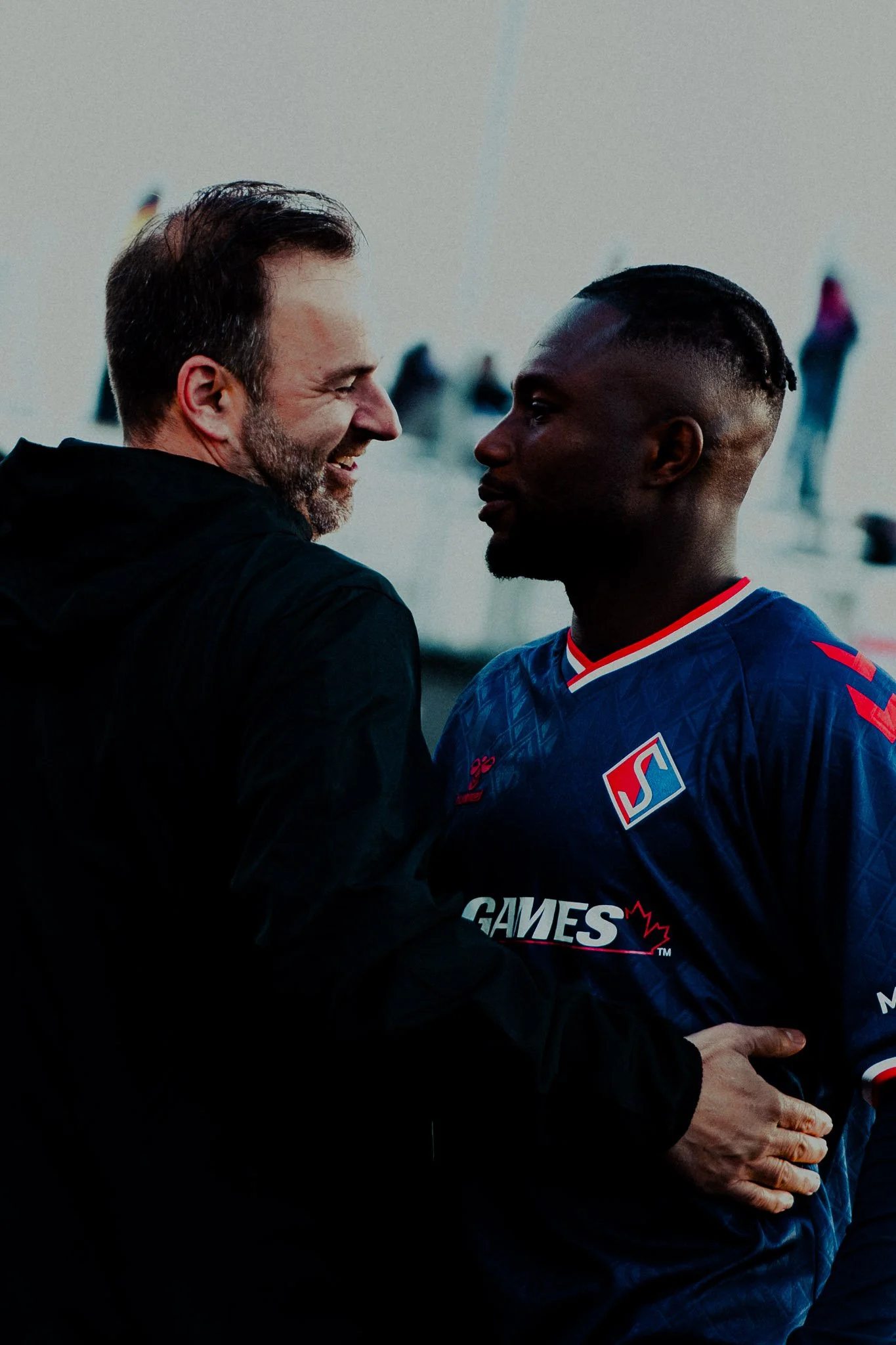
Kyt Selaidopoulos has reinvigorated players including semi-final goal scorer Zachary Brault-Guillard (Photo Credit: Anaïs Fabra)
The Value of Coming Home
For Canadian players, the professional pathway has often been defined by movement away from home.
Going abroad remains an important ambition, and rightly so. Exposure to different footballing environments can accelerate development and broaden a player's understanding of the game.
But the existence of a domestic professional league introduces another possibility: leaving, gaining experience and returning to a meaningful opportunity within Canadian football.
Nicolas Fleuriau Chateau's arrival at Atlético Ottawa is a compelling example.
Born in Ottawa, the forward developed locally with Capital United and West Ottawa before pursuing his career through NCAA soccer, Vancouver Whitecaps FC, Finland's Vaasan Palloseura and Ireland's Galway United. When speaking to CPLSoccer.com, Fleuriau Chateau said “it was hard to say no when the option to come home came up”.
His journey reflects the increasingly international nature of Canadian player development.
Opportunities emerged through different footballing environments, but his next chapter brought him back to the city where his footballing education began.
By the time he joined Atlético in July 2026, his spell at Galway had offered limited playing time. Similar to Zachary Brault-Guillard at FC Supra, Ottawa provided something increasingly valuable: an opportunity to play regularly, rebuild momentum and do so in front of family and friends.
He wasted little time making an impression.
Two days after signing, Fleuriau Chateau scored a dramatic stoppage-time winner against Pacific FC on his debut.
His pace, directness and willingness to attack space gave Atlético a different dimension, while his subsequent contributions helped revive the defending champions' season.
By the end of the regular campaign, he had established himself as one of the league's most influential mid-season additions.
His seven goals and three assists have put Canada’s capital club in a position to repeat their 2025 championship winning effort, even with a different format.
Yet the significance of his return extends beyond individual performances.
Atlético offered a professional destination for a player who had experienced several footballing environments but still had an opportunity to build something at home.
While Fleuriau Chateau’s postseason debut did not grab the headlines against Forge, his link up play and movement with Ballou Tabla helped Atletico secure a valuable 2-2 draw after the first-leg at home.
There is an important distinction between keeping players in Canada and creating conditions that make returning attractive.
The latter requires competitive clubs, meaningful playing opportunities and an environment in which ambition does not have to be sacrificed.
The CPL cannot prevent every talented Canadian from pursuing opportunities abroad. Nor should it try. Its value lies in ensuring that the pathway does not make Canada a perennial departure lounge for talent.
For Fleuriau Chateau, Ottawa has provided the opportunity to reconnect with his roots without stepping away from his professional ambitions. For the league, his return offers a glimpse of what a functioning domestic pathway can look like.
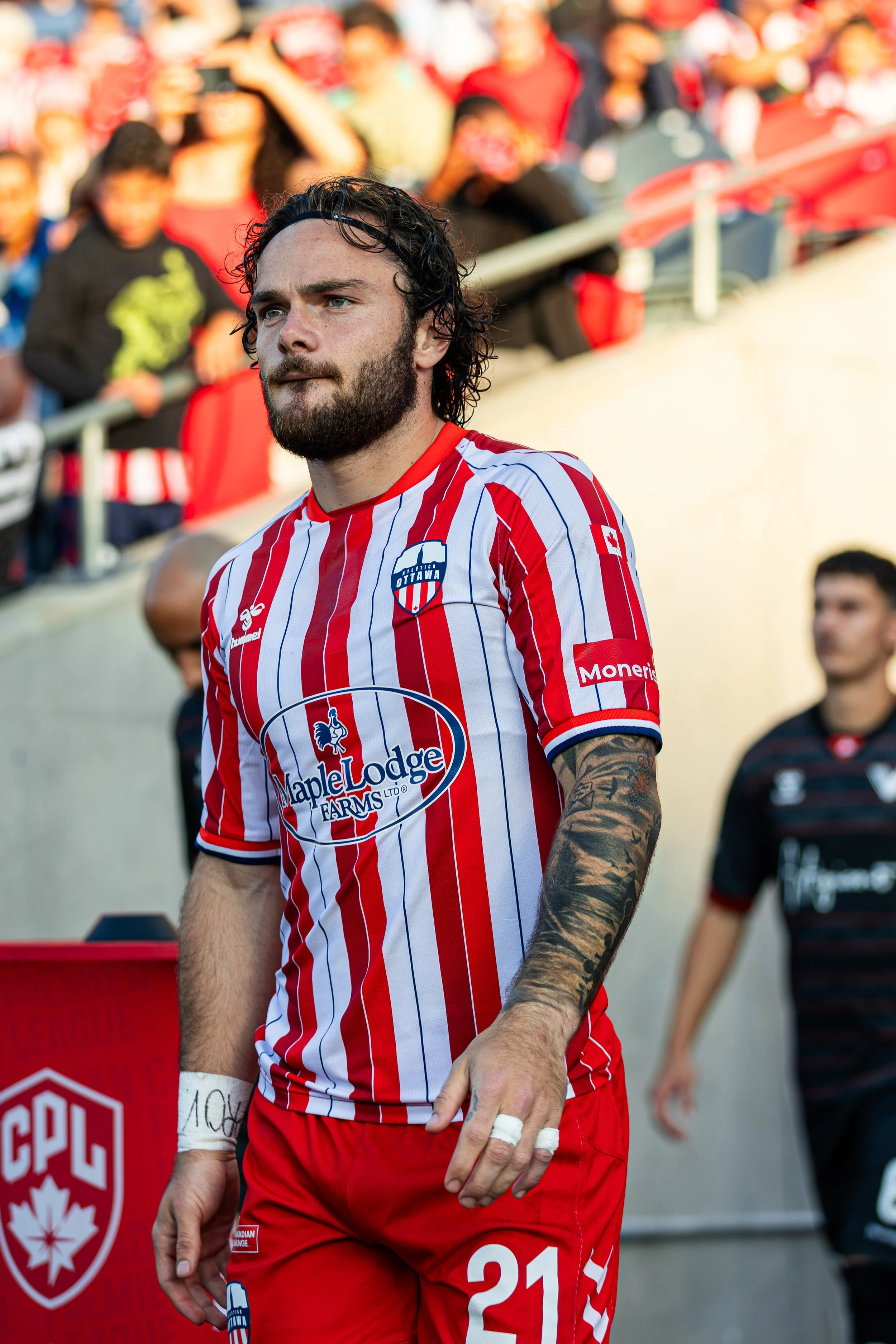
The lure of playing at home proved to be irresistible for Ottawa’s Nicholas Fleuriau Chateau (Photo Credit: Simon Circe)
A Continental Horizon
The final measure of a league's development is not simply how it performs against itself, but how effectively its clubs can compete beyond its borders.
Here, the CPL has another opportunity.
Canada has three guaranteed places in the 2027 Concacaf Champions Cup from Canadian competition: one for the CPL Shield winner, one for the playoff champion and one for the Canadian Championship winner. Further, the Vancouver Whitecaps of the MLS secured their place in the competition after finishing at the top of the Western Conference.
Cavalry FC secured the 2026 CPL Shield on the final day of the regular season, while Forge FC defeated CF Montréal to win the Canadian Championship a few days prior.
The remaining Concacaf Champions Cup qualification place will be determined by the outcome of the CPL playoffs.
Should a different club win the North Star Cup, three CPL organisations would represent Canada in the region's premier club competition.
That prospect carries significance beyond the additional exposure. Continental football introduces demands that domestic competition alone cannot replicate.
Travel, squad depth, tactical adaptability and the ability to compete against established organisations from Mexico, the United States, Central America and the Caribbean all become part of the equation.
It also changes the incentives facing clubs.
Building a squad capable of winning a domestic campaign is one challenge; assembling an organisation capable of sustaining itself across domestic and continental competition is another.
For Forge, Cavalry and potentially another playoff contender, the opportunity is not simply to participate. It is to test the quality of their structures against a broader regional standard.
The CPL has already had a glimpse of what continental participation can mean for a club's profile.
Vancouver FC's qualification for the 2026 competition, secured as the Canadian Championship runner-up, offered an important precedent for the league's ambitions.
Forge FC’s breakthrough win in the Canadian Championship, the first CPL side to lift the Voyageurs Cup, will also serve as inspiration for other sides.
Three distinct representatives in 2027 would take that progression further.
More importantly, regular continental involvement would give the league something it needs: an external measure of its development.
Domestic dominance can establish a club's position within the competition, but international competition reveals how much of that success translates beyond it.
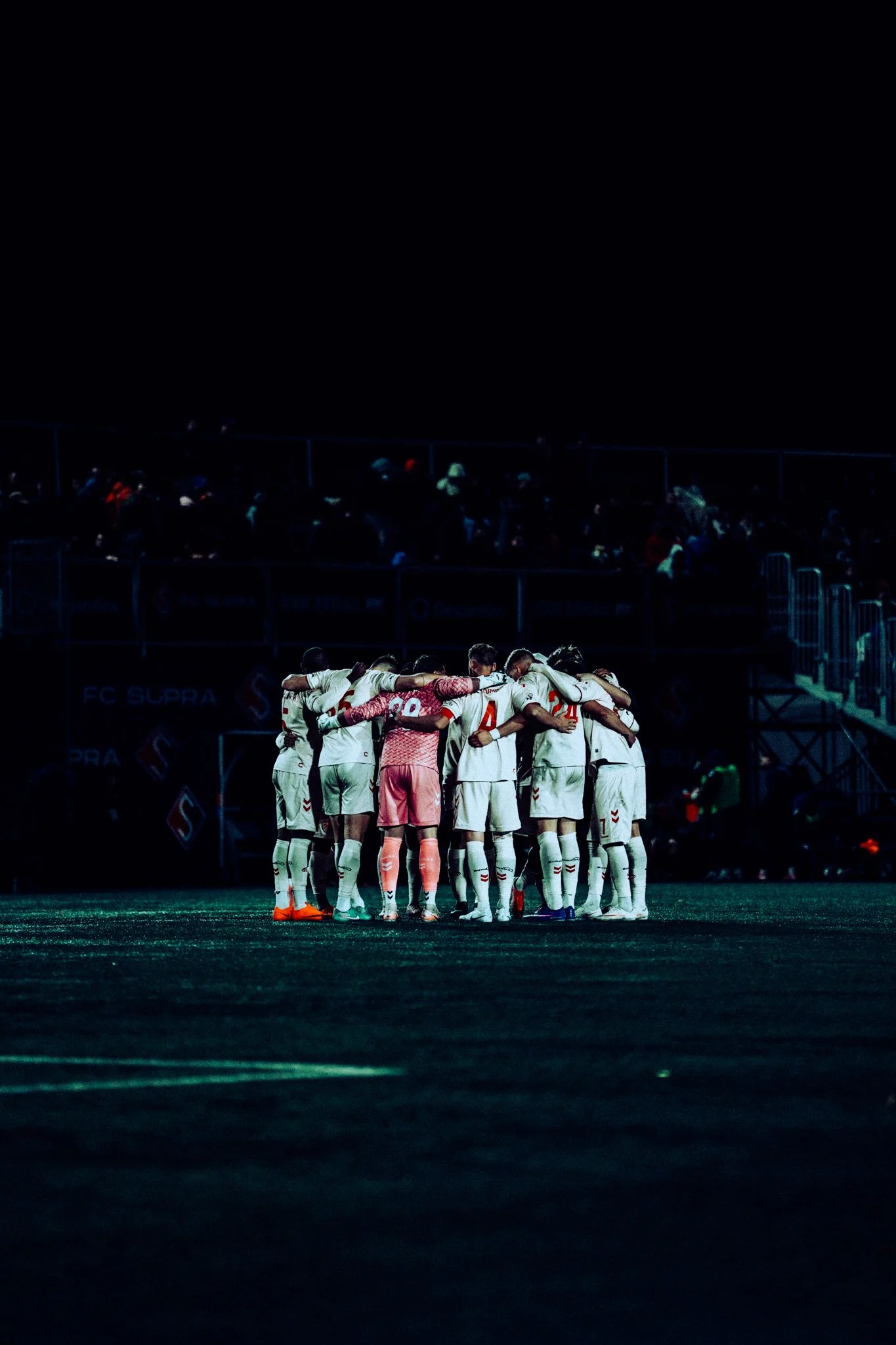
Regardless of their postseason fate, Cavalry FC will be participating in continental competition in 2027 (Photo Credit: Anaïs Fabra)
More Than a League Table
None of these developments guarantees the CPL's long-term success. FC Supra must turn its connection with Québec football into something sustainable.
Forge's influence must extend beyond its own achievements. Returning players need meaningful opportunities, while continental qualification must translate into competitive performances.
But taken together, these developments suggest that something more important than a collection of successful clubs is beginning to take shape.
A professional league becomes valuable not simply when it produces champions, but when it creates the conditions for football to grow around it. When clubs give communities something to identify with.
When coaches carry knowledge from one organisation to another. When players can leave, develop and find meaningful opportunities at home. When domestic success opens the door to a wider competitive world.
The CPL is still some distance from achieving all of this. Its institutions remain young, its clubs face considerable challenges and the sustainability of the wider professional game cannot be taken for granted.
But the foundations are becoming more visible.
The North Star will always be the prize. Yet the league's greatest achievement may ultimately be what it builds in pursuit of it: a football environment with the people, institutions and connections to sustain itself.
Because Canadian soccer does not simply need another generation of players capable of making it abroad. It needs a domestic game strong enough to give them somewhere meaningful to return to, somewhere to belong and something lasting to build.
Sources:
Murray Mollard, “The Canadian Men’s Soccer Team at the World Cup and Beyond”, Harbour Publishing, 2026
RDS, “Kyt Selaidopoulos is ready for the next step”, Nicholas Landry, 13 August 2026
The Guardian, “Un club d’ici’: FC Supra turns to a Bilbao-style model to keep Québec talent at home”, Josh Healey, 23 December 2025
The New York Times, “Canada’s newest soccer club — and its distinct recruitment policy”, Colin Millar, 23 October 2025
Forge FC, “Forge FC Assistant Coach Kyt Selaidopoulos to depart for opportunity with FC Supra du Québec”, 28 September 2026
Atlético Ottawa, “Atlético Ottawa Signs Centre-Forward Nicolas Fleuriau Chateau”, Thomas Stocking, 24 July 2026
CONCACAF, “2027 Concacaf Champions Cup: Qualified Clubs”, 29 October 2026
Canadian Premier League, “The Supra of 1988-92: The story of a community determined to keep soccer alive in Montreal”, Quentin Parisis, 24 September 2025
Photo Credits:
Supra Crowd, Anaïs Fabra, 1 November 2026 - Photo courtesy of assignment by PSP Media
Cavalry Huddle, Anaïs Fabra, 1 November 2026 - Photo courtesy of assignment by PSP Media
Handshakes, Anaïs Fabra, 1 November 2026 - Photo courtesy of assignment by PSP Media
Kyt Selaidopoulos, Anaïs Fabra, 1 November 2026 - Photo courtesy of assignment by PSP Media
Supra Jersey in Profile, Anaïs Fabra, 1 November 2026 - Photo courtesy of assignment by PSP Media
Nicolas Fleuriau Chateau, Simon Circe, 19 August 2026 - Photo courtesy of assignment by PSP Media
Video Credit:
FC Supra’s first playoff goal, Canadian Premier League, 1 November 2026 - Video courtesy of @CPLsoccer via X
All photos are used with permission. All rights reserved to the creator.

Support PSP Media
Every contribution helps support independent research and reporting