
The NSL Title Race Goes International
By Nii Wallace-Bruce
Six Northern Super League players have been called into Canada’s squad for October’s friendlies against Denmark.
For Montréal, Toronto and Ottawa, the call-ups arrive at precisely the wrong — and most revealing — moment: the title race has tightened, the margin for dropped points has narrowed, and the international window falls directly inside the decisive stretch of the domestic season.
Toronto have just moved into second place with a 3–0 victory over Ottawa. Montréal remain top after a 0–0 draw in Halifax, but the result allowed Toronto to close the gap. Ottawa, meanwhile, slipped to third after spending much of the season among the league leaders.
The three contenders now face a title race in which every remaining fixture carries greater weight. Montréal and Ottawa meet on October 2, then again on October 23.
Toronto are already applying pressure from behind. And in between those domestic contests, six of the players at the centre of the race will leave their clubs to join Canada.
The title race, in other words, is going international.
Canada is coming to Montréal’s Stade Saputo on October 9. Marie-Yasmine (Mimi) Alidou has just played there for the Roses.
On that occasion, the NSL set an attendance record. A few weeks later, she will return to the same stadium wearing red.
Before that happens, however, Alidou and Montréal have Ottawa to deal with. That is what makes this international window different.
Canada’s 24-player roster includes a record six players from the Northern Super League: Alidou of Montréal Roses; Melissa Dagenais and Delaney Baie (DB) Pridham of Ottawa Rapid; and Sabrina D’Angelo, Kaylee Hunter and Shelina Zadorsky of AFC Toronto. Canada will face Denmark on October 9 at Stade Saputo in Montréal before meeting the Danes again on October 12 at BMO Field in Toronto.
For the league, the call-ups are a landmark. For the three clubs still chasing the championship, they are also a complication.
The players are being rewarded for performances that have helped put their teams in contention.
Now those same players will leave the domestic competition, train under a different coach, play two international matches and return to a title race that will have continued without them.
The clubs cannot control the timing. They can only manage the consequences. And those consequences extend beyond availability.
Montréal must protect first place while replacing an injured goalkeeper and integrating Alidou into a side that has built its season around defensive organisation and patience. Toronto have climbed from a 16-point deficit to second and now have three internationals spread across their defensive and attacking structures.
Ottawa have slipped to third but remain one of the league’s most dangerous attacking teams, with Pridham at the centre of that threat.
The international window therefore becomes part of the title race itself.
There is an obvious way to look at October: six NSL players being selected by Canada is evidence of the league’s growing importance. But it is only half the story.
Twenty-four years ago, the problem facing Canada’s best young women was finding a professional place to play. Now the problem looks almost inverted.
The professional place exists — and it is producing players quickly enough that the national team is beginning to depend on it.
The question for Montréal, Toronto and Ottawa is what happens when that development pathway intersects with the final weeks of a championship race.
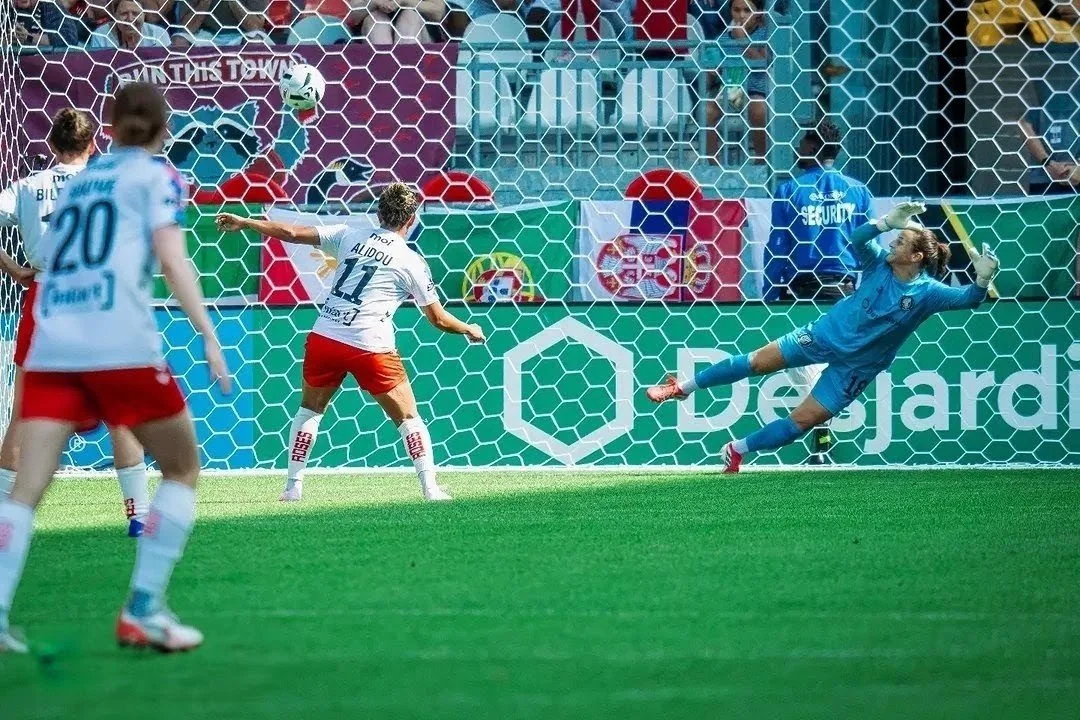
From rivals in August to teammates in October - Mimi Alidou and Sabrina D’Angelo. (Photo credit: Marc Eymé)
When Canada Calls
Canada's October matches are not exhibitions in the traditional sense.
They are the national team's final preparation window before November's Concacaf W Championship, which will determine qualification pathways for both the 2027 FIFA Women's World Cup and the 2028 Olympic Games.
That gives the call-ups genuine sporting importance. So does the identity of the players involved.
Toronto has three. Ottawa has two. Montréal has one. The distribution tells its own story.
Toronto's trio represents three different forms of value: D'Angelo's experience in goal, Zadorsky's experience at centre-back and Hunter's emergence as one of Canada's most promising young forwards.
Together, the three AFC players bring 145 senior international caps into camp, although much of that total belongs to the veteran D'Angelo and Zadorsky rather than Hunter, who has only recently entered the senior program.
Hunter also recently represented Canada with AFC teammate Olivia Chisholm at the FIFA U20 World Cup in Poland this month.
Ottawa's selections tell another story. Pridham is already one of the NSL's most productive attacking players.
Dagenais has been one of the league's busiest goalkeepers, leading the competition in saves according to the NSL's statistical leaders.
And Montréal's selection has an added layer of geography and emotion.
Alidou will return to Stade Saputo on October 9, only weeks after playing there for the Roses in front of a record NSL crowd.
The hometown return is one thing. The timing is another.
Before she joins Canada, Alidou and Montréal will host Ottawa on October 2 in a match with direct consequences for the title race.
The Roses therefore have a strange sequence ahead. First, Alidou helps them fight Ottawa for three points.
Then she has a different homecoming of sorts wearing Canada's colours.
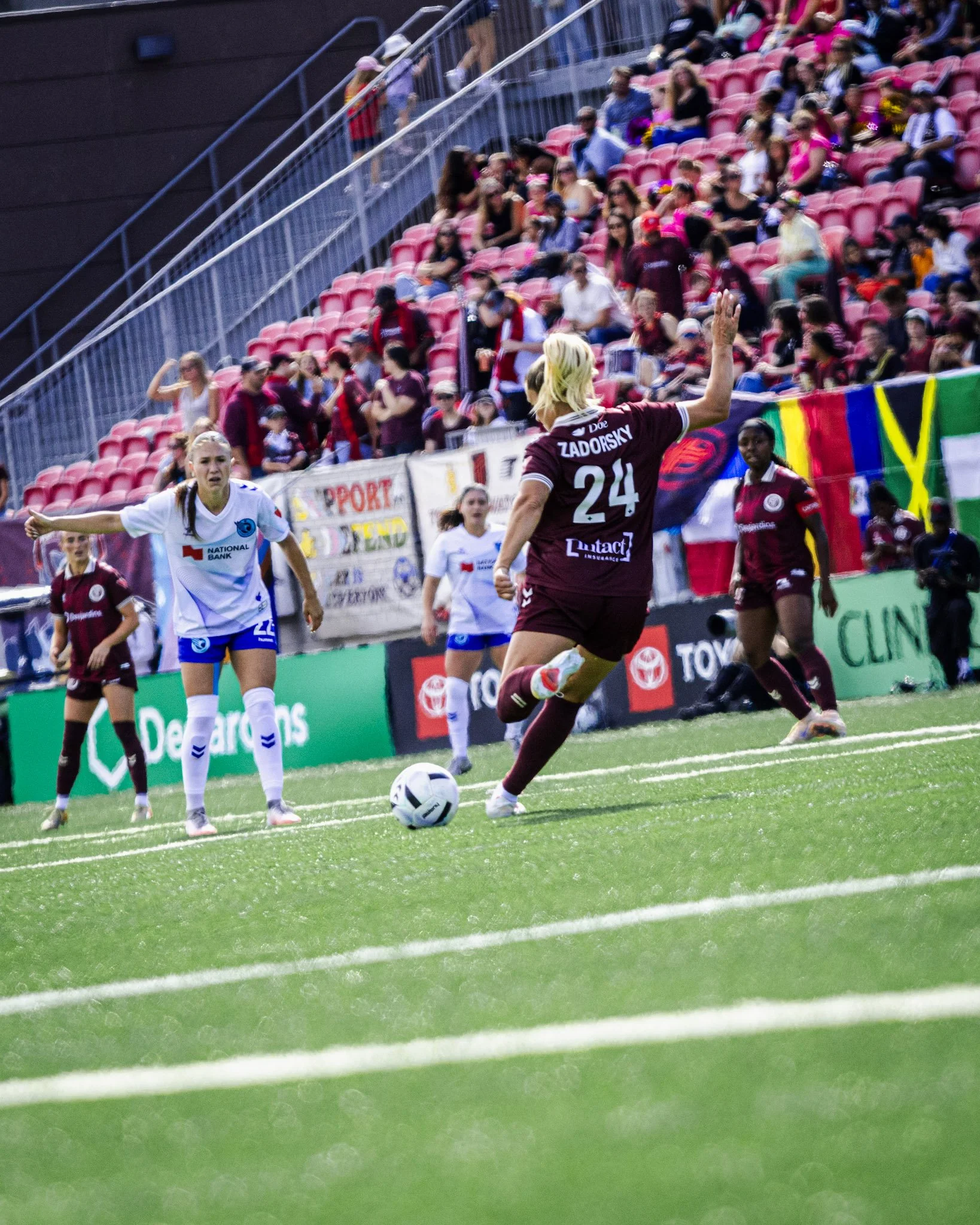
DB Pridham (#22) and Shelina Zadorsky (#24) will be wearing the same colours the next time they are both in Toronto (Photo credit: Zion Lawe)
Three Clubs, Six Players
The Roses have spent most of the season building their challenge through a combination of patience, defensive organisation and transition.
Now they have something different to protect: first place. Their lead has survived another difficult weekend.
Toronto beat Ottawa 3–0 at York Lions Stadium, while Montréal could manage only a goalless draw in Halifax.
The result was overshadowed by a sobering injury to goalkeeper Anna Karpenko, who left the game with an anterior cruciate ligament tear in the first half.
In a six-team league, the title race is not simply about who wins most often. It is about how quickly a team can recover when it does not.
Montréal have built enough of a cushion to remain in control, but the challengers are now close enough that every dropped point becomes part of the conversation.
The Roses will have to continue their stretch run without their shot stopping leader in Karpenko, who will not see the field again in 2026.
Montreal’s willingness to absorb pressure and adopt low and mid blocks has left the Roses vulnerable to shots from distance.
This will be something to watch during the stretch run.
With an impacted defense, Alidou and the attack become part of a revised equation.
Since returning to Montréal, she has given the Roses another attacking reference point alongside Elyse Bennett.
Bennett is among the league's top scorers, while Alidou's arrival has given Montréal another player capable of carrying the ball forward and creating danger between the lines.
But there is another consideration.
The Roses have matches immediately before and after the international period, and the physical and logistical demands of international football become part of the calculation.
There is no reason to assume that an international call-up automatically harms a club.
There is, however, a reason to acknowledge that it changes the workload.
For Montréal, the challenge is to keep the collective identity intact while navigating the potential changes to its starting XI.
The team has succeeded in many ways after a shock cup exit.
In the aftermath, head coach Maryse Bard-Martel challenged her squad to rise to the challenge, to which they obliged.
They remain undefeated on the road and have taken control of the league’s top spot. The forced change in goal could have a minor or major impact.
Consistency across the rest of the XI will be the key, as any slip ups will hand the initiative to Toronto and Ottawa.
Toronto's position has changed faster than anyone expected. Sixteen points once separated AFC from the top of the table. Now the gap has narrowed to something much smaller.
The 3–0 victory over Ottawa was not merely another result. It was the latest evidence that Toronto's comeback has become a genuine title challenge.
Lena Silano scored twice, Sarah Stratigakis added another, and Sabrina D'Angelo recorded her sixth clean sheet of the season.
After the game, Silano described the team’s pressing system as a form of momentum. The Maroons are just as imposing without the ball as they are when in possession of it.
Toronto's defensive record remains central to the story.
AFC had conceded just 21 goals through 22 matches entering the Ottawa game, the league's best defensive record.
D'Angelo's presence has been important, but so has the structure in front of her. Saturday’s scoreline suggested a gulf between the two Ontario teams.
However, two key block tackles by Sarah Rollins and a leg bar save by D’Angelo proved to be just as crucial as the goals scored by Silano and Stratigakis.
Further up the field, captain Nikki Small has been leading the league in tackles, however, she has also been contributing recently with her ball carrying abilities as well as chance creation in and around the box.
That makes the international window particularly interesting.
They are sending three players into the Canada setup.
D'Angelo is the goalkeeper. Zadorsky is a central defensive leader. Hunter is one of the team's principal attacking threats. The three occupy different parts of Toronto's structure.
Football systems are built through repetition: the timing of a centre-back's movement, the communication between goalkeeper and defence, the understanding between a forward and the players supplying her. Players return from international duty, with different experiences, higher standards and renewed confidence.
Younger players gain exposure to environments that their club could not replicate.
Hunter's recent U-20 World Cup experience is a good example.
The 18-year-old scored four times for Canada in Poland, including a hat-trick against France, before joining the senior team for the Denmark window.
For Toronto, that is both an asset and a challenge.
Head coach Marko Milanovic has mentioned that his squad has a “next player up” mentality, with each player in the matchday selection considered ready to contribute when called upon. Nevertheless, the Maroons managed to avoid defeat during the absence of Hunter and Chisolm, securing three draws.
For Toronto to defend the league title that they won in 2025, elevation will be required.
They have clawed their way back to the top without Esther Okoronkwo for most of the season.
However, teams have frustrated and negated their attacking threat through stubborn defensive setups.
They must continue to find goals from different sources, in addition to offensive production from Hunter and Lauren Rowe.
Ottawa entered the previous weekend in second place. They left it in third. The difference was not subtle.
Toronto's 3–0 victory moved AFC above Rapid and into second, while Ottawa's attacking threat was largely contained.
For a team whose identity has been built around attacking production, that is significant.
DB Pridham remains one of the league's leading scorers and assist providers, and Ottawa's 41 goals through 20 matches before the latest round demonstrated why they have remained in the title conversation.
Pridham is supported by a midfield where Keera Melenhorst can be found winning possession at one end and supporting the attack at the other end.
But the 3–0 defeat was another reminder that attack cannot always compensate for defensive problems.
Now Rapid have two players heading into Canada's camp. Pridham gives Canada another attacking option. Dagenais gives the national team another goalkeeper.
For Ottawa, there is no longer room for a poor run. The table is compressed, Toronto are moving upward, and Montréal remain ahead.
One thing that has been consistent throughout the periods of ascent and adversity has been the team’s culture.
Head coach Katrine Pedersen described culture as being key for the Rapid, with players knowing there is mutual support within the club regardless of on field results.
Ottawa's challenge is therefore twofold: improve the defensive side of their game while making sure their most influential attacking player returns from international duty ready for the final push.
Despite slipping into third place, Pedersen maintains that Ottawa's ambition for the league and the championship have remained the same.
Team captain Jyllissa Harris knows that the team must stay the course and take care of the contests in front of them. Resilience has kept Ottawa in the hunt for the title and the resilience would be required for the remainder of the season.
With the ultimate prize awaiting them at home in the form of hosting rights for the NSL Championship Final on November 14, Ottawa must solve their defensive problem.
A resilient backline in addition to the goalscoring threat of Pridham could take the Rapid back to the top, sending Pedersen on her way out as a champion, as well as a cultural leader for the club.
And the schedule offers little respite.
What the NSL Is Becoming
There is another way to read this story.
The international window is not simply taking players away from the NSL. The NSL is giving Canada players to take.
Six selections represent the league's largest-ever contingent on a Canadian senior women's national team roster.
Further, the league sent five players to Poland for the U20 World Cup - four from Canada and one from Colombia (Maithe Lopez).
Further, Canada’s 21-player U17 team for the World Cup in Morocco includes 12 players from NSL clubs or linked academies.
That matters beyond the immediate title race.
For years, one of the structural challenges facing Canadian women's football was the distance between domestic development and the highest level of the international game.
The NSL changes that equation.
A player can now develop professionally in Canada, play meaningful matches in front of Canadian supporters and still be visible to the national-team staff.
The call-ups are evidence of that pathway functioning. They are also evidence that the league's competitive level is producing players who can contribute to the national program.
Hunter is the clearest example of the developmental side.
The representation of NSL clubs and academies in Canada's youth teams provides an early indication of how quickly the domestic league is becoming embedded in the national development system. That being said, senior team head coach Casey Stoney has opined that she would like to see more youth getting playing time in the Northern Super League. The inclusion of Winnipeg in 2027 will assist in increasing the player pool for the league, though the inclusion of youth remains a national issue.
D'Angelo and Zadorsky represent the other end of the spectrum: established internationals choosing to play in the domestic league.
Alidou sits somewhere in between — an experienced international returning home and becoming a major contributor for a Montréal side chasing a championship.
Ottawa's Pridham and Dagenais add another dimension.
The national team is not drawing exclusively from one club or one type of player.
It is drawn from the league's leading teams and from different positions, ages and stages of development.
That is the bigger story.
It would be easy to frame October as an inconvenience. It would also miss the point. A professional league should want its players selected for their national teams.
It is to become good enough, deep enough and organised enough to absorb it. That is what the final weeks of this season will test.
Toronto have already demonstrated the value of squad depth.
Their 3–0 win over Ottawa came with players returning from international duty and others competing for places in a side that has been reshaped throughout the season.
Montréal have built a squad capable of protecting a lead even when matches become difficult. Ottawa has the attacking firepower to change a game quickly.
The question now is which team can keep its identity when the circumstances change.
For Montréal, that means maintaining the patience and defensive organisation that carried them to the top while adapting to the remaining schedule without their goalkeeper.
For Toronto, it means continuing the defensive consistency that has fuelled their comeback while maintaining a viable attacking threat built from pressing and pace.
For Ottawa, it means finding enough defensive stability to match an attack that remains among the league's most dangerous, while keeping Pridham and Dagenais fresh for the run-in.
And beneath all of it sits a larger development for Canadian women's football.
The players being pulled away from the NSL are not evidence of a league failing to keep its stars.
They are evidence of a league producing players worth taking.
That is the paradox of the final weeks.
The closer the NSL gets to deciding its champion, the more its best players are being asked to serve something larger than their clubs.
Canada needs them.
Their clubs need them.
Sources:
Michèle Hozer, “The Pitch - Documentary”, TVO and The Cutting Factory, 2025
Christine Sinclair with Stephen Brunt, “Playing the Long Game: A Memoir”, Vintage Canada, 2023
Canada Soccer, “CANW20 Roster Unveiled for FIFA U-20 Women’s World Cup Poland 2026™”, 20 August 2026
Maryse Bard-Martel, Montréal Roses Head Coach, press conference, 16 August 2026
Marko Milanović, AFC Toronto Head Coach, press conference, 26 September 2026
Lena Silano, AFC Toronto player, press conference, 26 September 2026
Katrine Pedersen, Ottawa Rapid Head Coach, press conference, 26 September 2026
Jyllissa Harris, Ottawa Rapid captain, press conference, 26 September 2026
Photo Credits:
Alidou scores against D’Angelo, Marc Eymé, 16 August 2026 - Photo courtesy of assignment by PSP Media
DB Pridham jersey, Zion Lawe, 26 September 2026 - Photo courtesy of assignment by PSP Media
Zadorsky clearance, Zion Lawe, 26 September 2026 - Photo courtesy of assignment by PSP Media
Video Credits:
Lena Silano first goal, Northern Super League, 26 September 2026 - Video courtesy of @northernsuperleague via X
All photos are used with permission. All rights reserved to the creator.

Support PSP Media
Every contribution helps support independent research and reporting.