
By Nii Wallace-Bruce
Montréal, Toronto, and Ottawa are fighting for the Northern Super League title.
Around them, a larger conversation is taking shape about keeping girls in sport—and what they gain when they do.
There is a particular kind of symmetry to the Northern Super League this week.
On Sunday afternoon in Ottawa, Montréal appeared to have the match under control.
The Roses scored twice inside the opening 17 minutes, then watched the advantage disappear. Ottawa came back.
The game became less about who had started better and more about who could remain composed when the match stopped behaving according to plan.
Then, in the 87th minute, Noémi Paquin scored.
Her introduction off the bench along with Evelyn Badu and Amandine Pierre-Louis added a new level of attacking threat and energy in the final third. Montréal won 3-2.
Four days later, the same thing happened again.
This time, Montréal went 2-0 up against Toronto at Stade Boréale. And again, the visiting side fought back in the final 10 minutes. Only this time, Toronto finished the job.
The match ended 2-2.
For Montréal, it was a point surrendered after holding a two-goal lead. For Toronto, it was a point earned through a comeback against the team sitting first in the table.
The Roses had punished AFC for not taking chances with dominant possession and control over the first 80 minutes of play.
However, despite being caught out in transition, AFC Toronto refused to give in, making their shots on target count when it mattered the most.
Toronto’s first goal scorer on the night, Lauren Rowe, acknowledged that it wasn’t pretty, yet the team kept pushing for a result.
It was fitting that captain Nikki Small buried the equaliser. Perhaps a rallying cry for the defending league champions as their grip on the shield is being tested each week.
After the game, Small remarked that the team refused to drop their heads after Amandine Pierre-Louis put away Montréal’s second goal.
She saw it as a testament to the club’s culture and who they were as people.
The goal itself came from persistence as Small, Rowe, and Victoria Pickett fought to break down the rear guard of the Roses.
And for a league trying to make women's professional sport part of the fabric of Canadian sport, there was something fitting about the two matches arriving so close together.
The title race is about points, obviously. But it is also about what sport asks of people when the game stops going according to plan.
Sometimes you find a way to win. Sometimes you fight your way back.
Either way, you have to stay in the game.
The Race is Tightening
The mathematics are straightforward.
Montréal has 38 points. Ottawa has 33. Toronto has 33.
Thursday’s draw kept AFC Toronto in the title hunt, however, they will need help from other teams to overhaul the Roses over the remaining five fixtures for the two teams.
Toronto continues to maintain a defense that has become one of the defining characteristics of its season.
The club has conceded only 20 goals through 20 matches, the best defensive record in the league.
Sarah Rollins' running battle with league top goalscorer Elyse Bennett is becoming a rivalry within the larger rivalry.
The hard-nosed centre-back that refuses to take a backward step against a physically imposing and prolific finisher.
It’s a shame that these competitors won’t meet again in 2026 until the postseason, if at all.
The problem, perhaps, is that AFC Toronto's platform of control from defense and midfield has yielded little on the scoresheet.
The absence of Esther Okoronkwo (injury) and Kaylee Hunter (international duty) has put more pressure on Lauren Rowe and Lena Silano up front.
On Sunday at BMO Field, against Calgary, Toronto created chances—11 shots in the first half alone—but could not find the goal as the teams settled for 0-0.
Frustration was the word that summed up the mood as Shelina Zadorsky and head coach Marko Milanović lamented the missed opportunities in the final third as well as the two points given away in the standings.
The two teams finished the week with different experiences
Toronto spent much of Sunday trying to break through. On Thursday, they refused to be broken.
Montréal spent much of its Sunday trying not to break. On Thursday, they could not break away.
Both found something useful in the experience.

Despite dropping points to begin September, AFC Toronto will hope to be the last team standing in October and November (Photo Credit: Matthew Joseph)
A Game, a School Day and a Fairground
There was something fitting about the setting of Toronto's latest home match.
The club had branded Sunday as a Back to Class celebration.
The game was played at BMO Field during the Canadian National Exhibition, with the match designed to connect sport and education as the new school year approached.
That matters. Not because the CNE somehow changes the quality of a soccer match. It doesn't. But because it changes the meaning of who is invited into the stadium.
The CNE is one of those Toronto institutions where generations overlap. Families go. Children go. Teenagers go.
People who might not ordinarily build their weekend around professional women's soccer suddenly have another reason to walk through the gates.
AFC Toronto has deliberately leaned into that connection.
Its 2026 schedule includes Youth Soccer Day, Back to Class and a separate "She Leads the Game" match designed specifically to spotlight leadership and opportunity for women and girls.
There is a larger point hiding in that programming. For professional women's sport to become culturally durable, the audience cannot only be today's football fan.
It has to include tomorrow's player. And tomorrow's coach. And tomorrow's referee. And tomorrow's executive.
The girl in the stands needs to be able to see the pathway as something real.
The Empty Locker
A few days before Toronto's Youth Soccer Day match, AFC Toronto and Dove had put a more pointed version of that idea into the club's locker room.
One stall was left empty. It was intended to represent the girls who leave sport because of low body confidence—the girls who aren't in the room, aren't on the field and never get to discover where sport might have taken them. The campaign, called The Empty Stall, was launched by Dove and AFC Toronto on Aug. 30.
Dove has since become a shirt sponsor for the club.
The image is effective because an empty locker is usually noticed only when someone is missing. And that is precisely the argument.
Dove's research says one in two girls who quit sports have been criticized about their body type.
Its broader campaign, The Game Is Ours, is built around the idea that body shaming can push girls away from sport while confidence and joy can help keep them playing.
The issue, then, isn't simply getting girls onto the field. It is keeping them there.
At Toronto’s 2026 FIFA World Cup Fan Festival, Dove’s campaign was featured in a clubhouse centred around The Game Is Ours.
Aside from promotional merchandise and interactive activities, messaging could be found.
According to studies, only 4 in 10 girls felt confident about how their body looked when playing sports.
Further, the number #1 reason why girls dropped out of sport was due to body confidence concerns.
Finally, girls who stayed in sport were twice as likely to believe in their abilities.
That distinction is crucial.
Because the benefits of sport don't arrive only at the moment a child learns to pass a ball or score a goal. They accumulate with time.
You learn to deal with failure.
You learn that being uncomfortable does not necessarily mean you should stop.
You learn how to depend on someone else—and how to become someone else’s dependable teammate.
You learn to speak when something needs to be said.
You learn to listen when you are not the person with the answer.
And sometimes, you learn to keep going when the scoreline has turned against you.
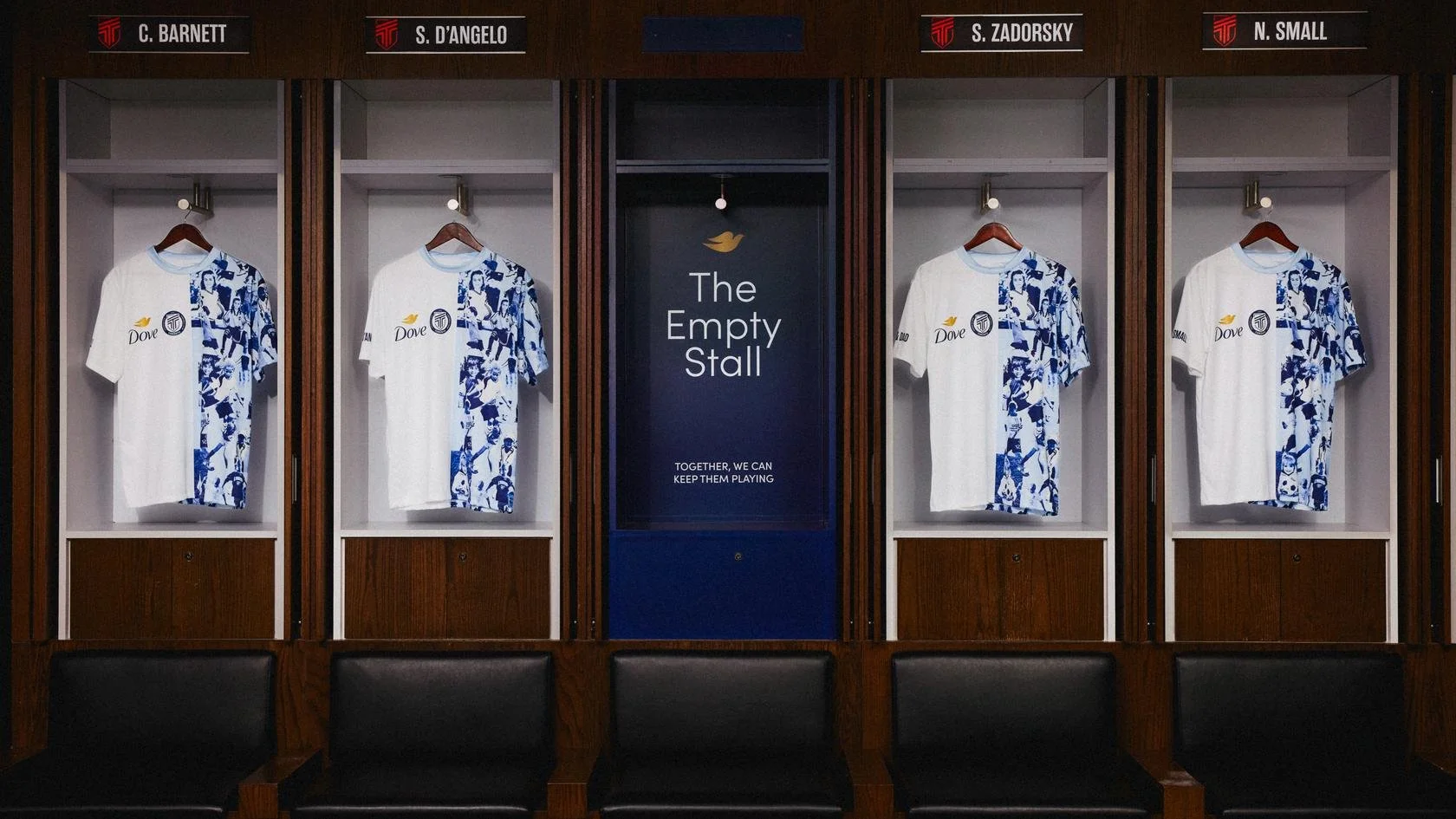
The Empty Stall made visible the stark reality facing young girls in sports (Photo Credit: AFC Toronto)
What Sport Gives Back
A new study, Girls Who Play Change the Game, puts some numbers behind that idea.
Researchers surveyed more than 9,500 people across Canada, the United States, Germany and the United Kingdom and found that women who played sports for at least three years before finishing school were nearly 50 per cent more likely to hold leadership positions, 37 per cent more likely to aspire to senior roles and 25 per cent more likely to have negotiated their salary.
Playing sport does not guarantee any of those outcomes.
But the findings point to something that happens along the way: confidence, resilience, teamwork and the ability to perform under pressure.
The benefits of staying in the game can follow you long after the final whistle.
The findings should not be reduced to a simplistic equation—play soccer, become a CEO. That is not what the research says.
Rather, it points toward the skills that participation can help develop: teamwork, resilience, perseverance, confidence and the ability to operate under pressure.
The report also stresses that the benefits aren't restricted to elite athletes. Participation itself matters. That distinction makes the findings more compelling, not less.
The girl doesn't have to become a professional footballer. She just has to be given enough time in the game to discover what the game can teach her.
And that is where the title race intersects with the Dove campaign.
One is asking who will win.
The other is asking who gets to keep playing.
They are different questions, but they are connected.
Because before there can be a professional player, there has to be a girl who doesn't quit.
Before there can be a captain, there has to be a young player who learns to take responsibility.
Before there can be a coach, executive or referee, there has to be someone who has experienced the particular education sport provides: failure without catastrophe, competition without isolation, responsibility without certainty.
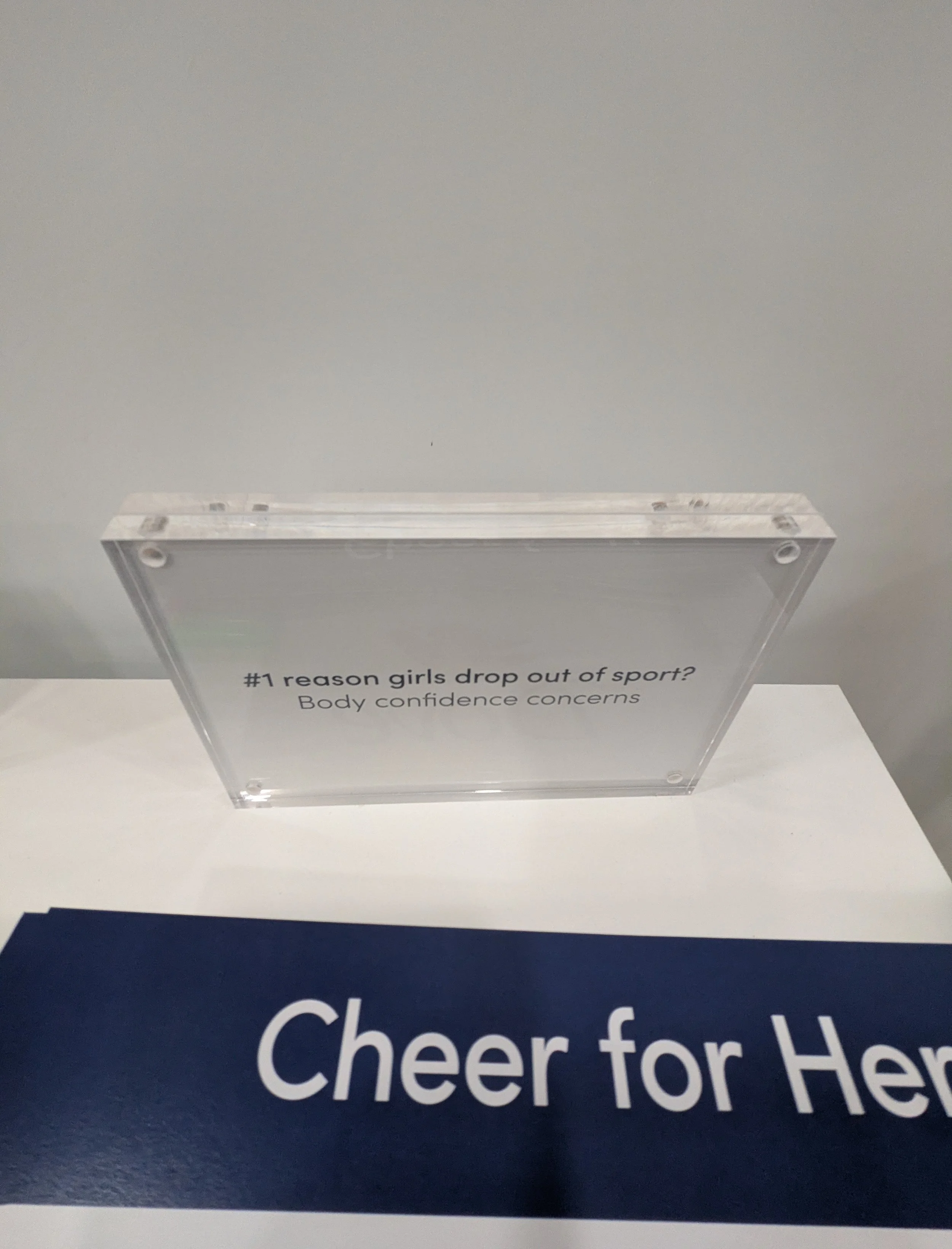
Dove’s campaign was also a feature at the 2026 FIFA World Cup Fan Festival (Photo Credit: Nii Wallace-Bruce)
The Pathway Has to Exist
The issue, then, isn't simply getting girls onto the field.
It is keeping them there. And that means giving them somewhere to go. AFC Toronto is beginning to build that next step.
This month, the club introduced the inaugural class of its Academy, a fully funded program for players aged 14 to 18 designed to develop young talent within the professional club environment and create a route toward the first team.
The first group was introduced at BMO Field before Toronto's Youth Soccer Day match against Ottawa.
For those players, the distance between youth football and the professional game was no longer theoretical. They could see the next level.
They could see the players they might one day become.
That matters. Because a pathway only works if a young player can see it.
One of the Academy players is Arya Winter - a centre-back who aspires to be part of the first team.
Within two weeks of joining the academy, she has already trained with the first team.
From that experience, Arya mentioned the emphasis on standards and professionalism while also having fun on the field.
It is one thing to tell a girl she has potential, that opportunities exist, that she can go further.
It is another to put her inside a professional environment and let her see the coaches, players and standards waiting at the next level.
The Academy is, in that sense, the other side of the empty locker.
The Empty Stall asks us to notice the girls who are no longer there.
The Academy asks what becomes possible when more of them stay.
Not all of them will become professional footballers. That isn't the point. The point is giving them enough time in the game to find out where it might take them.
That is the larger project behind the Northern Super League.
Diana Matheson knows better than most what it means to build a professional pathway in a country where, for much of her playing life, the pathway was incomplete.
The Women Playing the Lesson
That is why the Northern Super League matters beyond its standings.
Montréal, Toronto and Ottawa are not theoretical examples of women's football. They are the present.
They are women preparing for professional matches, recovering from injuries, managing pressure, solving problems in real time and making decisions that affect teammates. They are competing for titles and achievements in a Canadian professional league.
For a girl watching, that changes the equation. The pathway is no longer imaginary. That, in many ways, is the argument behind the Northern Super League itself.
League founder, Diana Matheson, has spoken about the importance of creating a professional environment in Canada where girls and women can see not just a team to support, but a future to pursue. The Northern Super League also created an ecosystem for players, coaches, referees, trainers, analysts, administrators, broadcasters, executives.
The significance is bigger than the number of professional players the league can eventually produce.
A girl does not have to become the next Christine Sinclair for the game to have changed her life. Sinclair's presence in the league makes that evolution unusually visible.
She spent her playing career showing Canadian girls what was possible on the field. As an owner, she is now helping shape what becomes possible off it.
That is the less obvious dividend of keeping girls in sport. The destination is not necessarily professional football. The destination is a possibility.
Sport can begin with a ball at your feet and end somewhere you could not have predicted.
That is one reason Christine Sinclair has always spoken about sport as something bigger than the result.
She spoke about the life skills of respect, hard work and sacrifice that sports can provide.
Further, she mentioned that sports can help girls to be confident, find their voice and express themselves.
Toronto's comeback offered the live version. The score was 2-0. The game said the outcome was already moving in one direction. Toronto kept playing.
And that is why the pathway matters. The girl who stays in sport gets more than the possibility of becoming a professional player.
She gets more opportunities to experience moments like this one: to be behind, to respond, to discover that a difficult situation can change.
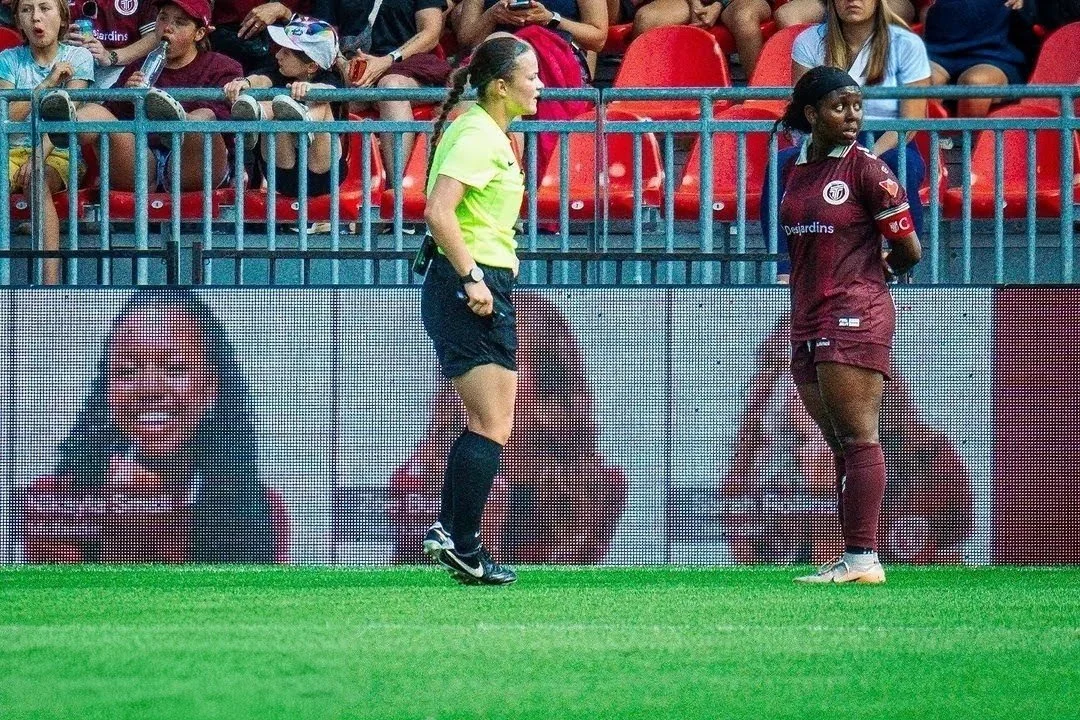
The NSL is providing opportunities for referees, including Anne-Marie Canuel, in addition to the players (Photo Credit: Marc Eymé)
Staying in The Game
Montréal's 3-2 win in Ottawa was a small football lesson in resilience.
A team that has a style of play built around absorbing pressure and responding has worked its way to the top of the table.
Four days later, Toronto offered another. A team that was previously 16 points behind the league leaders refused to give up on the race for the shield.
The difference was that this time Montréal was the team trying to protect the advantage, and Toronto was the team refusing to let the match go.
Two goals down, Toronto stayed with it. The reward was a point.
Montréal's early superiority was gone. Ottawa had the momentum. The league leaders were away from home, facing the team immediately beneath them in the table.
Yet the Roses stayed in it. They did not need to dominate the ball—in both games, Montreal surrendered 58 per cent possession to their opponent.
They needed to survive the moments when the match was moving away from them and wait for the next opportunity. They got it.
Paquin's late winner was not merely three points. It was the sort of moment that becomes part of a team's collective memory: we have been here before; we know how to respond.
That is one of the strange things about sport.
The lesson is rarely learned when everything goes well.
What Lies Ahead
Five matches remain.
Montréal has a five-point lead at the top of the table. Ottawa and Toronto are level on 33 points, with the Roses still having work to do before the league is theirs.
Montréal has created breathing room but not certainty.
The title race is therefore still a football story. But it is also becoming something else.
At BMO Field, a young AFC Toronto Academy player could look across the pitch and see the level she hopes to reach.
At the CNE, families who might not otherwise have attended a professional women's match were introduced to the league.
Inside the locker room, an empty stall asked a more uncomfortable question: who isn't here anymore, and why?
Those moments are connected. Diana Matheson helped build a professional league because the pathway that should have existed for Canadian players did not.
Christine Sinclair spent her career showing what was possible once a player reached the top of the game.
Now, the generation coming behind them is beginning to encounter something different.
A destination.
Matheson understands what that change represents. For much of her career, Canadian players who wanted to play professionally had to look elsewhere.
The Northern Super League changes that equation by creating a professional environment at home — not only for the players who are in it now, but for the girls who can finally see a reason to imagine themselves.
The game is not valuable because it promises you will win.
It is valuable because it gives you the chance to find out what you can do when you don't.
Sources
Michèle Hozer, “The Pitch - Documentary”, TVO and The Cutting Factory, 2025
Christine Sinclair with Stephen Brunt, “Playing the Long Game: A Memoir”, Vintage Canada, 2023
Christine Sinclair, NSL part-owner, Vancouver Rise, public lecture, 6 May, 2026
Arya Winter, AFC Toronto Academy player, press conference, 30 August 2026
Marko Milanović, AFC Toronto head coach, press conference, 6 September 2026
Shelina Zadorksy, AFC Toronto player, press conference, 6 September 2026
Nikki Small, AFC Toronto player, press conference, 10 September 2026
Lauren Rowe, AFC Toronto player, press conference, 10 September 2026
BusinessWire, “e.l.f. Beauty and Parity Release “Girls Who Play Change the Game”, 31 August 2026
e.l.f. Beauty & Parity, “Girls Who Play Change the Game”, 31 August 2026
AFC Toronto, “Dove and AFC Toronto Leave a Locker Empty to Spotlight the Girls Missing from Sport Due to Low Body Confidence”, 28 August 2026
AFC Toronto, “AFC Toronto Reveals Inaugural Academy Players and Expanded Academy Team”, 30 August 2026
Photo Credits:
Referee discussion with Nikki Small, Marc Eymé, 16 August 2026 - Photo courtesy of assignment by PSP Media
Shelina Zadorsky profile, Matthew Joseph, 6 September 2026 - Photo courtesy of assignment by PSP Media
Dove campaign at FIFA Fan Festival, Nii Wallace-Bruce, 15 June 2026 - Photo courtesy of Nii Wallace-Bruce
The Empty Stall, AFC Toronto Media, 30 August 2026 - Photo courtesy of AFC Toronto Media
Video Credits:
Noémi Paquin winner, Northern Super League, 6 September 2026 - Video courtesy @northernsuperleague via X
All photos are used with permission. All rights reserved to the creator.

Support PSP Media
Every contribution helps support independent research and reporting