
Three goals against Guatemala, a growing influence at Villarreal and a changing relationship with the demands of elite European football.
Tani Oluwaseyi's recent form suggests Canada may be developing another important attacking option at precisely the right time.
By Nii Wallace-Bruce | Research Assistance by Juan Ramos
There was something revealing about Oluwaseyi's reaction to his three goals against Guatemala.
For all the satisfaction of scoring three goals across two legs, his explanation of the achievement was less about the goals themselves than about the time it had taken to reach them.
"I had a hard time with the national team, but I never stopped believing," he told reporters after the second leg in Toronto.
It was an unusually candid admission from a player enjoying the most productive international spell of his career. Before the Guatemala tie, Oluwaseyi had scored twice in 31 appearances for Canada.
The absence of goals had inevitably invited scrutiny, but the striker offered a reminder of the particular difficulties facing players whose international careers unfold in intermittent bursts.
"It's hard to go away for three months and then come back, play two games, go away for another four months to come back and play two games," he explained.
The rhythm of club football is different. Training, competition and repetition provide opportunities to establish relationships and recover from difficult performances. International football offers no such guarantees.
A forward can wait months for another opportunity, with every appearance carrying the weight of expectations accumulated during the intervening period.
Oluwaseyi admitted that he was still learning how to manage those moments.
"At the end of the day, I think I'm my biggest critic," he said.
For a striker, that resilience is essential. Goals arrive in sequences, but confidence has to survive the periods in between.
The Confidence Travels
There is another dimension to Oluwaseyi's recent form that makes it particularly encouraging for Canada: the confidence he is developing at Villarreal appears to be travelling with him.
Assistant Head Coach Mauro Biello was quick to identify the connection after the matches against Guatemala.
"He's had two really good games. You see he was just having fun out there, and you see him with confidence," Biello told reporters.
"He's had good games with Villarreal also, so when players are in form, they bring it to the national team."
It is a relatively simple observation, but one that speaks to an important relationship in international football. The international break is an unforgiving place to establish yourself.
A striker can spend three months building confidence at club level, only to have 180 minutes with his national team determine the conversation around his performances.
In Oluwaseyi's case, Villarreal has provided the opportunity to compete against elite opposition and develop within a demanding footballing environment.
The benefits are becoming visible in his international performances.
Canada needs forwards capable of operating within its collective pressing system while retaining the instincts to attack the penalty area.
Oluwaseyi offers a useful combination: a physical reference point who can occupy central defenders, threaten the space behind them and provide another way into the final third.
Biello also highlighted the importance of the attacking relationships developing around him.
"We were really happy with the performance of the front four in Guatemala. It was one of the best performances. Three good goals. They were working off the ball and working on the ball. They were dangerous."
The coach's emphasis was not simply on the goals. It was on the movements and connections that created them.
"You want to create that continuity because, for forwards, it's all about rhythm," Biello explained.
"You see how Tani is able to get another two today, and you want to build that confidence. You want to build that rhythm within the movement."
Canada's attacking development is not simply about finding players capable of scoring. It is about creating combinations that make those goals more repeatable.
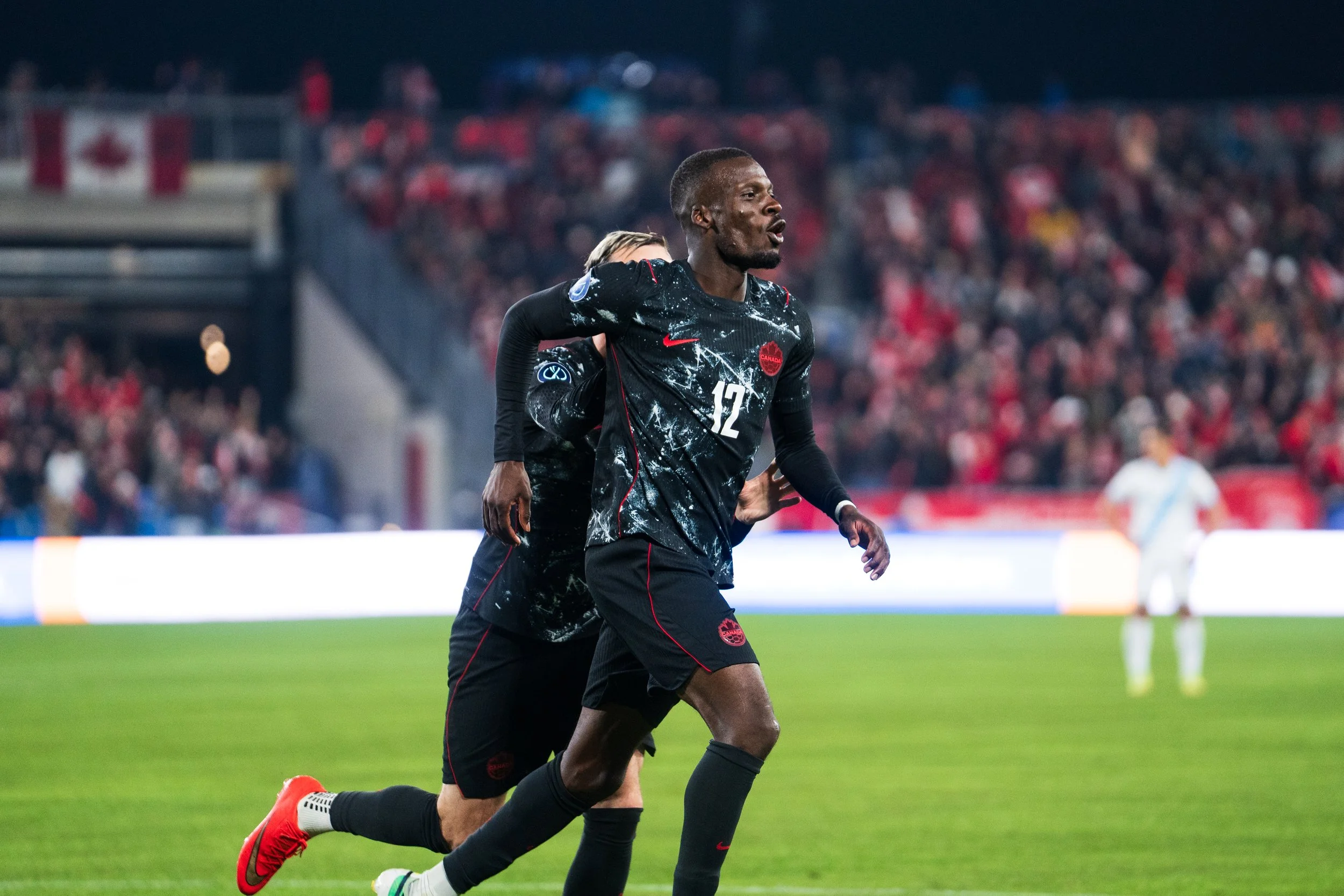
Tani Oluwaseyi has found form on both sides of the Atlantic (Photo credit: Fawzan Khan)
The Value of Familiar Faces
One of the less discussed advantages of Oluwaseyi's Villarreal experience is the presence of familiar Canadian connections.
Tajon Buchanan was already at the club when Oluwaseyi arrived and helped him settle into his new surroundings.
That kind of relationship can be particularly valuable when a player is adapting to a new country, language, tactical environment and dressing room.
The arrival of Nathan Saliba in August 2026 adds another dimension to the Canadian connection at the club. Saliba joined from Anderlecht on August 25, signing a contract running until June 2031.
He has described Villarreal's approach as "very patient football", a phrase that offers an interesting glimpse into the club's footballing philosophy.
Patience is not necessarily the first quality associated with the modern game, particularly in an era increasingly dominated by pressing, transitions and rapid attacking sequences. But patience can be a tactical weapon.
It requires players to understand when to accelerate, when to retain possession and when to wait for an opponent's defensive structure to change.
For attacking players, it also means developing an understanding of movement that goes beyond simply running into space.
Oluwaseyi is training and playing within a club structure where the demands of his teammates become familiar through repetition.
The relationships developed during daily training are different from those created during an international camp.
Canada can bring its players together for a limited period. Villarreal can work with them every day. That distinction becomes especially important when considering the national team's attacking combinations.
The Villarreal connection does not automatically translate into success for Canada.
Buchanan, Saliba and Oluwaseyi occupy different roles and their club relationships should not be mistaken for a ready-made national-team combination.
But familiarity has value.
For a Canadian team trying to become more sophisticated in possession while retaining its aggressive identity, those details are significant.
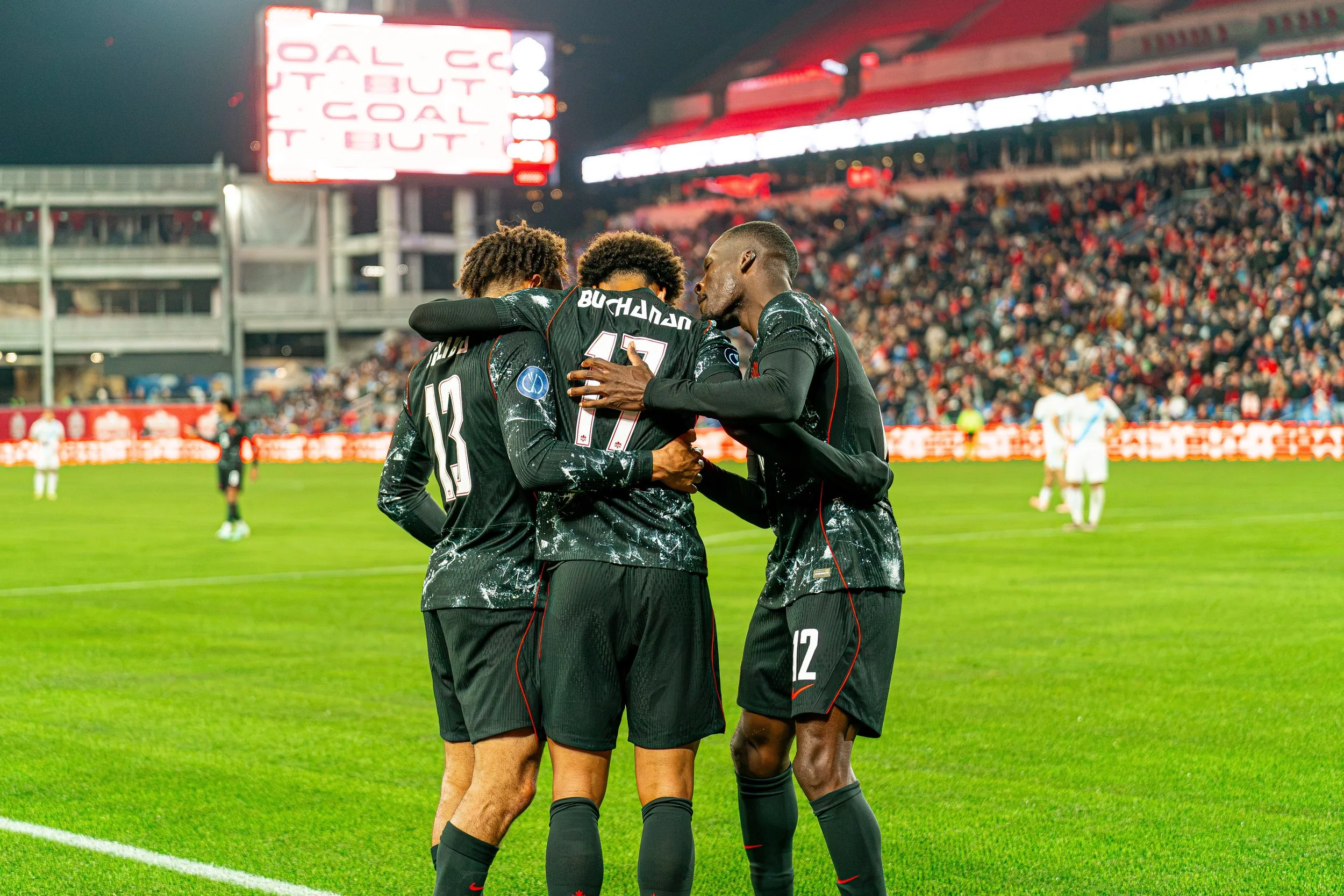
Training and playing together at Villarreal has created familiarity for Nathan Saliba (left), Tajon Buchanan (centre), and Tani Oluwaseyi (right) (Photo credit: Marc Eymé).
A Deeper Canadian Pool
There was another theme running through the post-match conversations in Toronto: Canada's growing depth.
Buchanan, who has experienced the demands of European football alongside Oluwaseyi at Villarreal, spoke about the value of continuity within the national team.
"We've been showing it in training, but at the same time, we have so many different guys that can come in and play and make the difference," he told reporters.
That flexibility is becoming important as Canada moves beyond a reliance on a relatively small group of established internationals.
Biello pointed to the number of players unavailable during the camp, estimating that approximately 13 or 14 could have been part of the group.
"We put our principles in place and players come in, and the team doesn't skip a beat," he said.
It is a reminder that international development is not simply about identifying the best 11 players.
It is about building a competitive pool capable of sustaining performance when injuries, club commitments and the demands of international football intervene.
Oluwaseyi's emergence fits that wider picture. His goals matter, but so does the fact that Canada is developing another forward capable of contributing at an increasingly competitive level.
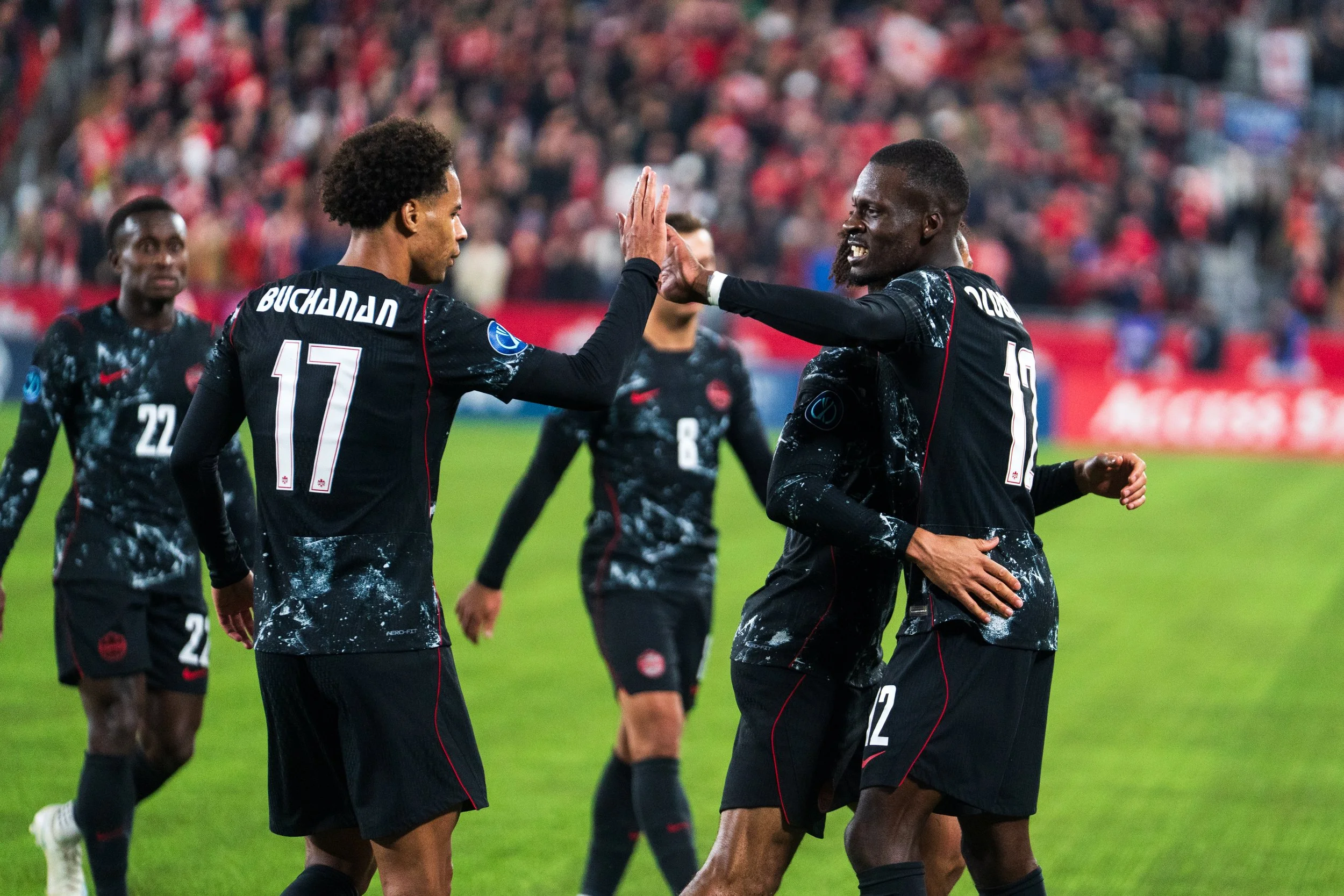
In November, Canada showcased multiple scoring options, including Buchanan and Oluwaseyi (Photo credit: Fawzan Khan).
From the Copa del Rey to Anfield
Perhaps the clearest indication of Oluwaseyi's changing footballing environment is the variety of stages on which he has begun to perform.
His first Villarreal campaign included goals in La Liga and the Champions League. Then on 29 October 2025, he delivered a complete performance, scoring a hat-trick in the Copa del Rey against Ciudad Lucena.
The 2026–27 season has already provided another significant reference point.
On October 20, Oluwaseyi scored in the 87th minute of Villarreal's Champions League encounter at Anfield. His goal brought the Spanish side within one, although Liverpool eventually held on for a 4–3 victory.
The result, however, told only part of the story.
Villarreal had established a two-goal lead inside the opening half-hour before Liverpool's response transformed the contest.
After the match, Villarreal coach Íñigo Pérez acknowledged that his players had struggled to manage the emotional demands of Anfield.
He spoke about the effect of the crowd's reaction as Liverpool found their way back into the game, describing how the atmosphere influenced his players' ability to maintain the control they had established during an excellent opening period.
It was a revealing admission. Anfield is not simply another difficult away ground.
It is an environment in which momentum can become tangible, where the emotional temperature of a match can change almost as quickly as its tactical balance.
For Oluwaseyi, however, the occasion still produced a personal milestone.
Introduced at half-time, he scored late in the game with a volley at the far post, giving Villarreal a final opportunity to salvage something from the contest.
It was a goal in defeat, but an important one in the context of his development.
For a Canadian forward who entered professional football through Minnesota, scoring at Anfield in the Champions League represents a considerable progression in competitive exposure.
The significance is not that he has suddenly arrived among Europe's elite.
It is that he is finding himself in environments where the demands are unforgiving, the margins are narrow and the opposition can punish even brief lapses in concentration.
Then came Barcelona.
Scoring against one of Spain's most prominent clubs adds another reference point to a period in which Oluwaseyi is appearing in the conversations surrounding Villarreal's attacking options.
But there is a pattern emerging.
He is scoring in different competitions, against different levels of opposition and within a club environment that continues to demand adaptation.
Canada's Attacking Question is Becoming More Interesting
For Jesse Marsch, Oluwaseyi's development arrives at an interesting moment.
Canada's tactical identity has become clearer over the past two years.
The team presses aggressively, attempts to play vertically and understands how to use its athletic qualities within a coordinated structure.
Yet the evolution of a national team is not simply a question of establishing an identity. It is about finding the players who can make that identity productive. The problem, particularly in attack, is one of optimisation.
Jonathan David remains central to Canada's attacking ambitions, but the players around him influence how effective he can be. Different forward partnerships create different possibilities.
A striker who can stretch defensive lines offers one solution. A forward capable of holding possession and bringing midfielders into play offers another.
A mobile attacker who can threaten the space behind defenders changes the geometry of the attack.
Oluwaseyi’s physical presence provides a different reference point from David, while his recent goalscoring form offers encouragement that he can contribute more than simply occupying defenders.
The Guatemala tie was particularly interesting because it demonstrated his capacity to turn opportunities into decisive contributions across two matches.
At the 2026 World Cup, Canada demonstrated that its pressing structure and territorial aggression could trouble technically accomplished opponents.
But the tournament also reinforced the importance of converting attacking situations into goals.
Creating pressure is one thing. Making that pressure count is another.
Oluwaseyi's emergence does not solve Canada's attacking questions, nor should three international goals establish a definitive hierarchy among its forwards.
But he gives Marsch another credible way to make the team's attacking identity productive. The more options Canada develops, the less predictable it becomes.
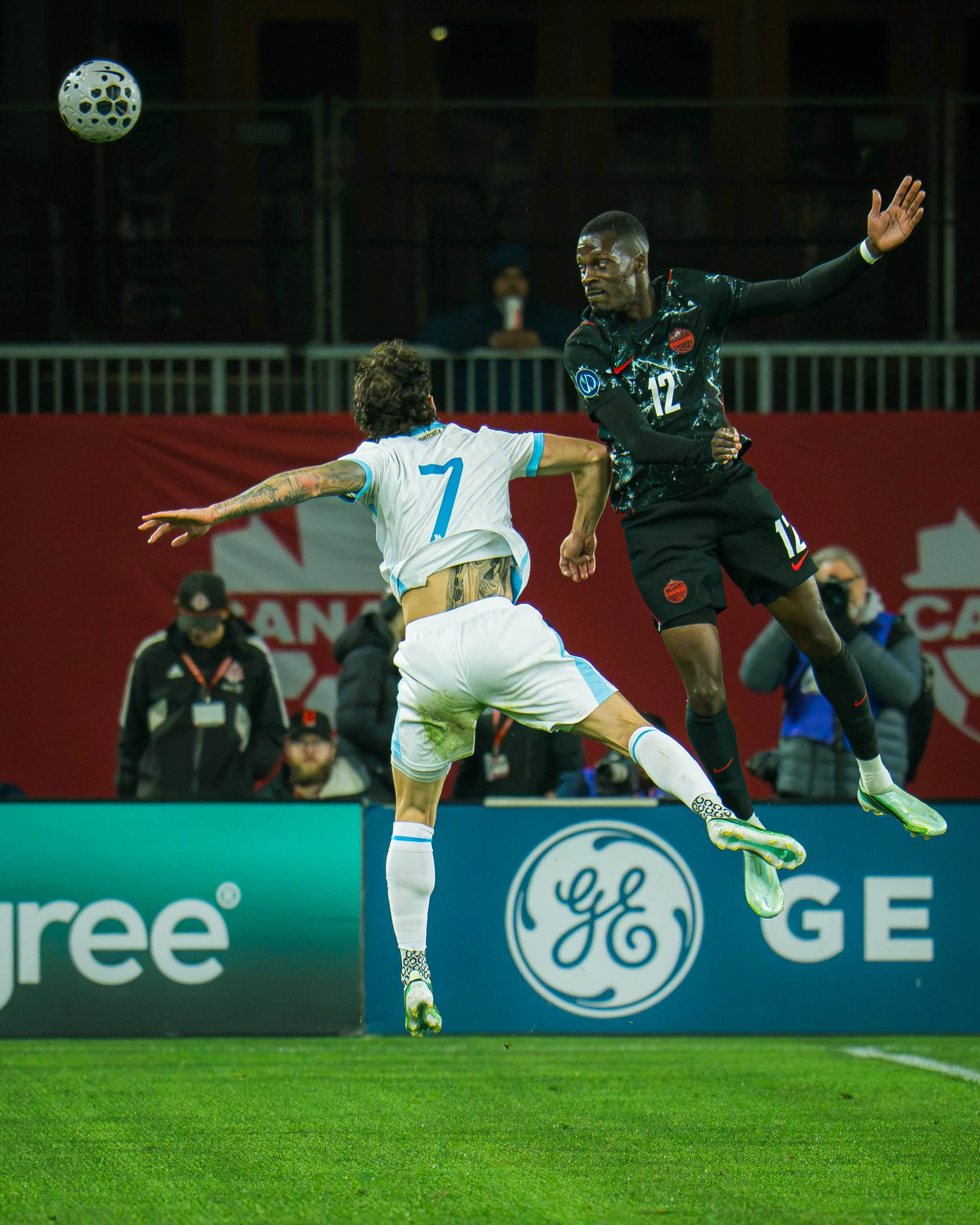
Oluwaseyi’s value extends beyond goal involvements, with his movement and pressing helping his teammates (Photo credit: Marc Eymé)
The Next Step is Consistency
There is a tendency in international football to look for the next breakthrough player, particularly when a national team is approaching a major tournament cycle.
For Oluwaseyi, his career has already involved enough unexpected turns to make any straightforward prediction unwise. His own description of the journey suggests that he understands as much.
But the current evidence is encouraging.
There is a broader significance here for Canada. Oluwaseyi's development is not simply about another forward finding goals in Europe.
It is about another player emerging from a demanding club environment with the tools to give the national team greater attacking flexibility.
His own journey has been anything but straightforward. The Guatemala tie offered a glimpse of what he might become, while Villarreal is providing the environment in which to find out.
For Marsch, the question is no longer simply whether Oluwaseyi can contribute. It is how much more Canada can do with him in its attack.
The goals against Guatemala offered a glimpse of what might be possible. Villarreal is providing the environment in which to develop it.
Canada now has another question worth asking: not whether Oluwaseyi belongs at this level, but what the team can become with him in it.
Sources:
Tani Oluwaseyi, Canada player, media scrum, 16 November 2026
Tajon Buchanan, Canada player, media scrum, 16 November 2026
Mauro Biello, Canada Assistant Head Coach, press conference, 16 November 2026
TSN (via The Canadian Press), “Canadian striker Oluwaseyi grateful for journey that's led to FIFA World Cup”, Gemma Karstens-Smith, 3 June 2026
TSN (via The Canadian Press), “Canadian Saliba introduced at Villarreal: ‘Really good step for me’”, 26 August 2026
Villarreal CF, “Iñigo: “It was a match with spells for both teams””, 20 October 2026
Video Credits:
Tani Oluwaseyi goal celebration at Camp Nou, La Liga, 22 November 2026 - Video courtesy of LaLiga via X
Tani Oluwaseyi goal at Anfield, DAZN Canada, 20 October 2026 - Video courtesy of DAZN Canada via X
Photo Credits:
Tani Oluwaseyi celebration in profile, Fawzan Khan, 16 November 2026 - Photo courtesy of assignment by PSP Media
Oluwaseyi and Buchanan, Fawzan Khan, 16 November 2026 - Photo courtesy of assignment by PSP Media
Saliba, Oluwaseyi, and Buchanan, Marc Eymé, 16 November 2026 - Photo courtesy of assignment by PSP Media
Oluwaseyi in flight, Marc Eymé, 16 November 2026 - Photo courtesy of assignment by PSP Media
Oluwaseyi scoring against Guatemala, Marc Eymé, 16 November 2026 - Photo courtesy of assignment by PSP Media
Oluwaseyi Celebration, Marc Eymé, 16 November 2026 - Photo courtesy of assignment by PSP Media
All photos are used with permission. All rights reserved to the creator.

Support PSP Media
Every contribution helps support independent research and reporting.