
September is Telling Canada More Than Saturday's Results Suggest
By Nii Wallace-Bruce
Canada's men learned what awaits them against Fiji at the 2027 World Cup. The women began a three-Test examination that could be seen as a rehearsal for another title run.
The temptation, after a Saturday like this, is to separate the two Canadian teams by result.
In Osaka, Fiji scored 45 points and Canada 29. In Edinburgh, Canada scored 64 and Scotland 26.
Canada’s men lost heavily. Canada’s women won heavily.
It would be easy, then, to file the day under familiar headings: disappointment for the men, encouragement for the women.
But September is not really about Saturday's scorelines.
For Canada's two national teams, these matches are becoming something closer to dress rehearsals for the futures they are trying to build.
The men's team will see Fiji again. The women's team will see England again.
And neither encounter will come with the luxury of being unfamiliar.
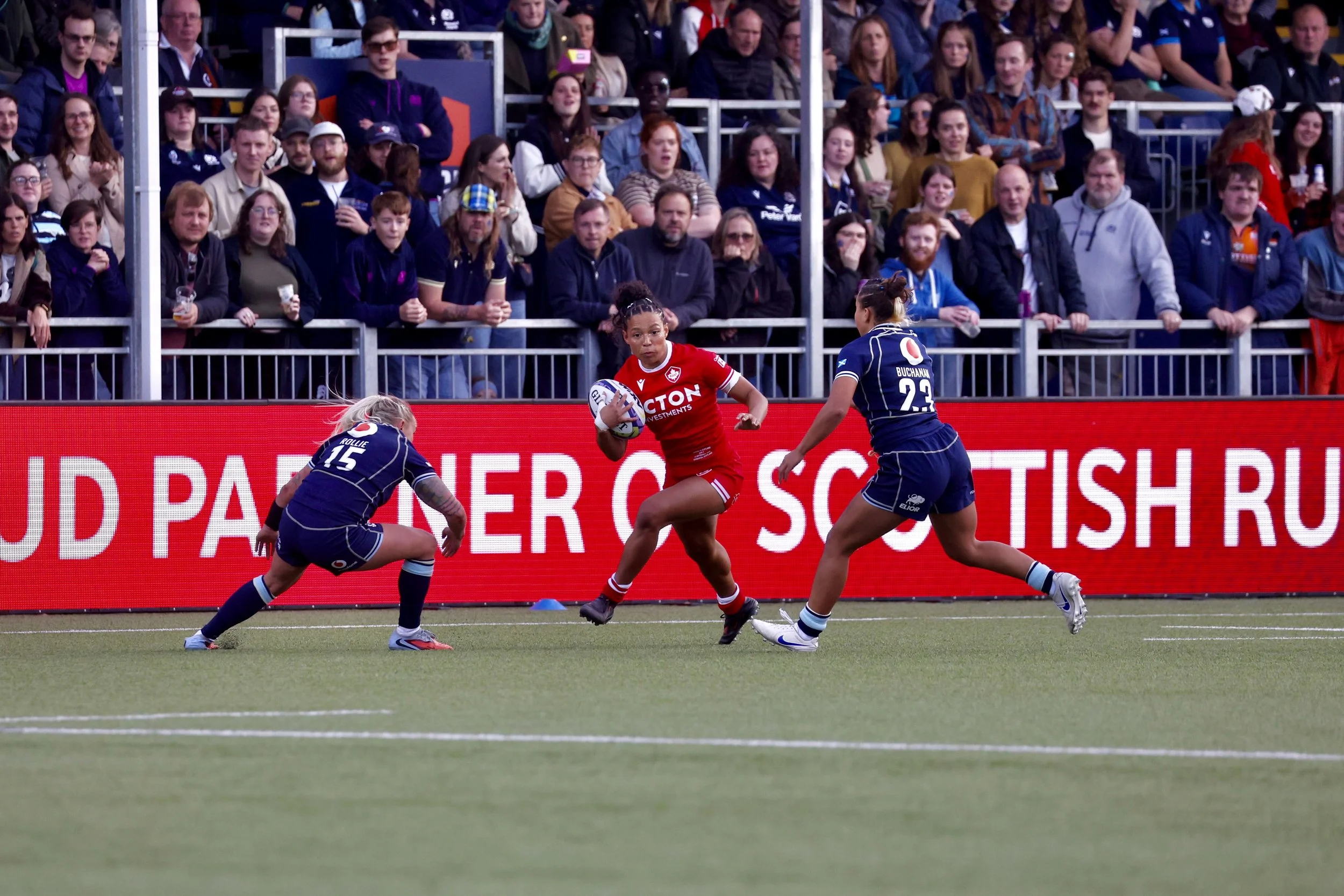
Asia Hogan-Rochester and Canada will be looking to take major strides in September’s WXV matches (Photo credit: Rugby Canada)
Fiji Offers a Preview
Fiji's 45-29 victory in Osaka sent the Flying Fijians into the Pacific Nations Cup final, but it also gave Canada something more useful than a semi-final victory could have: another look at an opponent waiting on the other side of the horizon. The two teams will meet again at the 2027 Rugby World Cup.
The Canadian men's problem against Fiji was not an inability to play.
There was enough attacking invention to produce four tries, enough physical resistance to keep the match alive, and enough individual performances to suggest a team still developing its depth. Mason Flesch scored twice; Lucas Rumball led the side in carries and tackles; young players were asked to operate in a match whose margins were unforgiving. Captain Rumball was proud of his team’s performance but emphasised the importance of the fundamentals and basic skills that proved the difference on the day.
Fiji demonstrated the distance still to travel.
The Fijians scored three tries in the opening 23 minutes and ultimately crossed seven times.
Canada could create pressure; Fiji was better at turning moments into points.
As Head Coach Stephen Meehan put it afterwards, Canada had periods of concentration lapses against a side capable of going 90 metres to score.
The team will get a chance to finish their tour of Japan on a high note with a third-place playoff against the United States in Tokyo.
Despite the loss, Saturday’s result was informative for the future. “We play Fiji at next year's World Cup and we're excited about that,” Meehan said.
When 2027 arrives, the players will know exactly what that speed looks like. The coaches will know which defensive decisions survived it and which did not.
A Pathway For The Next Generation
Fiji exposed one problem. What Canada does next will determine whether the lesson matters.
Rugby Canada's agreement with Champ Rugby, announced earlier this week, is one attempt to address that longer-term problem.
The partnership gives Canadian men's players a professional pathway into England's second tier, with support for relocation and accommodation, while allowing clubs to work around international commitments. Rugby Canada has explicitly positioned the arrangement as a means of developing players toward the 2027 World Cup.
It is not a replacement for a domestic professional competition, even with the changing landscape of Major League Rugby.
But it is an acknowledgement of the environment Canadian players need if the national team is going to close the gap exposed in Osaka.
That makes the timing significant. Canada has less than a year before the World Cup. It cannot rebuild its entire professional ecosystem before then.
But it can give more players access to professional rugby, and it can use September's difficult lessons to identify which players and which skills need to develop fastest.

Canada’s men are closing the gap on Fiji, knowing what’s on the line when they meet again in Australia (Photo Credit: World Rugby)
The Women See September Differently
The women's team is approaching the same problem from the opposite direction.
Their 64-26 victory over Scotland was spectacular on the scoreboard, with Olivia Apps returning to the 15s side and scoring two tries, while Lizzie Gibson also crossed over twice. Captain Alex Tessier spoke glowingly about Canada’s dominance at set pieces as well as in open play.
However, Head Coach Kevin Rouet has been explicit about refusing to treat this September programme as a collection of isolated Tests.
Scotland, England and France are the first three opponents in the WXV competition.
The sequence has the feel of a World Cup pool: Scotland first, then England and then France.
Canada reached the 2025 World Cup Final. The next objective is not simply to prove that the run was real.
It is to learn how to reproduce that level against the teams most likely to stand in the way of doing it again.
That makes Scotland the beginning rather than the story.
England comes next, in a rematch of last year's World Cup final, before France closes the European leg. Canada will then return home for two October matches against England.
The WXV is giving his players something that international rugby rarely provides outside a World Cup: repeated exposure to elite opposition, with the consequences of one match informing the next.
Rouet himself called Saturday’s win a good performance but stressed that Canada is “not a finished product yet,” with details still to refine in both attack and defense.
That is probably the most important sentence to take from Edinburgh. The Canadian women are not using September to demonstrate that they have arrived.
They are using it to find out what still needs fixing before they have to arrive again.
And that, ultimately, is what makes Saturday's two results less contradictory than they first appear.
The men lost to a team they will have to beat next year.
The women overwhelmed a team they may have to beat again in the future, while preparing to face two considerably more revealing examinations.
The immediate scorelines point in opposite directions. The longer view does not.
For the men, Fiji exposed the margins Canada must close. For the women, Scotland provided the first answer to a much larger question.
September 2026, then, may prove more informative for Canadian rugby than Saturday's results suggest.
The men learned what their future World Cup opponent can still do to them. The women began learning what it will take to reach another World Cup final.
The scoreboard told us who won Saturday. The calendar tells us why the matches mattered.
Sources:
Rugby Canada, “RUGBY CANADA PARTNERS WITH CHAMP RUGBY ON NEW PLAYER PATHWAY”, 8 September 2026
Stephen Meehan, Canadian men’s head coach, press conference, 12 September 2026
Lucas Rumball, Canadian men’s captain, press conference, 12 September 2026
Kevin Rouet, Canadian women’s head coach, press conference, 12 September 2026
Alex Tessier, Canadian women’s captain, press conference, 12 September 2026
Stephen Meehan, Canadian men’s head coach, press conference, 8 September 2026
Photo Credits:
Asia Hogan-Rochester runs at Chloe Rollie and Katie Buchanan, Rugby Canada, 12 September 2026
Stopping the runner, World Rugby, 12 September 2026
All photos are used with permission. All rights reserved to the creator.

Support PSP Media
Every contribution helps support independent research and reporting