
From Baghdad to the World: How Graham Arnold Helped Iraq Find Its Way Back
By Nii Wallace-Bruce
The scorelines were unforgiving.
Yet, in many ways, the most important part of Iraq's tournament had already happened before a ball had been kicked.
The Lions of Mesopotamia are here.
More Than Football
For a country that has spent much of the past four decades navigating war, political instability and upheaval, simply standing among the world's elite carries a significance that stretches well beyond football.
The World Cup is not the end of Iraq's story. It is proof that one still exists.
Football has long provided one of the few constants capable of uniting Iraq. At the 2004 Olympic Games, an unfancied U-23 side was within touching distance of a medal just a year after the invasion of Baghdad. Three years later came one of the greatest underdog triumphs Asian football has produced, defeating Saudi Arabia to lift the 2007 AFC Asian Cup.
That tournament also marked the first chapter in an unlikely relationship.
Graham Arnold was interim coach of Australia at the Socceroos' first Asian Cup after leaving Oceania. Expectations were enormous after a historic Round of 16 finish at the 2006 World Cup. Instead, Australia was humbled by a fearless Iraqi side whose triumph became a symbol of hope for an entire nation.
After Australia’s quarter-final exit, Arnold’s spell in charge soon came to an end.
While Iraq appeared destined for sustained success, the country's broader instability repeatedly interrupted football's progress. Promising generations came and went. World Cup qualification remained elusive.
An Unlikely Reunion
One member of that celebrated 2007 squad, however, would find a new life thousands of kilometres away.
Ali Abbas arrived in Sydney for an Olympic qualifier in 2007 against the Olyroos, which happened to be coached by Arnold. Abbas and other players would seek asylum in Australia after the match. Eventually granted refugee status, he rebuilt both his life and his football career in Australia. Abbas would play for Marconi Stallions, Newcastle Jets and Sydney FC.
At Sydney FC, he would end up being coached by Graham Arnold.
Years after the shock defeat to Iraq, Arnold rebuilt his own reputation. Club success with Central Coast Mariners and Sydney FC earned him another opportunity with Australia’s national team. He guided the Socceroos through the disruption of the COVID era, qualified for the 2022 FIFA World Cup and became the first Australian coach to lead the national team into the knockout stages.
Football can be unforgiving, though.
The final stage of Asian qualifying for the World Cup started poorly in September 2024. Australia were held goalless by Bahrain and Indonesia. Public confidence disappeared. Results stalled. Arnold parted company with the Socceroos' place at the 2026 World Cup still uncertain.
In a few short months, Iraq was searching for answers of its own. A draw with Kuwait and a defeat to Palestine in March 2025 left the World Cup chances of the Lions of Mesopotamia in jeopardy.
The phone call that changed everything came from a familiar voice: Ali Abbas.
Within weeks, Arnold was leading Iraq's national team. Abbas became his translator and cultural bridge. Former Socceroos goalkeeper Željko Kalac joined the staff alongside Robbie Stanton and other trusted Sydney FC colleagues, bringing an unmistakably Australian influence into one of Asian football's proudest but most turbulent nations.
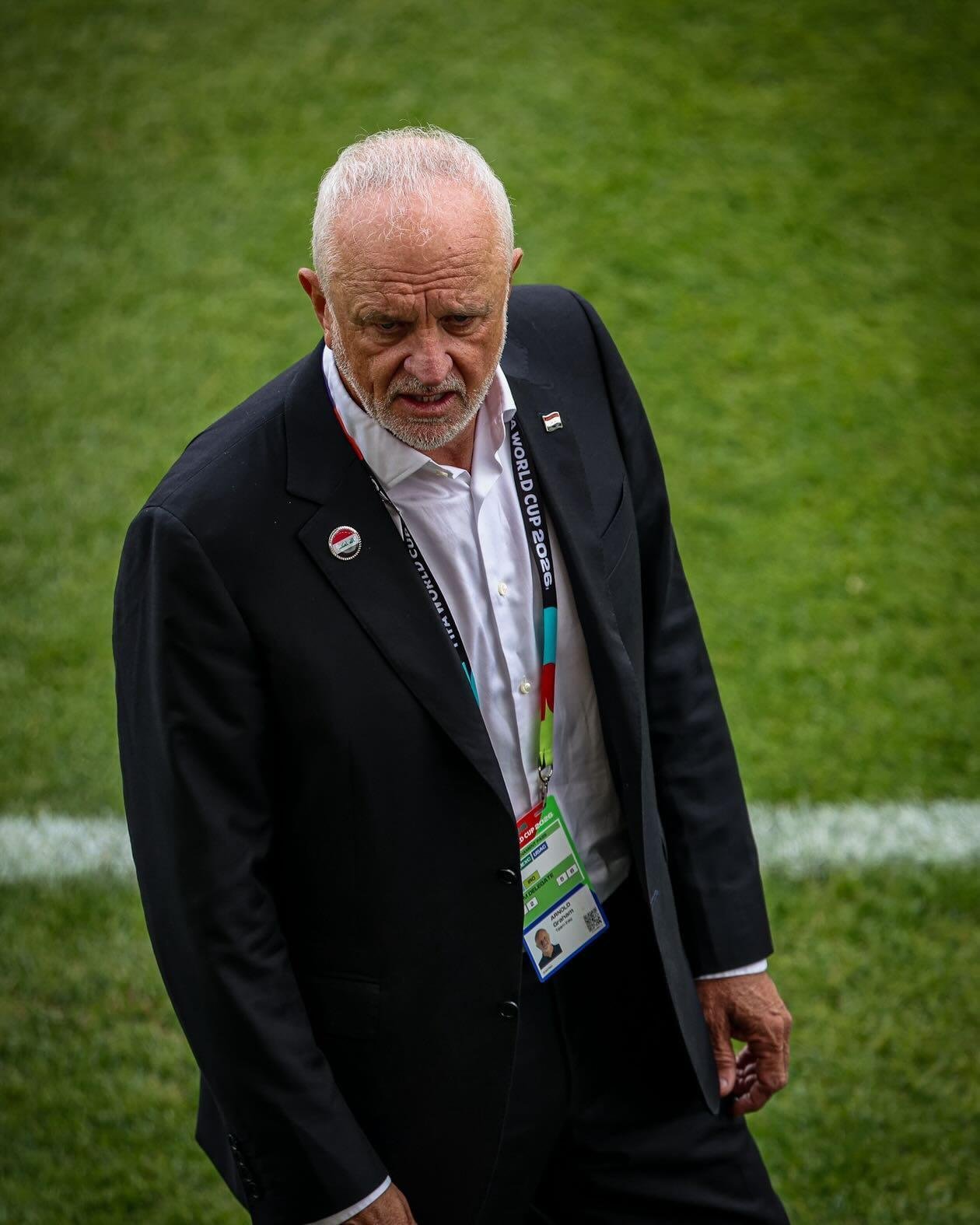
Despite a tough set of results in North America, Graham Arnold acheived his goal of guiding Iraq back to the World Cup (Photo Credit: Cheick Hardara)
Finding A Way
Progress was gradual rather than spectacular. The first match ended in a 2-0 defeat to Korea Republic in June 2025. However, this would turn out to be the last defeat for Iraq in this qualifying cycle.
Arnold's methods demanded patience. Patience was also demanded of Arnold when it came to cultural and linguistic nuances. Arnold adapted training and communication to fit the realities of a squad drawn from Iraq's global diaspora. English speakers, Arabic speakers and multilingual players were positioned to improve communication, while prayer times were accommodated as part of the team's daily rhythm. Rather than seeing those moments as interruptions, Arnold described them as another form of discipline. Defensive organisation improved. Iraq became harder to break down. Slowly, belief returned.
Qualification still wasn't straightforward.
Iraq reached the AFC playoffs, but narrowly missed automatic qualification, finishing behind Saudi Arabia on goal difference.
A further round of playoffs awaited in the form of a two-legged playoff against the United Arab Emirates.
After a 1-1 draw in Abu Dhabi, the second leg was played in Basra, Iraq. Both teams exchanged goals on either side of the hour mark. With the game seemingly headed to extra-time, there would be a chaotic finish. With an absurd 17 minutes of added time, Amir Al-Ammari converted a hotly contested penalty to give Iraq a place in the intercontinental playoffs. Then history intervened once more.
Conflict involving neighbouring Iran threw travel across the region into chaos. Players and staff, including Arnold and Abbas, found themselves unable to leave the Middle East on schedule for Mexico.
Their route to North America became a logistical maze rather than a flight plan. Getting out of the Middle East was the first step. Getting clearance to travel through the United States to Mexico for the playoffs was a difficult step for some.
It was messy, uncertain and exhausting. In many respects, it reflected modern Iraq itself.
Afterwards, Arnold reflected that his objective when he accepted the role had simply been to return Iraq to the World Cup. Against considerable odds, that “miracle”, as he described it, had become reality.
Resilience became the defining characteristic of Iraq under Arnold. Tactical bravery on the pitch mirrors the determination required simply to assemble the squad off it. For many players, representing Iraq has always meant carrying something much larger than a football shirt.
Arnold understood that quickly. The Australian arrived with experience and structure. Iraq supplied perspective.
The partnership has become one of the World Cup's most unexpected stories.
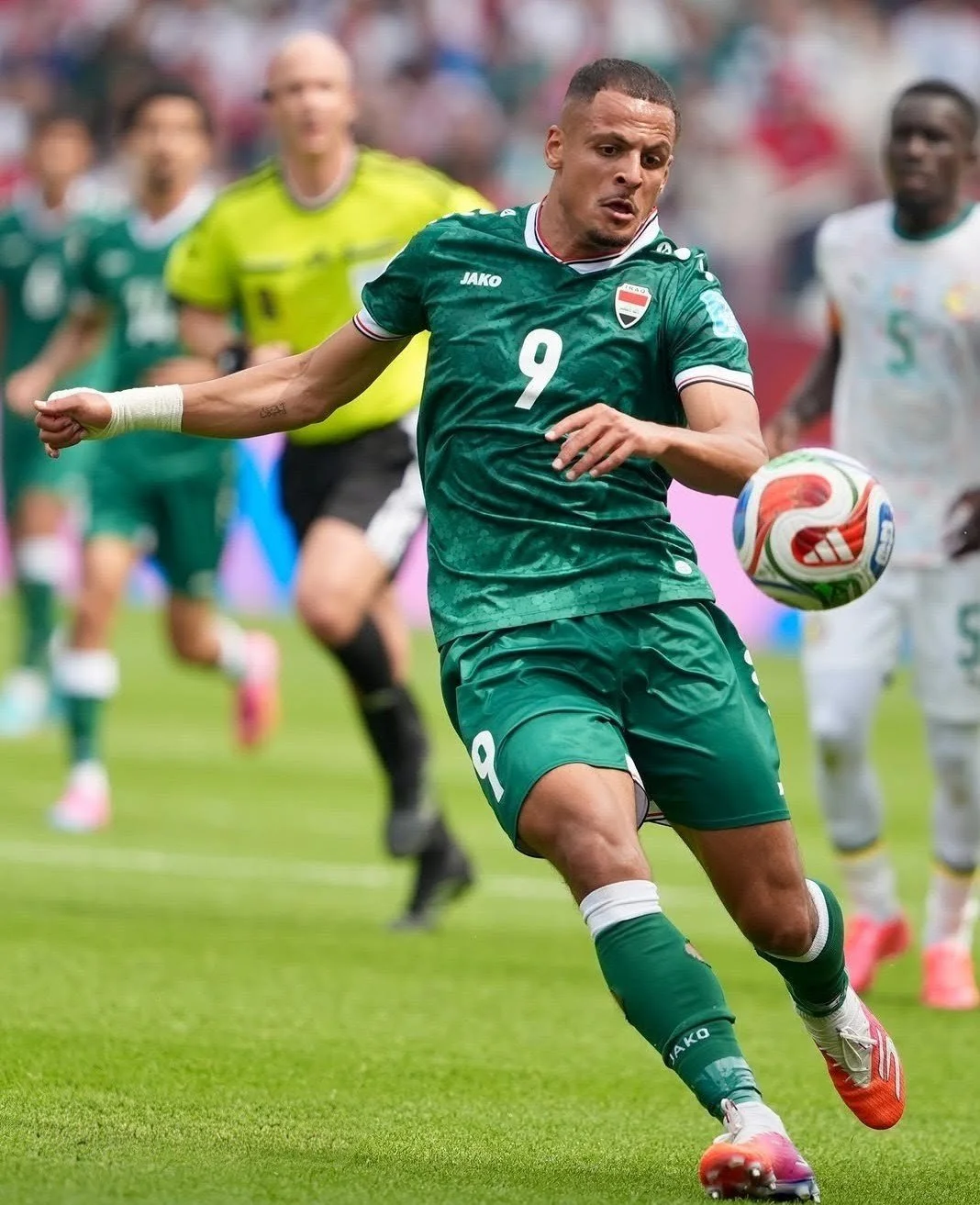
Iraqi striker Ali Al-Hamadi was a big part of the Lions of Mesopotamia qualifying campaign (Photo credit: Amar Shaker)
Presence Over Performance
Iraq's campaign ended this week. The Lions of Mesopotamia were one of the few teams to play competitive matches (World Cup play-offs and finals) in Mexico, the United States, and Canada during 2026.
But not every World Cup story is measured by points or goal difference. Some are measured by the distance travelled.
Left-back Merchas Doski understood that.
Reflecting on Iraq’s first World Cup appearance in four decades, he hoped the experience would become the foundation for future tournaments and the journey toward 2030.
Alongside Abbas—a former refugee who once sought safety in Sydney before helping bring an Australian coach to Baghdad and Basra—the circle feels almost impossibly complete.
There may be another chapter.
In Saudi Arabia next year, the Lions of Mesopotamia will meet Australia at the 2027 AFC Asian Cup, a reunion almost two decades in the making. It is up to the Iraqi FA to decide whether Arnold will be there or not.
For now, though, the spotlight belongs in North America, where one nation's long road back has already produced something more meaningful than results.
Nineteen years after Iraq broke Graham Arnold’s heart in Bangkok, he helped return the same nation to football’s biggest stage.
Sources:
The Guardian,“Iraq head coach Graham Arnold: ‘We’re capable of doing something that will shock the world’”, Sid Lowe, 15 June 2026
Code Sports, “Arnold’s life inside a high-security Iraqi compound — making World Cup history”, Erin Smith, 6 June 2026
The Sports Ambassador, “The Aussie with the dreams of 46-million Iraqis resting on his shoulders”, Tracey Holmes, 23 December 2025
SBS News Australia, “First Day: Ali Abbas' incredible journey from Iraq to Australian football glory”, Sylvia Varnham O'Regan, 6 December 2015
Australian Associated Press, “Arnold out to conquer toughest job, end World Cup pain”, George Clarke, 28 March 2026
Graham Arnold, Iraq Head Coach, press conference, 26 June 2026
Merchas Doski, Iraq player, media scrum, 26 June 2026
FIFA Training Centre, Senegal 5 Iraq 0 - POST MATCH SUMMARY REPORT, 26 June 2026
Photo Credits:
Ali Al-Hamadi in pursuit, Amar Shaker, 26 June 2026 - Photo courtesy of Amar Shaker
Graham Arnold on touchline, Cheick Hardara, 26 June 2026 - Photo courtesy of Cheick Hardara
All photos are used with permission. All rights reserved to the creator.

Support PSP Media
If this article resonated with you, consider supporting PSP Media.
Every contribution helps support independent research and reporting