
Anika Tóth and Tanya Boychuk met on opposite sides of a World Cup qualifying playoff. They then met on the following weekend in Northern Super League.
Their international rivalry is also a reflection of the league's growing connection to European football, where professional development, national identity and the movement of players increasingly intersect.
Part Five of a six-part series examining the connection between Northern Super League and international football
By Nii Wallace-Bruce
The stadium was in Slovakia, but the voices coming from the stands belonged to Ukraine.
For 90 minutes, Ukrainian supporters sang and chanted from both sides of the ground, following their national team thousands of kilometres from home.
Among those on the pitch was Tanya Boychuk, a Montréal Roses forward who had spent much of the preceding weeks competing against an opponent she knew increasingly well.
Anika Tóth, the Halifax Tides goalkeeper, was on the other side. In the Northern Super League, they were familiar opponents.
In October, they became international rivals, meeting across two legs of a UEFA qualifying play-off for the 2027 FIFA World Cup.
This tie was sandwiched between two league meetings on 27 September and 17 October respectively.
Their story is about more than four football matches in three weeks. It is about the connections being created between international football cultures through Canada's emerging professional women's league.
Yet the October fixtures carried a different significance for each player.
For Boychuk, the first leg brought a milestone she will not forget: her first international goal for Ukraine, scored in the 3–1 victory over Slovakia.
For Tóth, the two matches represented another important step in her international development, earning her second and third caps for Slovakia.
Their achievements were different in scale and circumstance, but both reflected the significance of opportunities that professional football in Canada had helped make possible.
One was beginning to leave her mark on the international scoresheet; the other was building her experience representing her country.
As Tóth explained, being able to represent Slovakia in front of a home crowd twice was a particularly special experience.
For Boychuk, the lasting memory of the tie would ultimately have less to do with her goal than with the Ukrainians who travelled to support their team.
And while the playoff offered a competitive test, it also revealed something about the different meanings attached to representing a national team.
Familiar Faces, Familiar Challenges
There is a particular familiarity that develops when footballers keep meeting each other.
At first, it is recognition. Then comes an understanding of tendencies, habits and preferences. An attacker begins to recognise the goalkeeper's positioning. A goalkeeper learns the movements of an opposing forward. What was once an unfamiliar opponent becomes a known quantity.
For Anika Tóth and Tanya Boychuk, that familiarity was built in the Northern Super League before being reinforced on the international stage.
Over a three-week period, they faced each other four times across club and international football.
It is an uncommon degree of familiarity between two players representing different countries, but it also illustrates the increasingly interconnected nature of the professional women's game.
Their October meetings simply transferred that familiarity into a different footballing context.
"After facing each other in 4 matches across a 3-week time frame, both at the club and international level, Tanya Boychuk and I have definitely developed a strong understanding of each other's game," Tóth said.
"I have learned her tendencies as an attacker, which has translated to my club preparation and allowed me to feel more comfortable and confident competing against a familiar competitor."
For Tóth, that knowledge is particularly valuable. Goalkeeping is as much about anticipation as reaction, and understanding an opponent's tendencies can influence everything from positioning to decision-making.
Boychuk, meanwhile, offered a similarly warm assessment of her Halifax counterpart. "Anika is a great player, and it was fun to see a familiar face during the recent international matches."
Their relationship as opponents also acquired another significant dimension on the final weekend of the regular season.
Boychuk delivered one of the defining moments in Montréal Roses history, scoring the winning goal against Ottawa on October 23 to secure the club's first Supporters' Shield.
It was a fitting contribution from a player whose international career had just provided another reminder of the significance of representing something larger than herself.
There is something fitting about that juxtaposition.
In the space surrounding their international commitments, these two players were also participating in the defining moments of Canada's emerging professional league.
For Boychuk, the Shield-winning goal was another reminder of what can be achieved in the NSL. In November, Boychuk will be hoping to win the Diana B. Matheson Cup with the Roses.
In December, she will once again represent Ukraine as they meet England in the final round of UEFA qualifying playoffs for the 2027 World Cup.
Their international rivalry did not exist independently of their club careers. It was an extension of them.
And that is perhaps the more interesting story: the same players, the same competitive instincts and many of the same tactical questions, but under different flags and in different footballing environments.
Different Footballing Educations
Tóth's development in Halifax has also been reflected in the team's defensive improvement.
Having established herself as the Tides' starting goalkeeper during the inaugural 2025 campaign, she continued to play an important role in 2026.
Halifax conceded just 24 goals across the regular season, tying AFC Toronto for the league's best defensive record.
It represented a significant improvement on the inaugural campaign, when the Tides conceded 43 times, the highest total in the league.
Yet the defensive progress was not enough to secure a playoff place.
Halifax's difficulty was at the opposite end of the pitch. A lack of goals ultimately undermined the team's efforts, leaving the Tides one point short of the postseason on the final night of the regular season.
For Tóth and the defensive unit, there was a degree of frustration in knowing that their work had provided a platform for the team, without the necessary attacking return to turn it into a playoff campaign.
Nevertheless, the season offered Tóth a valuable education in the demands of professional football in North America.
The extensive travel across the continent, the pressure of competing in consequential matches and the challenge of facing opponents with different approaches to possession and attacking play all contributed to her development. Some opponents sought to dominate the ball and dictate the tempo; others presented different problems through their defensive organization and transition play.
For a goalkeeper, those variations demand constant adjustment.
Reading the game, organizing the defensive line, managing space behind the defence and understanding when to intervene all become part of the tactical preparation.
Those experiences would have provided a useful foundation when Tóth returned to international football with Slovakia.
Her role, as she explained, changes depending on the tactical expectations of each environment, both in and out of possession.
The demands of international football are different, but the ability to adapt has become an increasingly important part of her development.
In that sense, Halifax's season was not defined solely by the playoff place it narrowly missed.
For Tóth, it was also a year of accumulating the experience, responsibility and tactical understanding required to compete at a higher level.

Anika Tóth’s saves were an asset to the improved Halifax Tides defense and a source of frustration for her opponents (Photo credit: Fiona Davidson)
The Weight of a Shirt
Due to the ongoing war in Ukraine, both of October’s fixtures were played in Slovakia. Despite this, Ukrainian supporters occupied both sides of the stadium.
They sang and chanted throughout the match, creating an atmosphere that Boychuk found difficult to ignore. Boychuk's recollection, however, was less about the football itself than the people watching it.
"At times, I found it hard to focus because I was so taken aback by the incredible support and patriotism around us."
For a professional footballer, concentration is ordinarily an essential part of the job. The crowd is something to manage, the noise something to process.
Yet there are occasions when the emotional significance of the surroundings becomes difficult to separate from the match.
For Ukraine, international football exists within a national context that cannot be treated as incidental.
The country continues to live with Russia's invasion, and its footballers carry that reality into their professional and international lives.
Supporters travelling to Slovakia were not simply following a team across a border. They were expressing a connection to a country whose circumstances have made ordinary life profoundly difficult.
"To see Ukrainians show up in those numbers, so far from home, was incredibly special," Boychuk said.
"The patriotism and resilience of Ukrainians is unmatched, especially given everything the country continues to face. It was a reminder of who we represent and just how much it means to so many people."
Ukrainian players and supporters alike were sustaining a connection with their country and national team while playing away from home because of the security situation.
It extended into the stands, across borders and into communities whose relationship with the national team is shaped by circumstances far beyond football.
For Boychuk, that responsibility is something she has come to appreciate through her teammates in Ukraine.
She spoke about receiving a message from a teammate describing the bombing of an electrical power plant, leaving people without electricity, heating and water as colder weather approached.
Another teammate had previously explained that her nightly routine involved praying to wake up the following morning, then waking up and praying she would make it through another day without being bombed.
These are not abstract descriptions of resilience. They are the realities of people who must continue living, working and finding ways to pursue their ambitions under extraordinary circumstances.
Yet Boychuk's account of her teammates was not defined solely by hardship.
She described players who continue to attend training with smiles on their faces, grateful for the opportunity to play and conscious of the everyday privileges that others might overlook.
"They've taught me a lot about perspective, gratitude and resilience," she said.
For a footballer playing professionally in Canada, that perspective travels back into the club environment.
It changes how opportunity is understood, how setbacks are processed and how much significance is attached to the ability to simply play the game.
The NSL may be geographically distant from the circumstances of Ukrainian football, but its players are not disconnected from them.
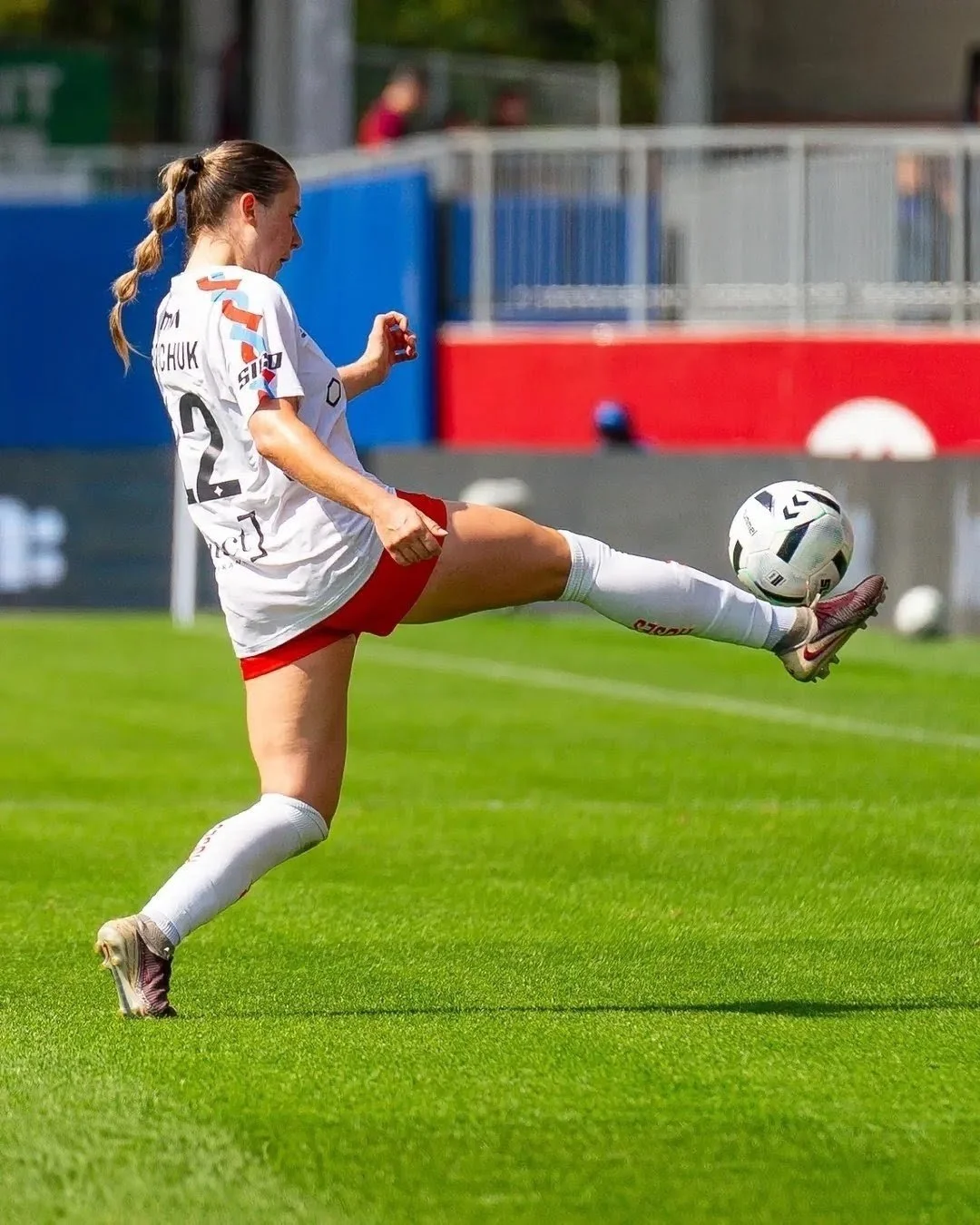
Tanya Boychuk’s connection with football has taken on a greater meaning when representing Ukraine (Photo credit: Marc Eymé)
The Global Game, Through a Canadian Lens
There is a broader significance to the relationship between Tóth and Boychuk.
One represents Slovakia, a country seeking its first appearance at a FIFA Women's World Cup.
The other represents Ukraine, a country whose footballing ambitions continue despite the extraordinary circumstances surrounding its national life.
Both have found professional opportunities in Canada.
Their journeys illustrate how the geography of women's football is changing. Players are increasingly able to pursue professional careers in one country while maintaining an international connection to another.
For the NSL, that creates a particularly interesting position. Canada's professional women's league is still young, but its influence is not limited to the development of the Canadian national team.
It is also becoming part of the professional infrastructure available to players representing other nations.
That influence is not necessarily measured through the number of international caps or goals scored during a qualifying campaign.
It can also be seen in the development of players, the exchange of tactical knowledge and the relationships formed between footballers who might otherwise have spent their professional careers in entirely separate environments. Tóth and Boychuk offer a particularly clear example.
Their national allegiances placed them on opposite sides of a World Cup qualifying tie. Their professional careers brought them into repeated contact.
Their experiences in October have now become another part of their respective footballing educations.
For Tóth, the playoff was an opportunity to establish herself further in international football and represent Slovakia in front of home supporters.
For Boychuk, it was an opportunity to score her first international goal, help Ukraine progress and witness the extraordinary connection between a national team and its supporters.
Their experiences were different, but neither was separate from the football they play in Canada.
The NSL is still defining what it will become. Its international influence will take years to measure properly. But the stories of its players already suggest that its importance extends beyond the domestic competition.
Sometimes, that influence is found in the exchange of footballing ideas between a goalkeeper and a forward.
Sometimes, it is found in a player returning from international duty with a renewed appreciation of the opportunity to play.
And sometimes, it is found in the sound of supporters singing their country's songs thousands of kilometres from home.
The global game does not stop at the Canadian border. It arrives with the players, develops through their experiences and leaves something behind.
For Tóth and Boychuk, October was a reminder that football can connect two countries through competition, while revealing just how much more exists beneath the surface of the game.
Sources:
Tanya Boychuk, Montréal Roses player, personal interview, 10 November 2026
Anika Tóth, Halifax Tides player, personal interview, 5 November 2026
Video Credit:
Boychuk Goal, Northern Super League, 23 October 2026 - Video courtesy of @NorthernSuperLg via X
Photo Credits:
Tóth makes save, Fiona Davidson, 26 October 2026 - Photo courtesy of assignment by PSP Media
Tanya Boychuk, Marc Eymé, 16 August 2026 - Photo courtesy of assignment by PSP Media
All photos are used with permission. All rights reserved to the creator.

Support PSP Media
Every contribution helps support independent research and reporting