
The Unfinished Canvas: How Al-Nassr Could Redefine Ange Postecoglou’s Career
By Nii Wallace-Bruce
Part One of a three-part series surrounding the appointment of Ange Postecoglou at Al-Nassr
For three decades, Ange Postecoglou has built teams through conviction rather than excess. Al-Nassr changes the equation.
With new objectives of domestic and continental success, the Australian now faces the defining challenge of his managerial career.
The Shift in Conditions
For most of his managerial life, Ange Postecoglou has worked in football’s margins of constraint rather than its centres of wealth.
He has built in environments where ideas mattered more than expenditure, where structure had to compensate for scale, and where identity was often the only sustainable competitive advantage.
From the domestic foundations of Australian football to the pressure-cooker of Glasgow and the high stakes of the Premier League, the pattern has been consistent: limited parameters, maximal conviction.
Al-Nassr alters that balance.
In Riyadh, Postecoglou steps into a footballing ecosystem underwritten by the Saudi Public Investment Fund, where ambition is framed by acceleration.
This is not a rebuilding job in the traditional sense.
It is a construction project with few visible limits, a club already populated by global names and designed to compete not only domestically, but across Asia and increasingly on the global stage. The question, then, is not whether Postecoglou can build. That has already been proven across multiple continents.
It is whether he can impose structure upon abundance—and what happens when a manager defined by structure and system is placed in charge of stars assembled under a different logic entirely.
The Unfinished Canvas
There is a temptation to frame Ange Postecoglou’s journey as a series of incremental steps towards a higher level. South Melbourne to Brisbane Roar.
Melbourne Victory to Yokohama F. Marinos. Celtic to Tottenham Hotspur. Each move outward, each league stronger, each stage more scrutinised.
Yet the defining thread is not progression. It is construction.
At South Melbourne, he shaped a dominant domestic force within the constraints of a semi-professional National Soccer League.
At Brisbane Roar, he produced one of the most coherent sides in A-League history, built not on individual brilliance but positional discipline and collective understanding.
The Roar still hold the A-League record with a 36-match unbeaten run.
Yokohama F. Marinos offered his first major success in Asia’s elite club landscape, where his principles translated into a league title and a distinct attacking profile.
Despite being controlled by motoring giant Nissan, Yokohama’s membership in the City Football Group allowed Postecoglou to utilise the technical resources of the wider group.
The City Football Group’s informal connection with Celtic’s principal shareholder Dermot Desmond led to a meeting between the Glasgow club’s board and Ange Postecoglou.
From there, “Big Ange” would become a legend with the Bhoys where domestic dominance became routine but expectations in Europe provided a sterner measure of adaptation.
Tottenham Hotspur, finally, placed him in the Premier League's gravitational centre, where ideological football met structural imbalance.
Even amid inconsistent league form, captain Son Heung-min credited Postecoglou with changing the club's trajectory after he guided Spurs to the Europa League and ended a 17-year wait for major silverware.
Every job began with limitations.
There is another common thread. Postecoglou's teams have rarely been easy to inherit.
The automatisms underpinning his football—aggressive pressing, positional rotations and relentless tempo—have often taken months to establish and proved difficult to reproduce once he departed. That durability is one measure of the depth of his coaching; it is also a reminder that his influence extends beyond results alone.
Al-Nassr is the first time that equation changes.
Here, optimisation is no longer enough.
The task is a synthesis: of elite talent, high-profile personalities, and a tactical identity that must deliver both domestic control and continental authority.
It is, in essence, the richest canvas of his career—not only financially, but conceptually.
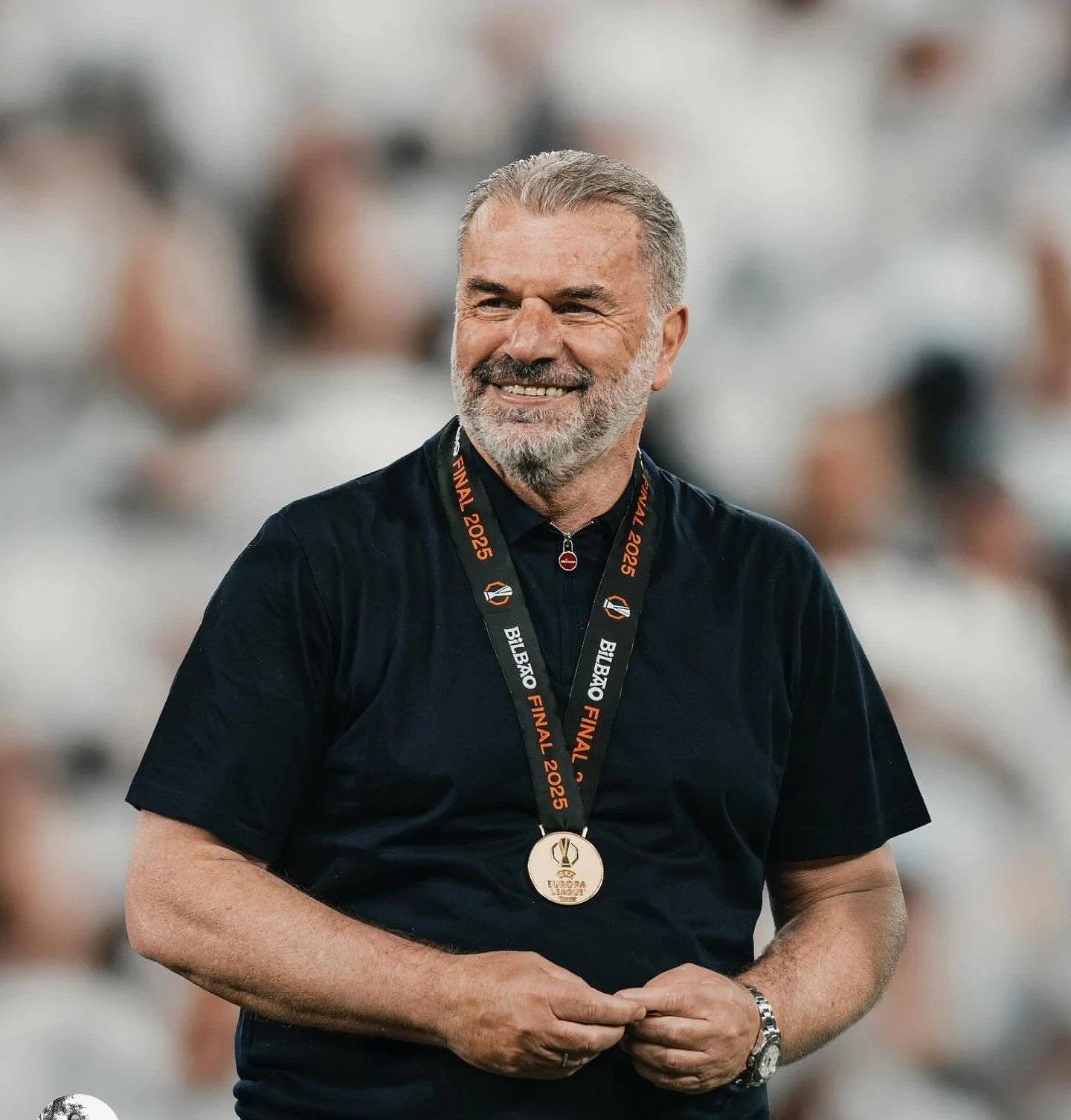
Postecoglou’s high watermark in club football was guiding Tottenham to the Europa League title, ending a lengthy trophy drought (Photo credit: Frederikke Hejbøl Jensen)
From Builders to Backers
The context of Postecoglou’s arrival cannot be separated from the broader direction of Saudi football.
Under the stewardship of the PIF, the domestic league has evolved from a regional competition into a strategic sporting platform.
Broadcast rights have expanded globally to increase visibility of the league.
The Investment Fund has already stated a desire to focus on domestic projects between now and 2030, as opposed to foreign ventures such as LIV Golf.
High-profile appointments such as Simone Inzaghi's arrival at Al-Hilal reflect a shift from spectacle toward long-term footballing credibility.
The league has also introduced foreign-player restrictions and youth-development initiatives designed to strengthen domestic talent.
Al-Nassr’s decision to appoint Postecoglou fits within that same trajectory.
This is no longer simply about attracting names; it is about assembling a squad capable of competing across multiple competitions simultaneously, from the Saudi Pro League to the AFC Champions League Elite, and potentially the expanded FIFA Club World Cup, where qualification has become an increasingly strategic objective.
The presence of global stars has already altered objectives.
Cristiano Ronaldo remains the symbolic centre, while João Félix, Kingsley Coman, and Sadio Mané add further layers of elite European pedigree.
Yet the strategic question facing the club is no longer recruitment at the top end alone, but coherence beneath it.
Several of the club’s highest-profile players are approaching key decisions over their futures, adding another layer to Postecoglou’s planning.
Postecoglou arrives not as a celebrity manager, but as one whose reputation rests on methodology rather than aura.
In a league that initially attracted attention through star power, that distinction is increasingly significant.
That distinction matters.
Because while Al-Nassr have previously leaned into individual brilliance, they now appear intent on layering that talent within a more defined collective structure.
The Significance of Expectation
Success in Riyadh will be measured across multiple dimensions.
Domestically, the Saudi Pro League title remains the foundational goal.
Continentally, the AFC Champions League Elite represents the clearest benchmark of regional supremacy. Al-Nassr will have a chance to contest both in 2027.
Beyond that lies the symbolic prize: qualification and impact at the FIFA Club World Cup and FIFA Intercontinental Cup, where Saudi clubs increasingly measure themselves against global opposition.
For Postecoglou, however, the stakes extend further. He has two seasons to make an impact. He said he is coming to win trophies with Al-Nassr.
Failure in such an atmosphere does not simply mean a lost title race or an underwhelming continental campaign.
It risks interruption to a career trajectory that has, until now, consistently moved upward.
Success, by contrast, would place him in a rare category of modern managers: those capable of translating a defined football philosophy into environments of extreme pressure and elite talent density.
It is not difficult to imagine how that changes his longer-term standing. With Saudi Arabia set to host the 2034 FIFA World Cup, and with ongoing alignment between domestic football and national team planning, sustained success at Al-Nassr would inevitably place him within broader conversations about international management in the region.
But those outcomes remain distant.
The immediate task is more fundamental: to impose coherence on a squad built for dominance but not yet fully shaped by identity.
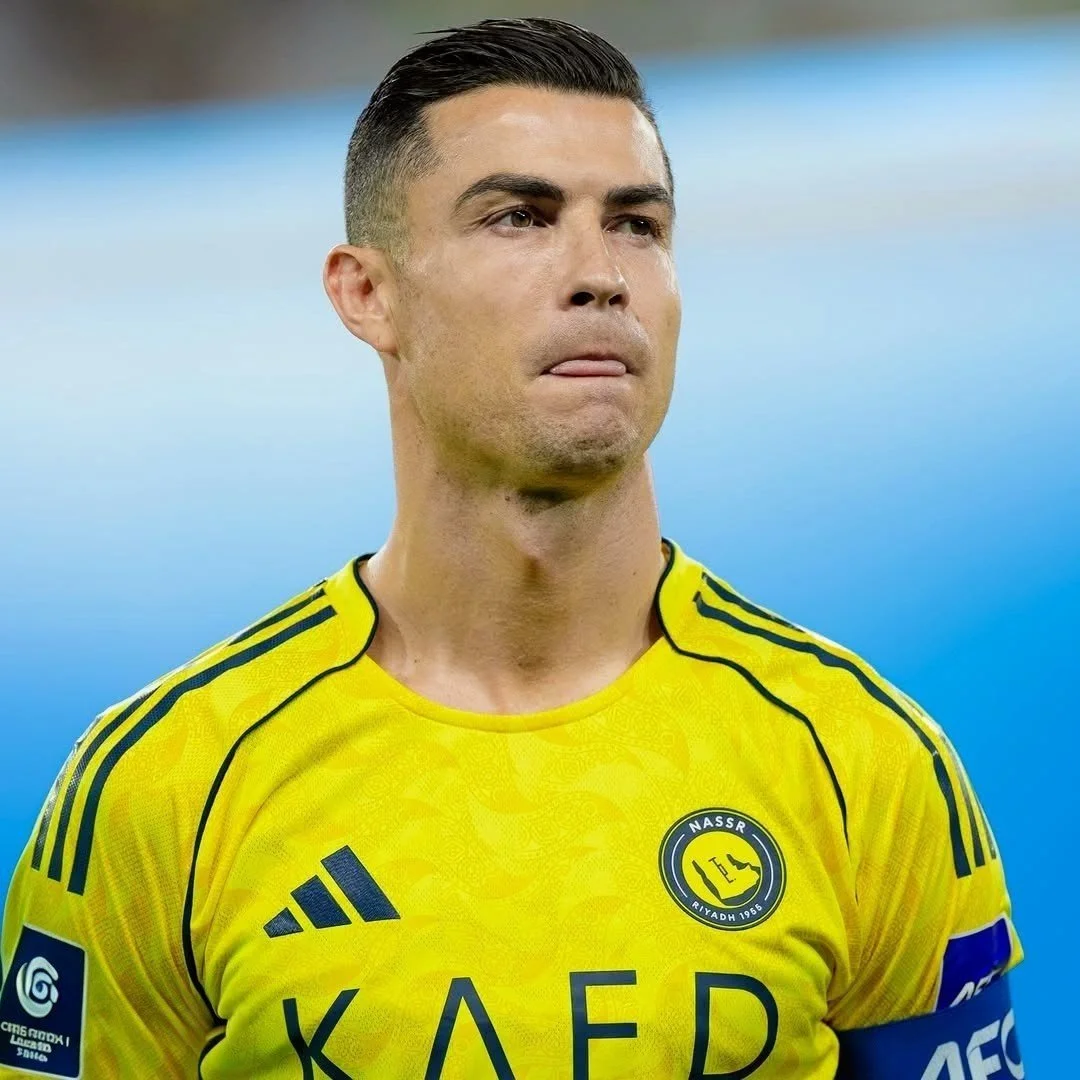
Man-management of stars such as Cristiano Ronaldo is a big task for Postecoglou, but the rewards are also large. (Photo credit: Motim Al-Osaimi)
The Question That Remains
Every managerial path is defined by a central tension.
For Postecoglou, it has long been the balance between ideology and environment—between a clear footballing vision and the practical limitations of the squads available to him.
At Al-Nassr, that tension shifts. The question is no longer whether his ideas can survive constraint. It is whether they can thrive without it.
And whether, in the most resource-rich environment of his career, Ange Postecoglou can do what he has always done—only on a scale he has never yet been allowed to attempt.
If he can, Al-Nassr will not simply represent another chapter in his journey.
It may well become its defining page.
Sources:
BBC, “Spurs captain Son says Postecoglou a club 'legend'", Mantej Mann, 7 June 2025
ESPN, “Ange Postecoglou joins Cristiano Ronaldo's Al Nassr as head coach”, Mark Ogden, 3 July 2026
Reuters, “Saudi to focus $925 billion fund on domestic economy under new 5-year plan”, Timour Azhari and Jana Choukeir, 15 April 2026
Sports Pro, “Saudi Pro League international media rights revenue up 20%”, Stuart McCaskill, 25 September 2025
The Times of India, “How many foreign players can Saudi Pro League clubs have? Rules for international players explained”, 8 September 2025
South China Morning Post, “AFC Champions League to relax foreign player caps and adjust calendar to boost global standing”, 25 February 2022
Transfermarkt US, “Al-Nassr FC”, 3 July 2026
The Celtic Way, “Postecoglou first words as Al-Nassr boss paints similar Celtic picture" James McLaughlin, 5 July 2026
Vince Rugari, “AngeBall: The Definitive Biography of Ange Postecoglou”, Headline, 2025
Photo Credits:
Cristiano Ronaldo, Motim Alosaimi, 16 May 2026 - Photo courtesy of Motim Al-Osaimi
Ange Postecoglou, Frederikke Hejbøl Jensen, 27 August 2025 - Photo courtesy of Frederikke Jensen
All photos are used with permission. All rights reserved to the creator.

Support PSP Media
If this article resonated with you, consider supporting PSP Media.
Every contribution helps support independent research and reporting