
After Saturday, Canada's Questions Are Getting Harder
By Nii Wallace-Bruce
For a week, Canadian rugby had been asking questions.
Could the men absorb what Fiji had shown them before the two sides meet again at the 2027 Rugby World Cup?
Could the women turn a dominant victory over Scotland into something more meaningful against the team that had denied them a world title less than a year ago?
By Saturday evening, there were two very different answers.
In Tokyo, Canada's men held off the United States 19-16 to finish third in the Pacific Nations Cup, surviving nine phases inside their own five-metre line in the final moments to secure the result. Hours later in Exeter, Canada's women stood toe-to-toe with England in a 26-26 draw that ended the Red Roses' extraordinary winning run at 39 games.
The men's result was narrow. The women's was historic.
Together, they offered something more useful than either scoreline on its own: evidence that Canadian rugby is moving into a different phase of its development, one in which the question is no longer simply whether Canada can compete.
It is whether Canada can sustain it.
The Men Learned How to Close
The Pacific Nations Cup was always going to tell Canada something about where it stood before the 2027 World Cup.
Fiji provided the brutal version of that lesson last week, scoring 45 points and exposing the margins Canada still has to close.
The United States offered a different test. This was a game Canada could not afford to lose.
It was also a game in which the Canadians were repeatedly asked to protect a lead, recover from losing it and then survive the kind of ending in which a single missed tackle or breakdown penalty can erase an afternoon's work.
After being put on the back foot early against Fiji in the semi-final, Canada started sharply.
Ben LeSage finished a lineout set play after 10 minutes. Mason Flesch then crossed seven minutes later, extending his remarkable tournament to three tries.
At 12-0, Canada appeared to have control. But the United States gradually pulled the game back.
Luke Carty's kicking kept the Americans within range, and a penalty early in the second half gave them their first lead at 13-12.
Mason Flesch carried Canada inside the five-metre line. The forwards went to work. Jesse Kilgour eventually found the gap for his first international try. It was not spectacular.
It was exactly what Canada needed.
The final quarter became a test of something less glamorous than attacking invention: defensive composure.
Carty's third penalty reduced Canada's advantage to three points with eight minutes remaining.
Then, in the final seconds, the Americans worked through nine phases inside Canada's five-metre line.
The USA chose to scrum for the win. Canada defended it. Captain Lucas Rumball got over the ball at the critical moment, forcing the error that ended the match.
That sequence may be more valuable to head coach Stephen Meehan than the third-place finish itself.
“We want to be on the attack throughout our matches,” Rumball said afterwards. “You saw a little bit of that come through in that first half, probably a little bit less in the second.”
Meehan was equally candid, acknowledging that Canada made more errors than it had in its previous matches and identifying that as an area to improve when the team reconvenes in November. That is the less obvious significance of the victory. Canada did not dominate the United States.
It learned how to win a close international match.
The Women Learned They Belong in the Fight.
If Tokyo was about surviving, Exeter was about confronting the past.
It had been 12 months since England beat Canada 33-13 in the Rugby World Cup final at Twickenham.
The setting was smaller this time — a sold-out Sandy Park rather than a record-breaking crowd at the national stadium — but the history travelled with both teams.
England arrived with 39 consecutive Test victories.
Canada arrived with the memory of the final, and with a much clearer understanding of what had separated the sides 12 months ago.
This time, Canada did not allow England to establish the same control.
Lizzie Gibson struck in the sixth minute. DaLeaka Menin scored twice, including one just before half-time.
England responded through Claudia Moloney-MacDonald, Hannah Botterman and, after the interval, Bryony Field.
But every time England tried to turn the match into the kind of relentless forward-driven contest that has become so familiar during its extraordinary run, Canada found an answer. When England led again through Field, Canada responded through Olivia Apps.
And when the Red Roses finally had Canada pinned near its own line late in the match, the visitors refused to break.
With a scrum feed in the dying moments, Canada opted to kick for touch.
Head coach Kevin Rouet said of Canada's decision to kick into touch at the end: “Everybody has a decision to make, and you can't judge on outcome.”
The final score was 26-26. So was the larger statement.
England's 39-match winning streak ended, although the Red Roses remain unbeaten in 40 Tests.
Canada became the first side since New Zealand in the 2022 World Cup Final to avoid defeat against England.
There was something particularly fitting about the way it ended. Canada did not need a miracle. It needed to defend. And it did.
It is tempting to describe the draw as revenge for the World Cup final. In 2025, England repeatedly forced Canada into long defensive sequences.
Twelve months later at Exeter, Canada was able to establish possession, get its forwards over the gain line and keep England from converting pressure into separation.
Menin's performance was emblematic. Her two tries came from the sort of close-range power that England has traditionally made central to its game.
Sophie de Goede's influence was different. She helped Canada maintain momentum and then released Apps for the try that brought the sides level again.
And when England had the final sustained spell of pressure, Canada's defence held.
Some Red Roses saw Saturday as a missed opportunity for victory.
England’s rake Bryony Field had such sentiments: “We know in this team that we can get it across the line, and that's where the disappointment comes from”.
The match became a contest in which both teams had legitimate opportunities to win and neither could separate itself.
England captain Megan Jones welcomed the challenge, although she expected England to improve in certain areas moving forward.
“It was amazing Test Match rugby, which is what we want. We want a battle,” she said.
That is a very different place from where Canada stood at Twickenham last September.
The Canadian XV had changed significantly since the World Cup final, with Claire Gallagher, Olivia Apps, Taylor Perry, Rachel Smith, Julia Omokhuale and Lizzie Gibson among those taking on major roles in Exeter.
DaLeaka Menin and Sophie de Goede remained central, but the surrounding architecture of the side had shifted.
Apps, used as a finisher in the 2025 final, started this time and had a more influential role in Canada's attacking shape.
Exeter Chiefs prop Daleaka Menin earned the Player of The Match award, scoring two tries in familiar surroundings.
The draw therefore said something about more than Canada's ability to correct the mistakes of 2025.
It suggested a team capable of absorbing change without losing its competitive identity.
The draw also meant England retained the Utrecht Shield, the fan-created lineal title in women's rugby that traces its lineage to the first women's international in 1982.
It is equivalent to a boxing championship belt: a title that changes hands only when the holder is beaten.
Canada previously held the shield in October 2024, before losing it to England.
Should England avoid defeat against New Zealand at Twickenham next Saturday, there will be an opportunity for Canada to win back the Utrecht Shield on home soil in October. Regardless of whether the Shield is on offer in Toronto and Ottawa, Canada will get two more shots at the official world champions next month.

England’s Ellie Kildunne and Claudia Moloney-Mcdonald hold the Utrecht Shield, retained by England since October 2024. (Photo Credit: David Algie / Raeburn and Utrecht Shields [CC BY-SA 4.0])
The Calendar Will Reveal Whether Either Lesson is Repeatable.
Canadian rugby does not have the depth of England's professional system, nor the resources of the major rugby nations.
England's Red Roses had been operating with centrally funded professional contracts since 2019.
Canada, by contrast, entered the 2025 World Cup having launched a $1 million public fundraising campaign to close part of its preparation gap.
Some Canadian players have professional contracts, while others have other jobs to support their rugby careers.
Overall, generating sustainable financial support for the game has been a challenge in North America.
And yet, for 80 minutes at Sandy Park, the difference in resources did not produce a difference on the scoreboard.
The men will have to wait until November for their next opportunity to build on their Pacific Nations Cup campaign. The women do not.
They will face France next weekend before returning home for two matches against England. That creates something rare in international rugby: continuity.
One Test can tell you what happened. Three can begin to tell you why.
Canada's women now have England's defensive structures, set-piece tendencies and attacking patterns fresh in their minds. England has the same information about Canada.
The competitive advantage will come from who learns faster. The playing field could potentially flatten by the time of the third Test between Canada and England in Ottawa.
That is a much more demanding proposition than simply asking who won the last match.
The men still have to close the distance to Fiji before Australia. The women still have to prove that Exeter can be repeated — and then improved upon.
Now the performances are beginning to look like evidence. The more important result may be that, for both teams, the next question has become harder.
Not can Canada compete?
But what happens if it learns to do this consistently?
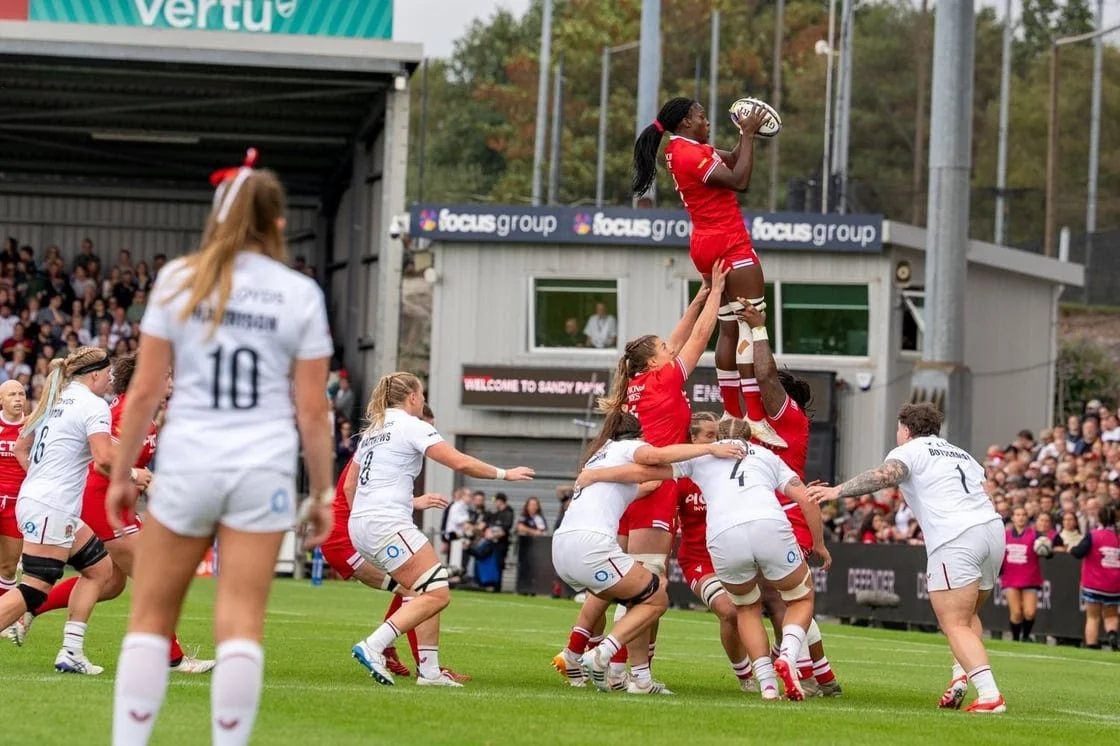
Canada showed more composure at set pieces compared to the 2025 Rugby World Cup final (Photo Credit: Rugby Canada)
What Saturday Actually Proved
A week ago, the story was about what Canada still needed to learn.
Fiji had exposed the men's weaknesses. Scotland had demonstrated the women's attacking potential. Now the picture is more complicated — and more interesting.
The men leave Japan with a third-place finish, but also with a match in which they had to withstand pressure and protect a narrow lead.
Jesse Kilgour has his first international try. Rumball reaches 70 caps. Cooper Coats reaches 25.
And the team finishes a difficult Pacific Nations Cup campaign with something it did not have against Fiji: a victory in a match decided by the final moments.
The women leave Exeter with something even harder to manufacture: proof that last year's World Cup final has not defined the relationship between these teams.
England will still be England. Canada will still have to find another level.
But the next two meetings between them will no longer be framed solely through what happened at Twickenham. They will be part of a series.
The WXV Global Series was designed precisely around this idea — more certainty of elite fixtures, more repeated exposure to the best teams and a longer competitive pathway toward the 2029 World Cup.
Canada will now get two more opportunities against England at home, in Toronto on October 16 and Ottawa on October 23.
That changes the value of Saturday's draw. A one-off upset can be explained away. A three-match series gives coaches nowhere to hide.
England will adjust. Canada will adjust.
And the next match will tell us whether Exeter was an isolated achievement or the beginning of a different competitive relationship.
Sources:
Stephen Meehan, Canada men’s head coach, press conference, 19 September 2026
Lucas Rumball, Canada men’s captain, press conference, 19 September 2026
Kevin Rouet, Canada women’s head coach, press conference, 19 September 2026
Megan Jones, England women’s captain, press conference, 19 September 2026
Bryony Field, England women’s player, press conference, 19 September 2026
Photo Credits:
Flesch stretching to score, World Rugby, 19 September 2026 - Photo courtesy of World Rugby
Canada leading the lineout, Rugby Canada, 19 September 2026 - Photo courtesy of Rugby Canada
The Utrecht Shield with Ellie Kildunne and Claudia Moloney-Mcdonald, David Algie - Photo courtesy of David Algie / Raeburn and Utrecht Shields
Video Credit:
Mason Flesch Try, Rugby Canada, 19 September 2026 - Video courtesy of @RugbyCanada on X
All photos are used with permission. All rights reserved to the creator.

Support PSP Media
Every contribution helps support independent research and reporting